Android sideloading in 2027: what developer verification means
By Nihar Ranjan Das · Fri Sep 25 2026 · 5 min read · 0 views
View as a Web StoryGadgets#google play#android developer verification#sideloading#f-droid#android 2027
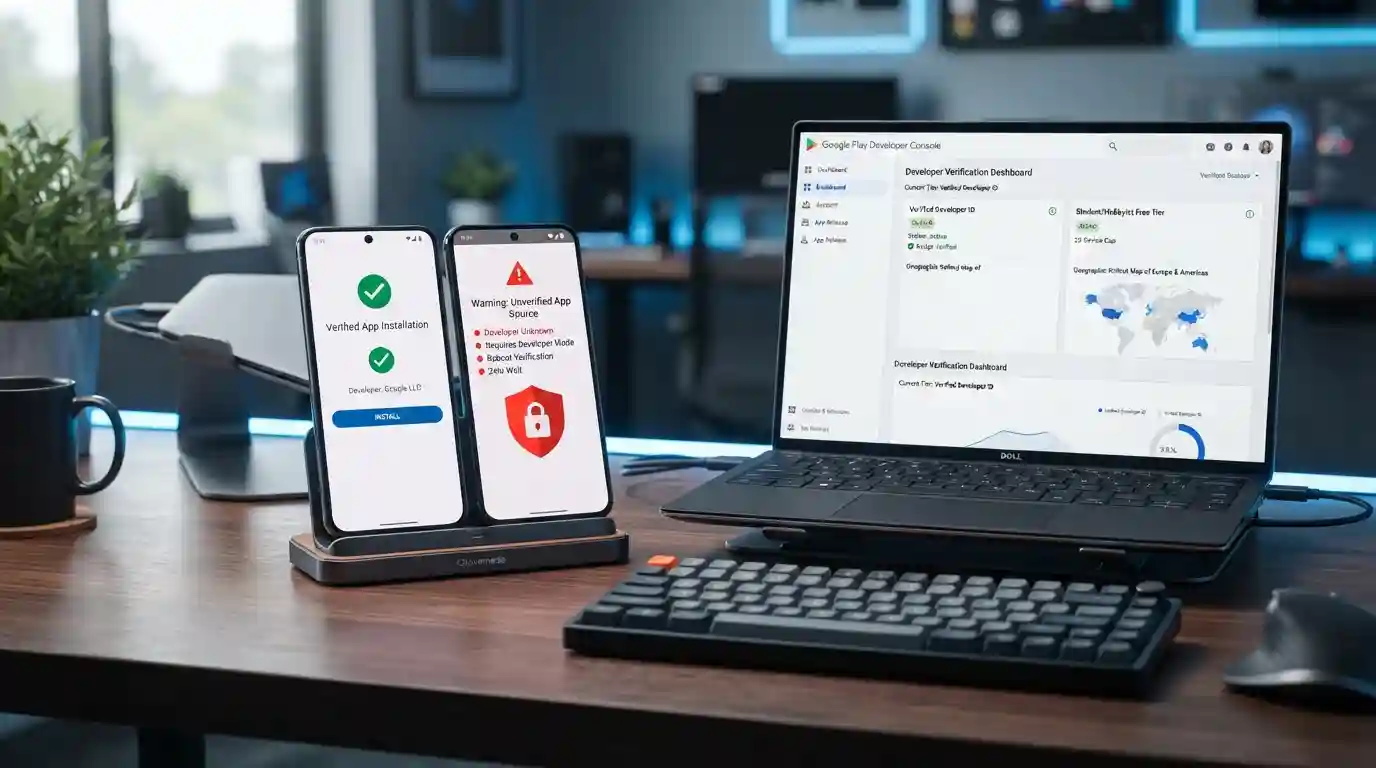
If you sideload Android apps in the United States or Europe, nothing changes on September 30, 2026. Google's developer verification rule takes effect that day in Brazil, Indonesia, Singapore, and Thailand only. The rest of the world, including US and European users, follows in 2027 and beyond. That gives you months to get ready. Here is what it means for you, and what to check.
Android developer verification is a Google program. It requires apps on certified Android devices to come from a developer whose identity Google has checked, even when the app is sideloaded. Sideloading is installing an app from a source other than a device's default app store, such as a downloaded APK file or a third-party store. The rule is in the news because F-Droid released version 2.0 on September 24, days before the first enforcement date.
When does Android developer verification take effect?
Enforcement begins on September 30, 2026 in Brazil, Indonesia, Singapore, and Thailand, then expands globally in 2027 and beyond. That timeline comes from Google's developer verification page. It says the first wave covers certified devices running Android 7 or later.
Google lists seven participating stores: Google Play, HONOR App Market, OPPO App Market, Galaxy Store, Palm Store, V-Appstore, and GetApps. The page gives no dates for the United States or Europe beyond the global 2027 window. Treat any exact US or EU date you see elsewhere with care.
| Date | What happens |
|---|---|
| August 2026 | Developer APIs, limited distribution accounts, and the power user advanced flow launch |
| September 30, 2026 | Enforcement begins in Brazil, Indonesia, Singapore, and Thailand |
| 2027 and beyond | Rollout expands globally to all apps on certified Android devices |
What can a sideloader still do after enforcement?
An unverified app can still be installed through an advanced flow that Google built for power users. It is slow on purpose. The Register's reporting on the flow lists these steps:
- Confirm that nobody is forcing you to install the app.
- Enable developer mode.
- Reboot the device.
- Wait 24 hours.
- Acknowledge several warning screens.
- Choose whether unverified apps may run for one week or indefinitely.
The advanced flow is the installation path for unverified apps on certified devices. The 24-hour wait draws the most criticism. Android Authority reports that Google says the program "isn't going to impact sideloading on Android." The same article argues the extra friction contradicts that claim. Weigh both views when you decide how worried to be.
The Register also notes that the whole flow runs through Google Play Services. Its concern is that Google could stop the process at any time. That is a reported worry about the design, and Google has not confirmed it.
What does a developer have to do?
Developers register through one of three routes. The right one depends on where the app is distributed. Google's page describes them.
| Account | Best for | Cost and ID | Limit |
|---|---|---|---|
| Google Play Console | Apps on Google Play, or on and off it | Not stated on Google's page | None stated |
| Android Developer Console | Apps distributed only outside Google Play | Fee and government ID, per Android Authority | None stated |
| Limited distribution account | Students, teachers, and hobbyists | No fee and no government ID | Up to 20 devices |
A limited distribution account is a free registration tier for students, teachers, and hobbyists who share apps with a small group of devices. It requires neither a government ID nor a registration fee. Everyone else pays a one-time $25 developer fee and verifies a government-issued ID, according to Android Authority's F-Droid report.
Google says its Play Console automatically registers 99% of apps, per the developer verification page. Developers who ship only outside Play must register by hand. So must those whose apps were not registered automatically.
Advertisement
How does F-Droid 2.0 fit in?
F-Droid 2.0 is the biggest update to the open-source app store in a decade. It ships without waiting for Google's rule to settle. The Register calls the release a ground-up rewrite of the client. Android Authority notes that F-Droid shows a countdown banner about the changes and has criticized the restrictions.
F-Droid's position is a useful signal for anyone who depends on it. How Google's rule applies to apps in the F-Droid catalog is the open question. Neither Google's page nor the reporting above answers it, and F-Droid users should watch the project's announcements closely.
What should you do before 2027?
Sideloaders in the US and Europe should get ready now. The rule is still a region away. Developers should pick an account type before their own region is enforced. These steps apply either way:
- List each app you get outside Google Play, such as F-Droid apps or APK files you download.
- Note which of those apps still have a developer who could sign up.
- Read Google's developer verification FAQ for the exact rules on your app type.
- If you are a hobbyist, check if a limited distribution account fits how you share.
- If you publish widely, plan for the $25 fee and the ID check.
Wait before you change your setup. Google has not published a US or EU date, and Android Authority notes the original September 2026 start was already pushed to 2027 for most of the world. Do not switch phones or drop a store because of this rule yet. Do check any app you rely on that has no active developer, because someone has to register an app for it to pass.
Advertisement
FAQ
When does Android developer verification start?
It starts September 30, 2026 in Brazil, Indonesia, Singapore, and Thailand. Google says it then goes global in 2027 and beyond. The rule covers certified devices on Android 7 or later. It reaches sideloaded apps too, not just store apps.
Will Android developer verification affect sideloading in the US?
Not yet. The first wave covers only four countries. Google's global rollout is dated 2027 and beyond. When it comes, you can still install unverified apps. You use an advanced flow with developer mode, a reboot, and a 24-hour wait.
How much does Android developer verification cost?
Standard sign-up costs a one-time $25 and needs a government ID, according to Android Authority. A limited distribution account is free. It is for students, teachers, and hobbyists, needs no ID, and covers up to 20 devices.
Can you still install unverified apps on Android?
Yes, through Google's advanced flow. You confirm nobody is forcing the install, turn on developer mode, reboot, and wait 24 hours. You then accept the warnings and pick one week or no time limit. The Register reports that this runs through Google Play Services.
Is F-Droid affected by developer verification?
F-Droid released version 2.0 on September 24, 2026 and has criticized the rules. Neither Google's page nor the reports above say how the rule applies to apps in its catalog. Watch F-Droid's announcements for news.
Comments
Loading…
Sign in to join the conversation.
Related posts

Should you buy a GPU now, or wait out 2026?
AMD raised Radeon prices 10% in August 2026 and the RTX 5090 sells near $4,700. Here is when to buy a GPU now and when to wait.
Wed Aug 19 2026 · 6 min read · 28 views

Is there Chinese CXMT memory in your new laptop?
Three of the largest PC makers now ship some notebooks with Chinese memory chips, and the machines that get them are sold outside the United States. That makes this a European shopping question rather
Sun Aug 16 2026 · 5 min read · 6 views

No standard iPhone 18 this fall. What should you buy?
Apple is set to launch three iPhone models in September 2026, and every one of them belongs to the premium tier. The standard iPhone 18 is not among them. That single change rewrites the autumn
Sun Aug 16 2026 · 5 min read · 11 views