OpenAI shuts off GPT-4, o1 and o4-mini on October 23
By Nihar Ranjan Das · Tue Sep 29 2026 · 6 min read · 0 views
View as a Web StoryAI#gpt-5.6#openai api#model deprecation#gpt-4#o4-mini
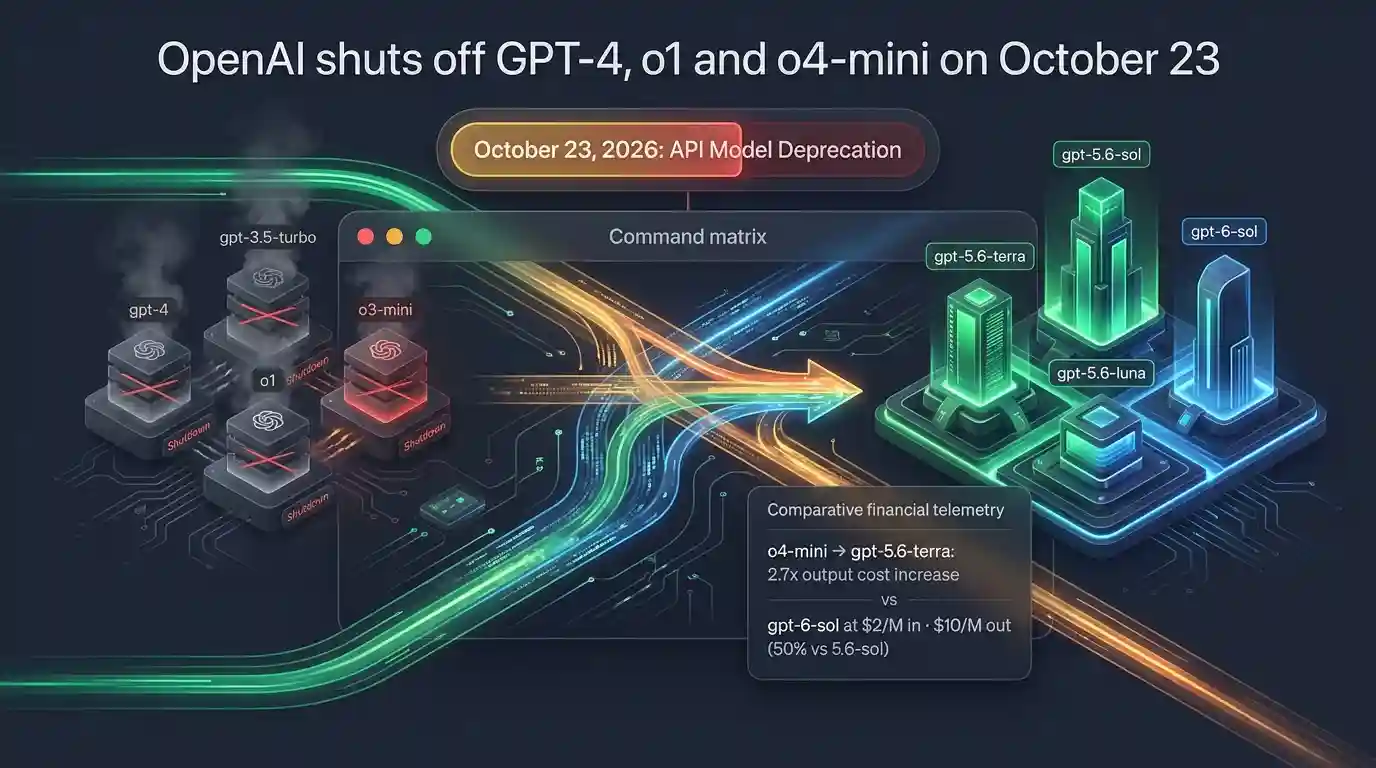
OpenAI shuts off GPT-4, GPT-3.5 Turbo, GPT-4 Turbo, o1, o1-pro, o3-mini, o4-mini and several other models on its API on October 23, 2026. That is 24 days away. Any call that names one of those models will return an error afterward.
The OpenAI deprecations page names a replacement for each one. It does not say what the swap costs. This post adds that: some replacements are cheaper, and several are more than twice as expensive.
Which OpenAI models shut down on October 23, 2026?
OpenAI's October 23, 2026 shutdown is a removal of older API models announced on April 22, 2026, according to the deprecations page. The page says the goal is to improve reliability and make model choice simpler for developers. The October 23 shutdown table lists each model and its replacement.
The standard models and their named replacements:
| Model removed | OpenAI's named replacement |
|---|---|
gpt-3.5-turbo, gpt-3.5-turbo-0125 |
gpt-5.6-terra |
gpt-4, gpt-4-0613 |
gpt-5.6-sol |
gpt-4-1106-preview |
gpt-5.6-sol |
gpt-4-turbo, gpt-4-turbo-2024-04-09 |
gpt-5.6-sol |
gpt-4o-2024-05-13 |
gpt-5.6-sol |
gpt-4.1-nano, gpt-4.1-nano-2025-04-14 |
gpt-5.6-luna |
o1, o1-2024-12-17 |
gpt-5.6-sol |
o1-pro, o1-pro-2025-03-19 |
gpt-5.6-sol with reasoning.mode: pro |
o3-mini, o3-mini-2025-01-31 |
gpt-5.6-sol |
o4-mini, o4-mini-2025-04-16 |
gpt-5.6-terra |
gpt-image-1 |
gpt-image-2.5-sunburst or gpt-image-2.5-flare |
Fine-tuned models on gpt-3.5-turbo, gpt-4, gpt-4.1-nano, o4-mini, babbage-002 and davinci-002 shut down the same day. Only the dated gpt-4o-2024-05-13 snapshot is on the list, not the current gpt-4o.
Four older models already shut down on September 28, per the September 28 shutdown notice: gpt-3.5-turbo-instruct, babbage-002, davinci-002 and gpt-3.5-turbo-1106. The page maps all four to gpt-5.6-terra.
What do the replacement models cost compared with the old ones?
gpt-5.6-sol, gpt-5.6-terra and gpt-5.6-luna are OpenAI's three tiers of the GPT-5.6 family, priced from Sol at the top to Luna at the bottom. Their prices come from the standard pricing table on OpenAI's pricing page, in US dollars per million tokens, short context.
| Old model (input / output) | Replacement (input / output) | Input cost ratio | Output cost ratio |
|---|---|---|---|
gpt-4-0613 ($30 / $60) |
gpt-5.6-sol ($4 / $20) |
0.13x | 0.33x |
o1 ($15 / $60) |
gpt-5.6-sol ($4 / $20) |
0.27x | 0.33x |
gpt-4-turbo ($10 / $30) |
gpt-5.6-sol ($4 / $20) |
0.40x | 0.67x |
gpt-4o-2024-05-13 ($5 / $15) |
gpt-5.6-sol ($4 / $20) |
0.80x | 1.33x |
o3-mini ($1.10 / $4.40) |
gpt-5.6-sol ($4 / $20) |
3.6x | 4.5x |
o4-mini ($1.10 / $4.40) |
gpt-5.6-terra ($2 / $12) |
1.8x | 2.7x |
gpt-4.1-nano ($0.10 / $0.40) |
gpt-5.6-luna ($0.20 / $1.20) |
2.0x | 3.0x |
gpt-3.5-turbo-0125 ($0.50 / $1.50) |
gpt-5.6-terra ($2 / $12) |
4.0x | 8.0x |
A ratio below 1.00x means the replacement is cheaper. A ratio above 1.00x means it costs more.
Methodology: we analyzed the standard short-context rows on OpenAI's pricing page as of September 29, 2026, and each ratio is the new price divided by the old price. Every price in this table passed a fact-check against that page.
The pattern is clear. Teams still on GPT-4 or o1 get a large price cut. Teams on the cheap small models, o3-mini, o4-mini, gpt-4.1-nano and gpt-3.5-turbo, pay about two to eight times more per token.
Advertisement
A caveat sits in the pricing notes on promotional rates. OpenAI writes that GPT-5.6 Sol's promotional pricing is available at least through November 21, 2026. The gpt-5.6-sol numbers above may not last.
Is gpt-6-sol a cheaper replacement than gpt-5.6-sol?
gpt-6-sol is a newer OpenAI model that the pricing page lists at $2 per million input tokens and $10 per million output tokens. That is half the price of gpt-5.6-sol, which lists at $4 and $20 in the gpt-6 and gpt-5.6 price rows.
OpenAI's replacement list for gpt-4 and o1 still names gpt-5.6-sol, not gpt-6-sol. The page does not say whether the two behave alike for a given workload. For an o3-mini job, gpt-5.6-sol makes output 4.5 times as expensive, while gpt-6-sol at $10 output makes it 2.3 times.
The same pricing page lists gpt-6-luna at $0.10 input and $0.50 output. That is close to the old gpt-4.1-nano price of $0.10 and $0.40. Run your own evaluation before switching, because a cheaper model that fails more often costs more in retries.
If you use EU data residency, regional endpoints add a 10% uplift for eligible models released on or after March 5, 2026, per the data residency note on OpenAI's pricing page. Check whether your chosen replacement falls under that rule.
How do I find every old model name in my code?
Search for the model IDs, not just the words GPT or o1. Hardcoded strings from 2023 and 2024 tutorials are the usual culprit, and no-code workflows hide them in exported JSON. The n8n community audit thread makes the same point about workflow tools: model IDs are typed once and rarely reviewed.
This search skips the models that are not being removed, such as gpt-4o and gpt-4.1:
grep -rnE 'gpt-3\.5-turbo|gpt-4-(0613|1106-preview|turbo)|"gpt-4"|gpt-4o-2024-05-13|gpt-4\.1-nano|"o1"|o1-pro|o3-mini|o4-mini|gpt-image-1|babbage-002|davinci-002|ft:gpt-(3\.5|4)' .Then work through five steps:
- Run the search on every repository, environment file and CI config.
- Export each no-code workflow as JSON and search the file the same way.
- Check your database and admin panels for saved model names, not only code.
- List fine-tuned model IDs starting with
ft:and note which base model each uses. - Check your OpenAI usage dashboard for the models that appear in the last 30 days.
The usage check catches callers you forgot. A script that runs once a month will not show up in a grep of the main service.
What changes besides the model name?
The OpenAI deprecations notes say no endpoint or parameter differences are listed for these removals. The n8n audit warns that newer models can differ in tone, length and JSON formatting, so outputs can shift even when the request succeeds.
Three changes need real work:
- o1-pro. OpenAI maps it to
gpt-5.6-solwithreasoning.mode: pro. The pricing page does not list a separate rate for that mode. - Fine-tunes. The page names a base model as the replacement for each fine-tune. Plan to re-run fine-tuning on the new base or test whether a better prompt on the base model is enough.
- Structured output. Run your JSON parsing tests against the new model before October 23, not after.
Should I switch now or wait until October 23?
Switch now for anything customer-facing, and do it in this order. Start with the cheap small-model jobs, because they carry the largest price increase and deserve a second look at whether they need a model at all.
For each job, run 50 to 100 real inputs through the old model and the replacement. Compare accuracy, format failures and cost per successful result. Then pick gpt-5.6-terra, gpt-5.6-luna or a gpt-6 model on evidence.
Leaving the change until October 23 has one hard cost. Your calls fail on that date, and you learn about the output differences from customers. A three-week window is enough to test properly, and not much more.
Advertisement
FAQ
What replaces GPT-4 on OpenAI's API after October 23?
OpenAI names `gpt-5.6-sol` as the replacement for `gpt-4`, `gpt-4-0613`, `gpt-4-1106-preview` and `gpt-4-turbo`. At $4 input and $20 output per million tokens, it costs about one-eighth of `gpt-4-0613` on input ($30) and one-third on output ($60), according to OpenAI's [gpt-4-0613 price row](https://developers.openai.com/api/docs/pricing).
Is o4-mini being shut down?
Yes. OpenAI removes `o4-mini` and `o4-mini-2025-04-16` on October 23, 2026, and names `gpt-5.6-terra` as the replacement. Terra lists at $2 input and $12 output per million tokens, against $1.10 and $4.40 for o4-mini.
Does the shutdown affect fine-tuned models?
Yes. Fine-tuned models built on `gpt-3.5-turbo`, `gpt-4`, `gpt-4.1-nano`, `o4-mini`, `babbage-002` and `davinci-002` also stop working on October 23. OpenAI's page lists a base model as the replacement, so a fine-tune needs re-creating or replacing.
What happens if my code still calls a removed model?
The request fails with an error after the shutdown date. The n8n community audit puts it plainly: calls return errors and any workflow naming those models stops producing output.
Comments
Loading…
Sign in to join the conversation.
Related posts
Claude Sonnet 5.5 migration: which changes return a 400
Claude Sonnet 5.5 launched on September 28, 2026 at the same price as Claude Sonnet 5, $2 per million input tokens and $10 per million output tokens. Moving to it is not a model-ID swap. Several
Tue Sep 29 2026 · 6 min read · 0 views

AI SDK 7 Changed usage. Your Token Counts Are Now Wrong
If a project upgraded to AI SDK 7 and its per-request token costs suddenly look higher than before, nothing is actually costing more. result.usage used to report only the final step's tokens. In AI
Tue Sep 29 2026 · 6 min read · 0 views
Anthropic's Akamai Deal: What It Buys Claude Users
Anthropic signed an $11.6 billion cloud deal with Akamai. Here's what it actually buys — more future capacity, not necessarily fewer outages.
Sun Sep 27 2026 · 4 min read · 2 views