AirPods Live Translation vs Google Translate vs DeepL Voice
By Nihar Ranjan Das · Wed Oct 14 2026 · 9 min read · 0 views
View as a Web StoryGadgets#live translation#airpods#google translate#deepl#apple intelligence
Which live translation option should you pick?
Pick Google Translate if you own any Bluetooth headphones and want a free option. Pick AirPods Live Translation if you already own compatible AirPods and an iPhone with Apple Intelligence. Pick DeepL Voice if your use case is a Teams or Zoom meeting. The bottom line: the three products overlap less than their marketing suggests.
Live translation is a feature that listens to speech in one language and plays or shows a translation in another language within a few seconds. All three products here do that, but they run in different places and need different hardware.
How do the three compare side by side?
The table below pulls each requirement from the vendor's own announcement or from a news report that quotes it. Where a source gave no figure, the cell says so.
| Google Translate (Live Translate with headphones) | Apple AirPods Live Translation | DeepL Voice | |
|---|---|---|---|
| Headphones needed | Any Bluetooth wireless headphones | AirPods Pro 2, AirPods Pro 3, or AirPods 4 with ANC | None for conversations and meetings |
| Phone needed | iPhone or Android | iPhone 15 Pro or newer with Apple Intelligence | Mobile, web, Teams or Zoom |
| Languages | More than 70 | 11 as of iOS 26.1 | More than 40 |
| Where it runs | Cloud | On the device | Hosted service on web, mobile and API |
| Price | Free | Included with compatible hardware | Not stated; self-serve with a free trial |
| Best for | Travel with the headphones you own | Owners of recent AirPods | Multilingual meetings |
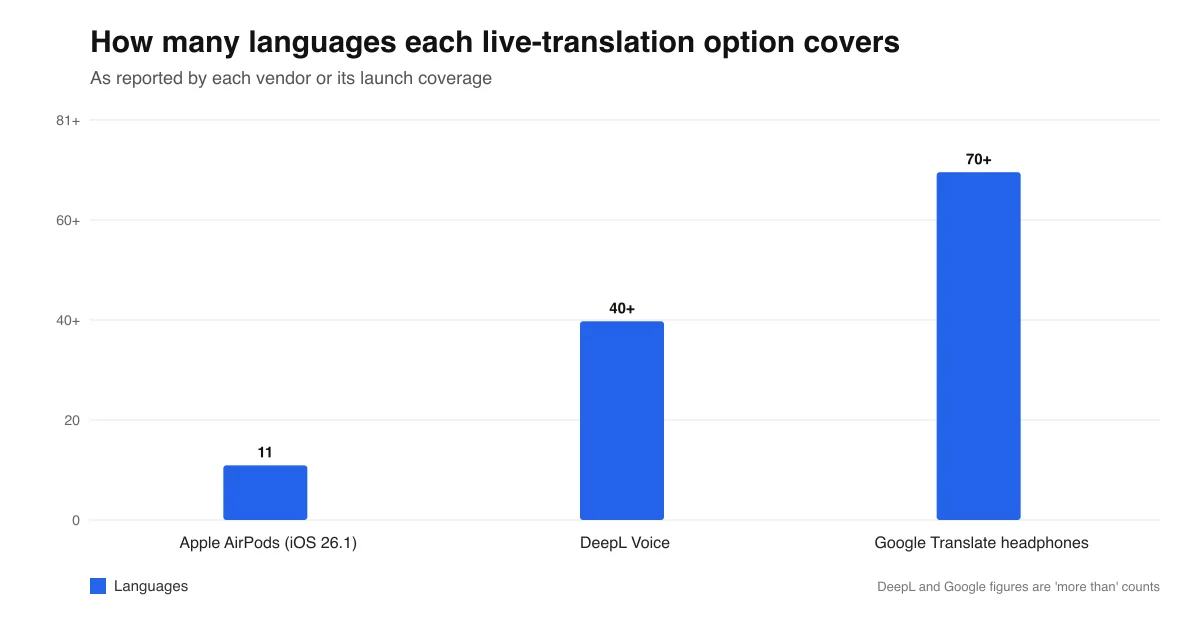
Language coverage is the widest gap between the three. Google leads, DeepL covers Europe in depth, and Apple's launch list is the shortest.
What does Google Translate offer?
Google Translate's Live Translate with headphones is a free feature that translates speech into your ears through any Bluetooth headphones. MacRumors reported on March 26, 2026 that it reached iPhone after launching in beta on Android in late 2025.
The same report says the feature supports more than 70 languages and is expanding to France, Germany, Italy, Japan, Spain, Thailand and the United Kingdom. It also says Google processes translations in the cloud, while Apple's feature runs on the device. Cloud processing means audio leaves your phone, which matters if you translate private conversations.
To use it, open Google Translate with your headphones connected, tap Live Translate, then select Listening. The report does not say whether every listed country is live yet, so check the app in your region.
What does Apple AirPods Live Translation need?
AirPods Live Translation is an Apple Intelligence feature that translates conversation through compatible AirPods. According to MacRumors on the EU rollout, it needs AirPods Pro 3, AirPods Pro 2 or AirPods 4 with Active Noise Cancellation. It also needs an iPhone 15 Pro or newer with Apple Intelligence turned on, iOS 26.2 and Apple's Translate app.
The same article lists 11 supported languages as of iOS 26.1: English (U.S. and U.K.), French, German, Brazilian Portuguese, Spanish, Simplified and Traditional Chinese, Japanese, Korean and Italian. That list is a November 2025 snapshot, and Apple may have added more since, so check Apple's feature page before you buy.
Advertisement
For example, a traveler with AirPods Pro 2 and an iPhone 15 Pro has everything needed and pays nothing extra. A traveler with older AirPods or a budget Android phone cannot use it at all.
Is AirPods Live Translation available in the EU?
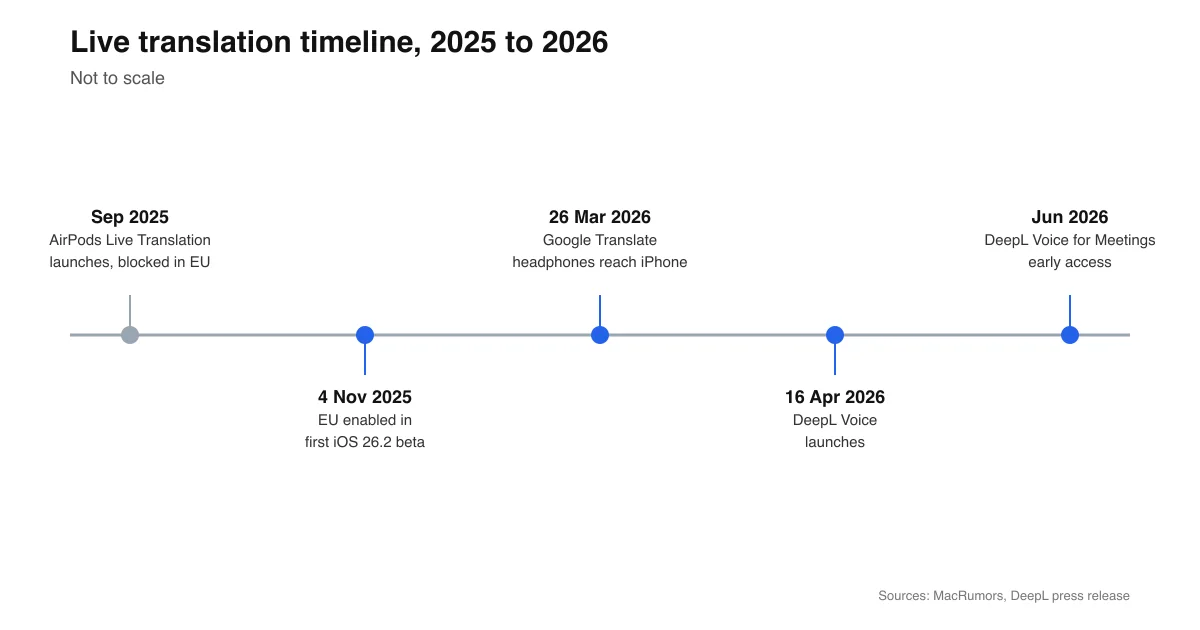
Yes. AirPods Live Translation reached the EU with iOS 26.2, after Apple said it "needed additional time to ensure compliance with the EU's Digital Markets Act," according to MacRumors. The first iOS 26.2 beta seeded to developers on November 4, 2025 enabled it, and Apple planned a general release that December.
The Digital Markets Act is the European Union regulation that sets interoperability and fairness rules for the largest platform companies. Apple's delay came from that law rather than from a technical limit. A later report from 9to5Mac lists iOS 26.2 as the release that first extended the feature to EU users.
What is DeepL Voice, and who is it for?
DeepL Voice is DeepL's real-time spoken translation product, launched on April 16, 2026, according to DeepL's press release. It supports more than 40 languages, including all 24 official EU languages plus Vietnamese, Thai, Arabic, Norwegian, Hebrew, Bengali and Tagalog.
The European Union lists 24 official languages, from Bulgarian to Swedish, so DeepL's coverage matches that list in full. Its products split into three parts:
- Voice for Meetings translates inside Microsoft Teams and Zoom, with early access starting in June.
- Voice for Conversations works on mobile and web, and is generally available.
- Group Conversations lets people join by QR code, and became generally available on April 30.
DeepL's press release gives no prices and no US versus EU availability split. It says small teams can buy online through a self-serve model with a free trial. DeepL is based in Cologne, Germany.
What are the differences in privacy?
The biggest difference is where the audio goes. Google processes translations in the cloud, while Apple's feature runs on the device, according to MacRumors. That means Google's service sends your conversation to Google servers, and Apple's keeps the processing on your iPhone.
DeepL's press release does not say where Voice processes audio, and it describes the product as a hosted service reached through web, mobile, Teams, Zoom and an API. If you translate a private medical, legal or financial conversation, check each vendor's data-handling terms before you start. We did not audit any vendor's privacy policy.
For most travel use, such as ordering food or asking directions, the privacy gap is a minor concern. For a business meeting with confidential figures, it is the first question to ask.
What do you need to start with each option?
Each option has a short checklist, and Apple's is the longest. Here is the minimum for each, from the sources linked above.
Google Translate:
- Any Bluetooth wireless headphones, paired to your iPhone or Android phone.
- The latest Google Translate app.
- Open the app with the headphones connected, tap Live Translate, then select Listening.
Apple AirPods Live Translation:
- AirPods Pro 3, AirPods Pro 2, or AirPods 4 with Active Noise Cancellation.
- An iPhone 15 Pro or newer with Apple Intelligence turned on.
- iOS 26.2 and Apple's Translate app.
DeepL Voice:
- For conversations, a phone or browser. DeepL says Voice for Conversations works on mobile and web.
- For groups, a QR code that lets each person join on their own device.
- For meetings, Microsoft Teams or Zoom, with early access from June 2026.
Which one fits which situation?
Match the tool to the job. A traveler, an expat and a team lead need different things, and no option wins in every case.
- A week in Italy with the headphones you already own. Use Google Translate. It is free, works with any Bluetooth headphones and covers more than 70 languages.
- You already own AirPods Pro 2 and an iPhone 15 Pro. Try Apple's feature first. It costs nothing extra and keeps processing on the device, but check that your language is on Apple's list.
- A remote team with members in Germany, France and Poland. Test DeepL Voice for Meetings in Teams or Zoom. It covers all 24 official EU languages, according to DeepL.
- A call-centre team serving EU customers. Ask DeepL about the Voice-to-Voice API, which was in early access at launch. Chatbot disclosure rules under the EU AI Act may also apply, so ask counsel.
- A rare language such as Maltese or Irish. Check each vendor's language page. Apple's list is short, and DeepL lists all 24 official EU languages, which include both.
What do the sources not tell us?
Several things stayed out of reach, and a buyer should know where the gaps are. We did not test any of the three products, so we cannot rank translation accuracy or delay.
- Latency. No source gave a delay in seconds for Google, Apple or DeepL.
- Accuracy. None of the announcements published an accuracy comparison.
- Price of DeepL Voice. The press release gives no price, only a self-serve model with a free trial.
- Country rollout for Google. The MacRumors report says Google is expanding to France, Germany, Italy, Japan, Spain, Thailand and the United Kingdom, but does not say whether each is live.
- Apple's current language list. The 11 languages are a snapshot from iOS 26.1.
Our advice is to test with a real conversation before a trip or a meeting. A two-minute trial in a quiet room reveals more about delay and accuracy than any spec sheet.
What other AI language news should you know about?
Three related stories came out over the last several months, and each affects what you can build or buy.
- Claude's tokenizer changed the cost of text. Anthropic's pricing page says newer Claude models produce approximately 30% more tokens for the same text. We priced the effect in "Claude's 30% token inflation: does your bill actually rise?" Sonnet and Haiku get cheaper, and Opus rises about 4%.
- LLM translation is cheap. We estimated about $2.49 to translate 100,000 English words into German on Claude Sonnet 5.5, in "Translating a 100,000-word book with Claude: what it costs."
- The EU's AI transparency rules are live. Article 50 has applied since 2 August 2026, per Goodwin's client alert. We summarize the dates in "EU AI Act Article 50: what chatbots must disclose now."
The MacRumors headline on Google's iPhone launch credits Gemini AI for smarter translations, which suggests Google is applying its newer models to translation as well.
What should you check before you buy?
Run through this short list, in order, before spending money on hardware:
- Does your phone and headphone combination meet the Apple requirements?
- Is your language on Apple's list, Google's list or DeepL's list?
- Do you need on-device processing for privacy?
- Is the use travel, daily life or meetings?
- Have you tried the free Google Translate option first?
If the answers point to Google, you can start today at no cost. If they point to Apple, you likely own the hardware already. If they point to DeepL, request early access and ask about price in writing.
Which one should you buy or use?
Choose by your situation, not by feature count. Consider these three cases:
- You travel a few times a year and own any Bluetooth headphones: use Google Translate. It costs nothing and covers the most languages.
- You already own AirPods Pro 2 or newer and an iPhone 15 Pro or newer: turn on Apple's feature first. It runs on the device, so the audio stays on your phone.
- You run multilingual calls for work: evaluate DeepL Voice for Meetings. The Google and Apple features described above work through headphones for personal conversations, while DeepL built this product for Teams and Zoom.
Do not buy AirPods only for this feature. A free Google Translate setup does most of the job, and Apple supports far fewer languages. Buy them only if you want the on-device privacy and already planned to upgrade.
Advertisement
FAQ
Does Google Translate work with any headphones?
Yes. Google Translate's Live Translate with headphones works with Bluetooth wireless headphones connected to an iPhone or Android phone, according to MacRumors. It supports more than 70 languages and is free in the Google Translate app.
Which AirPods support Live Translation?
AirPods Pro 3, AirPods Pro 2 and AirPods 4 with Active Noise Cancellation support Live Translation. You also need an iPhone 15 Pro or newer with Apple Intelligence and iOS 26.2. AirPods Max are not on the supported list.
Is Apple Live Translation available in Europe?
Yes. Apple brought AirPods Live Translation to the EU with iOS 26.2, after delaying it to comply with the Digital Markets Act. A general release was planned for December 2025.
Does DeepL Voice work in Zoom and Teams?
Yes. DeepL Voice for Meetings translates inside Microsoft Teams and Zoom. DeepL said early access started in June 2026. Conversations on mobile and web are generally available.
Comments
Loading…
Sign in to join the conversation.
Related posts
Android sideloading in 2027: what developer verification means
If you sideload Android apps in the United States or Europe, nothing changes on September 30, 2026. Google's developer verification rule takes effect that day in Brazil, Indonesia, Singapore, and
Fri Sep 25 2026 · 5 min read · 19 views

Should you buy a GPU now, or wait out 2026?
AMD raised Radeon prices 10% in August 2026 and the RTX 5090 sells near $4,700. Here is when to buy a GPU now and when to wait.
Wed Aug 19 2026 · 6 min read · 37 views

Is there Chinese CXMT memory in your new laptop?
Three of the largest PC makers now ship some notebooks with Chinese memory chips, and the machines that get them are sold outside the United States. That makes this a European shopping question rather
Sun Aug 16 2026 · 5 min read · 9 views