GPT-6 Sol vs Opus 5.5: cost per correct task, not per token
By Nihar Ranjan Das · Fri Sep 25 2026 · 6 min read · 0 views
View as a Web StoryAI#claude opus 5.5#gpt-6 sol#llm api pricing#cost per task#ai model comparison
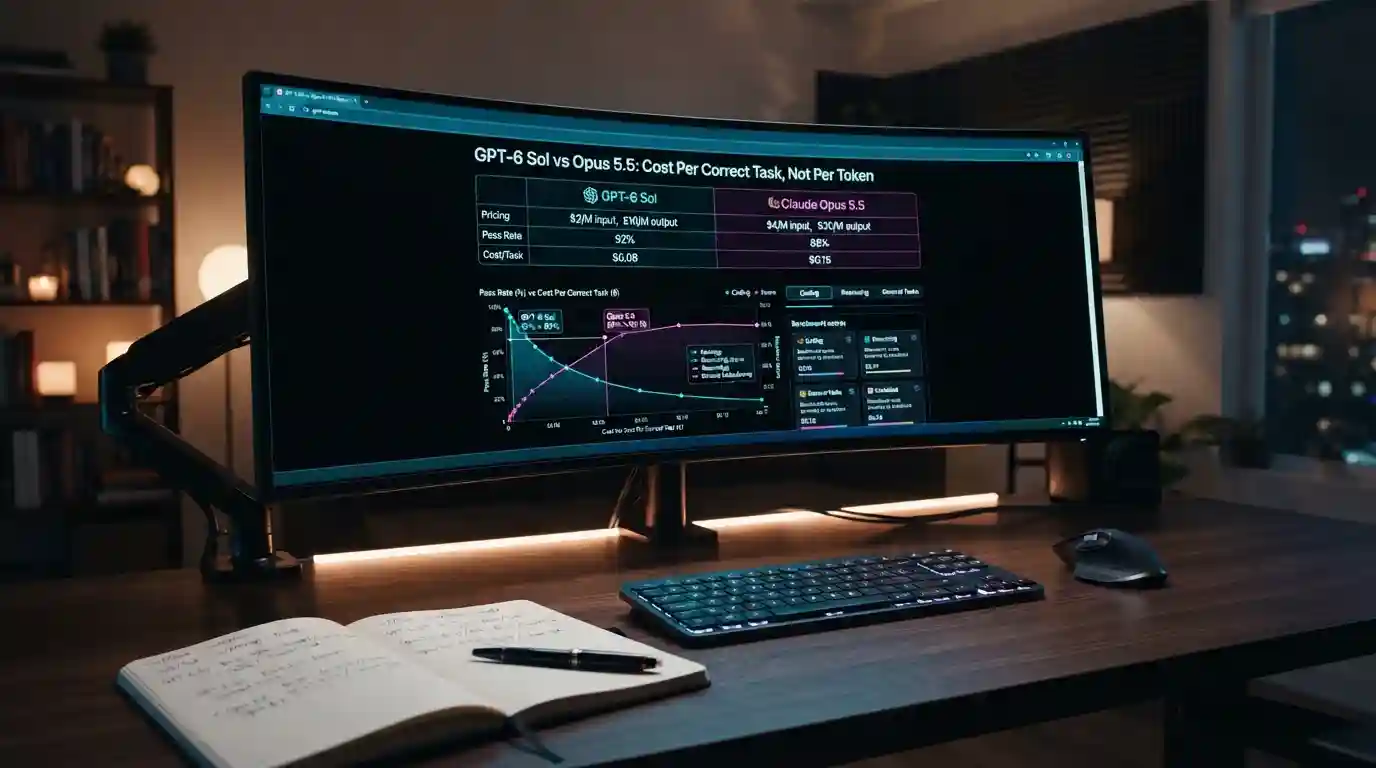
GPT-6 Sol costs exactly half as much per token as Claude Opus 5.5, but that does not make it half the cost of finishing your work. Sol is cheaper per attempt. Opus 5.5 succeeds more often on hard coding and knowledge tasks. The metric that actually matters is cost per correct task, and at list prices Opus 5.5 needs a pass rate roughly twice Sol's to win on it.
GPT-6 Sol is OpenAI's model for demanding work such as coding, agent loops, and multi-step reasoning. Claude Opus 5.5 is Anthropic's flagship for long-running agentic coding and knowledge work. Both models became commercially available on September 22, 2026, according to 9to5Google's launch report, so many engineering organizations are reconsidering their default model selection right now.
How much do GPT-6 Sol and Claude Opus 5.5 cost per token?
Sol costs $2 per million input tokens and $10 per million output tokens, while Opus 5.5 costs $4 and $20 for the same amounts. Those are OpenAI's and Anthropic's list prices, as reported by Technori's pricing analysis and confirmed for Opus in Anthropic's Opus 5.5 developer notes.
| Price line (USD per million tokens) | GPT-6 Sol | Claude Opus 5.5 |
|---|---|---|
| Input | $2.00 | $4.00 |
| Output | $10.00 | $20.00 |
| Cached input read | $0.20 | $0.20 |
The cached read line is the trap in the headline comparison. Both models charge $0.20 per million tokens for cache reads, which means that the gap between them narrows considerably on cache-heavy agent work. Digital Applied's cost benchmark estimates that Sol costs roughly 57 percent of Opus 5.5 on such tasks, not 50 percent. For a Claude-side view of why cache pricing dominates agent bills, see our breakdown of how Bedrock cache writes ate 85 percent of one AI bill.
What is cost per correct task?
Cost per correct task is the cost of one attempt divided by the share of attempts that succeed. A cheap model that fails frequently can ultimately cost considerably more per finished job than an expensive model that usually works. The formula is simple:
cost per correct task = cost per attempt ÷ pass rate
This method needs two inputs from you, namely your average tokens per attempt and your pass rate on your own tasks, and neither can be taken from a vendor's marketing page. A benchmark's pass rate is a stand-in, not a measurement of your workload.
What does the calculation look like at list prices?
Opus 5.5 passes 52.5% of Terminal-Bench 4.0 tasks and Sol passes 43.9%, according to Digital Applied's Terminal-Bench 4.0 summary, and those two pass rates feed the example. The worked example below uses one assumption. Each attempt uses 100,000 uncached input tokens and 20,000 output tokens on both models. Real runs differ, because token use varies by model and by task, so treat this as a method demonstration.
| Step | GPT-6 Sol | Claude Opus 5.5 |
|---|---|---|
| Input cost (100K tokens) | $0.20 | $0.40 |
| Output cost (20K tokens) | $0.20 | $0.40 |
| Cost per attempt | $0.40 | $0.80 |
| Pass rate (Terminal-Bench 4.0) | 43.9% | 52.5% |
| Cost per correct task | $0.91 | $1.52 |
The pass rates come from the Terminal-Bench 4.0 figures that Digital Applied summarizes, which compare Opus 5.5 at medium effort with Sol at maximum effort. On these assumptions Sol still costs about 40 percent less per correct task. The break-even rule follows directly. Because Opus costs twice as much per attempt in this example, it needs a pass rate at least twice Sol's to come out cheaper.
Consider what that means in practice. On a benchmark where the two pass rates sit close together, as they do here, the cheaper model wins on cost. On a task where Sol passes one attempt in five and Opus passes one in two, Opus wins instead. Your own evaluation set, rather than any public leaderboard, decides which of these cases you are actually in.
Advertisement
Where does Sol win and where does Opus 5.5 win?
Sol wins on budget-tier work, and Opus 5.5 wins on coding and knowledge work. According to Artificial Analysis testing on September 22, 2026, as summarized by Digital Applied's benchmark write-up, the split sits at an Intelligence Index score of about 44, because below that score Sol is the cheaper way to reach a given result and above it Sol runs out of headroom.
On business workflows, Sol at xhigh scores 61.7% against 61.2% for Opus 5.5 at medium, per the AutomationBench-AA results. The full comparison is below.
| Measure | GPT-6 Sol | Claude Opus 5.5 |
|---|---|---|
| Intelligence Index, best setting | 47.5 at $1.06 per task | 51.2 at $1.34 per task |
| Terminal-Bench 4.0 (coding) | 43.9% at maximum effort | 52.5% at medium effort |
| AutomationBench-AA (business workflows) | 61.7% at xhigh | 61.2% at medium |
| Knowledge-work document tasks (Elo) | Behind | Ahead by roughly 90 to 160 points |
Sol's best index score of 47.5 still falls below Opus 5.5's default medium score of 51.2. Opus buys 3.7 more points for about 26 percent more cost per task. On business workflows the two are nearly tied on quality, and Digital Applied reports Sol reaching that level at 40 percent of the average cost per task.
Does the 272K token surcharge change the math?
It can erase Sol's advantage on long-context jobs. Digital Applied reports that OpenAI charges a surcharge on requests above 272,000 input tokens. Our earlier post on the GPT-6 Astra 272K token cost cliff explains how that threshold works on the larger sibling model.
Check carefully whether your typical prompts cross that threshold before you assume that Sol will really deliver half the price. Agent loops that keep accumulating conversation context across many turns are the usual offenders. If a typical request in your system exceeds 272,000 input tokens, recompute the table with the surcharge included.
Which model should you use?
Use both models together, and route each request by the kind of task it represents. Send high-volume, lower-complexity work to Sol. Send hard coding, analysis, and document-heavy work to Opus 5.5. That mirrors the routing recommendation in Digital Applied's analysis, and it keeps the expensive model on the work that justifies it.
Follow this sequence to reach a defensible decision for your particular organization:
- Take 50 to 100 real tasks from your own workload.
- Run them on both models at a fixed effort level.
- Record tokens per attempt and pass rate for each.
- Apply the formula above.
- Route each task class to whichever model wins on cost per correct task.
Switching from Opus 5 to Opus 5.5 also carries an additional migration cost that engineering managers frequently overlook. Anthropic's model rejects some old request settings, which our guide to Claude Opus 5.5 400 errors covers. Budget engineering time for that compatibility work alongside the anticipated token savings.
Advertisement
FAQ
Is GPT-6 Sol cheaper than Claude Opus 5.5?
Per token, yes. Sol costs $2 input and $10 output per million tokens, half of Opus 5.5's $4 and $20. Per correct task, it depends. Sol is cheaper on budget-tier and business-workflow tasks, while Opus 5.5 leads on coding and knowledge work.
What does cost per correct task mean?
It is the cost of one attempt divided by the pass rate. A model that costs twice as much per attempt must succeed twice as often to match on cost per correct task. It measures what a finished job costs, not what a token costs.
Do GPT-6 Sol and Claude Opus 5.5 charge the same for cached input?
Yes. Both list cached input reads at $0.20 per million tokens. Because of that shared line, Sol's cost advantage on cache-heavy agent tasks is roughly 57 percent of Opus 5.5's cost rather than 50 percent, according to Digital Applied.
Which model is better for coding?
Opus 5.5 leads on published coding benchmarks. On Terminal-Bench 4.0, Opus 5.5 at medium effort scores 52.5 percent, while Sol at maximum effort scores 43.9 percent, per Digital Applied's summary of Artificial Analysis testing.
When was GPT-6 Sol released?
GPT-6 Sol went live in the API as `gpt-6-sol` on September 22, 2026, the same day as Claude Opus 5.5. It also reached ChatGPT plans for Plus, Pro, Business, Enterprise, and Edu accounts that day, according to Technori.
Comments
Loading…
Sign in to join the conversation.
Related posts
Claude Opus 5.5 returns 400 errors. Here is how to fix it
If your code moves from claude-opus-5 to claude-opus-5-5 and starts returning 400 errors, one of two request fields is the cause. Either thinking is set to disabled, or toolchoice is set to any or
Fri Sep 25 2026 · 8 min read · 0 views

Sora 2's API is gone. What replaces it?
OpenAI removed the Sora 2 Videos API on Sept 24, 2026 with no successor. Compare per-second prices for Veo 3.1, Kling and self-hosted options.
Thu Sep 24 2026 · 5 min read · 2 views

GPT-6 Astra Pricing: The 272K-Token Cost Cliff
GPT-6 Astra API pricing is $10 per million input tokens, but a prompt over 272K tokens reprices the whole request to $20. Here is the real cost, and how it compares.
Sun Sep 06 2026 · 6 min read · 3 views