Nano Banana Pro or 2.1: which image model to pay for
By Nihar Ranjan Das · Sat Oct 17 2026 · 8 min read · 0 views
View as a Web StoryAI#google#gemini api#pricing#nano banana pro#nano banana 2.1#ai image generation
Nano Banana Pro or 2.1: which image model to pay for
What does each Nano Banana model cost per image?
Nano Banana Pro costs $0.134 per image at 1K and 2K and $0.24 at 4K. Nano Banana 2.1 costs about $0.0336 at 1K, $0.0504 at 2K and $0.113 at 4K. These are standard rates on the paid tier, from Google's Gemini API pricing page.
Nano Banana Pro is Google's premium image model in the Gemini API, with the model ID gemini-3-pro-image. Nano Banana 2.1 is the newer fast, cost-efficient model, with the ID gemini-nano-banana-2.1. Google's image generation documentation names 2.1 as the primary model and recommends it for new projects.
| Model | Model ID | 1K | 2K | 4K |
|---|---|---|---|---|
| Nano Banana Pro | gemini-3-pro-image |
$0.134 | $0.134 | $0.24 |
| Nano Banana 2 | gemini-3.1-flash-image |
$0.067 | $0.101 | $0.151 |
| Nano Banana 2.1 | gemini-nano-banana-2.1 |
$0.0336 | $0.0504 | $0.113 |
| Nano Banana 2 Lite | gemini-3.1-flash-lite-image |
$0.0336 | n/a | n/a |
Source: Google Gemini API pricing page and image generation docs, read October 16, 2026. Paid tier only, USD, standard rates.
Nano Banana 2 also offers a 0.5K size at $0.045. The Lite model lists only a 1K price. Google's page shows no free tier for any of these image models.
Google's page shows the 2.1 image prices with a tilde, as approximate, and lists the token rates beneath: $1.50 per million input tokens and $30 per million image output tokens. LMMarketCap's comparison page shows the same $1.50 and $7.50 input and text-output rates, which agrees with Google.
How much do 1,000 images cost?
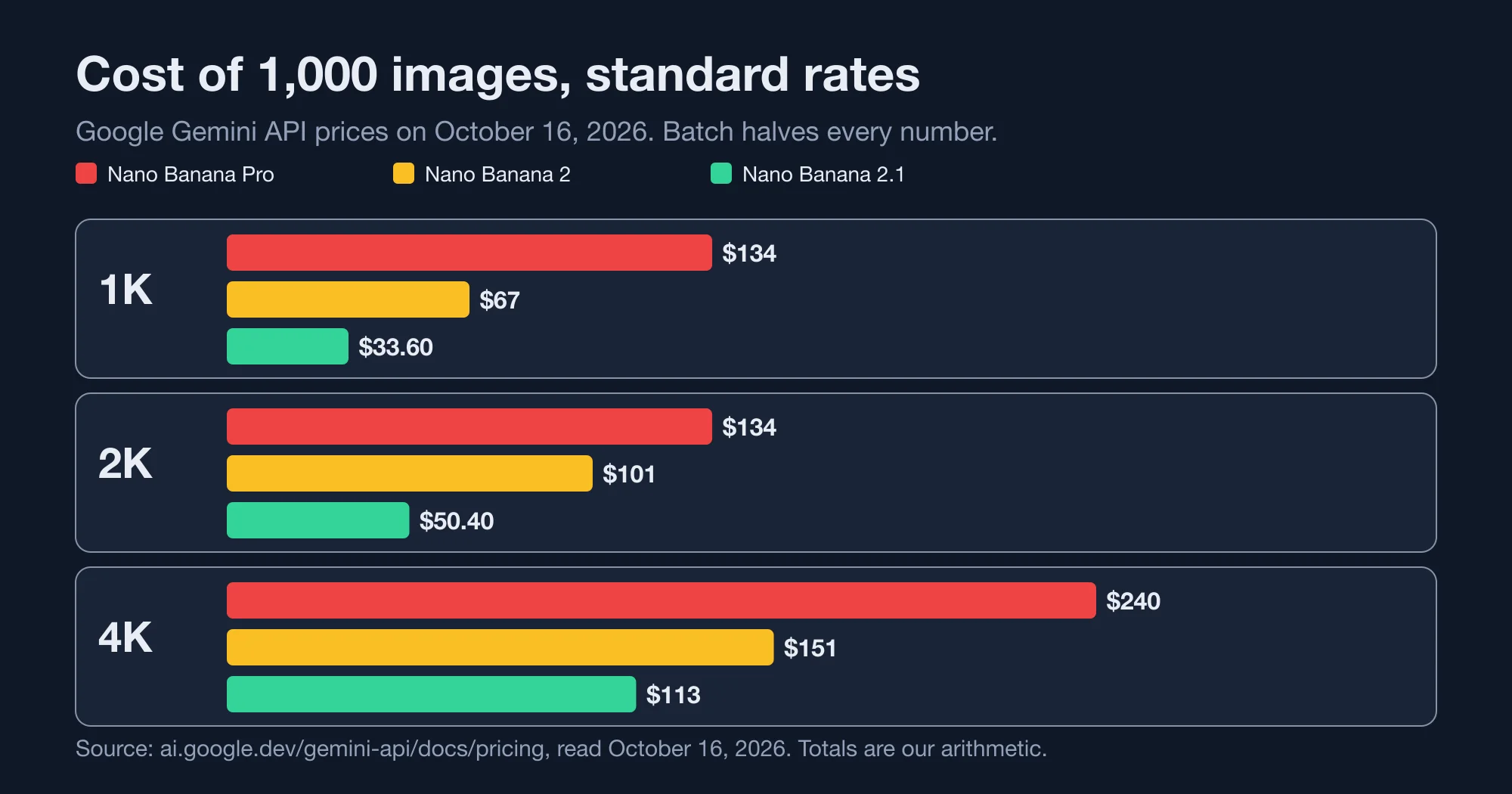
At 2K, 1,000 images cost $134 on Pro, $101 on Nano Banana 2 and $50.40 on Nano Banana 2.1. At 4K the same thousand cost $240, $151 and $113. Per-image prices look small, and volume is where they turn into a budget line.
| 1,000 images | Pro | Nano Banana 2 | Nano Banana 2.1 |
|---|---|---|---|
| 1K, standard | $134 | $67 | $33.60 |
| 2K, standard | $134 | $101 | $50.40 |
| 4K, standard | $240 | $151 | $113 |
| 1K, batch | $67 | $33.50 | $16.80 |
| 2K, batch | $67 | $50.50 | $25.20 |
| 4K, batch | $120 | $75.50 | $56.50 |
Source: NiharDaily arithmetic on Google's published per-image rates, October 16, 2026.
Batch pricing is a discounted rate for requests that Google processes asynchronously instead of instantly. On Google's page it cuts each image rate roughly in half. If your job can wait, such as overnight product images, batch is the substantialst saving available.
When does Nano Banana Pro pay for itself?
Pro is more economical per usable image only when the more economical model needs more attempts to deliver one. The break-even is the price ratio. At 2K, Pro is $0.134 and Nano Banana 2.1 is $0.0504, so the ratio is 2.66.
Advertisement
Here is the governing decision rule. If Nano Banana 2.1 needs more than 2.66 attempts on average to give you one image you can ship at 2K, Pro costs less per keeper. If it needs fewer, 2.1 wins.
| Resolution | Pro price | 2.1 price | Break-even attempts |
|---|---|---|---|
| 1K | $0.134 | $0.0336 | 3.99 |
| 2K | $0.134 | $0.0504 | 2.66 |
| 4K | $0.24 | $0.113 | 2.12 |
Source: NiharDaily arithmetic, October 16, 2026. Break-even attempts is the Pro price divided by the 2.1 price.
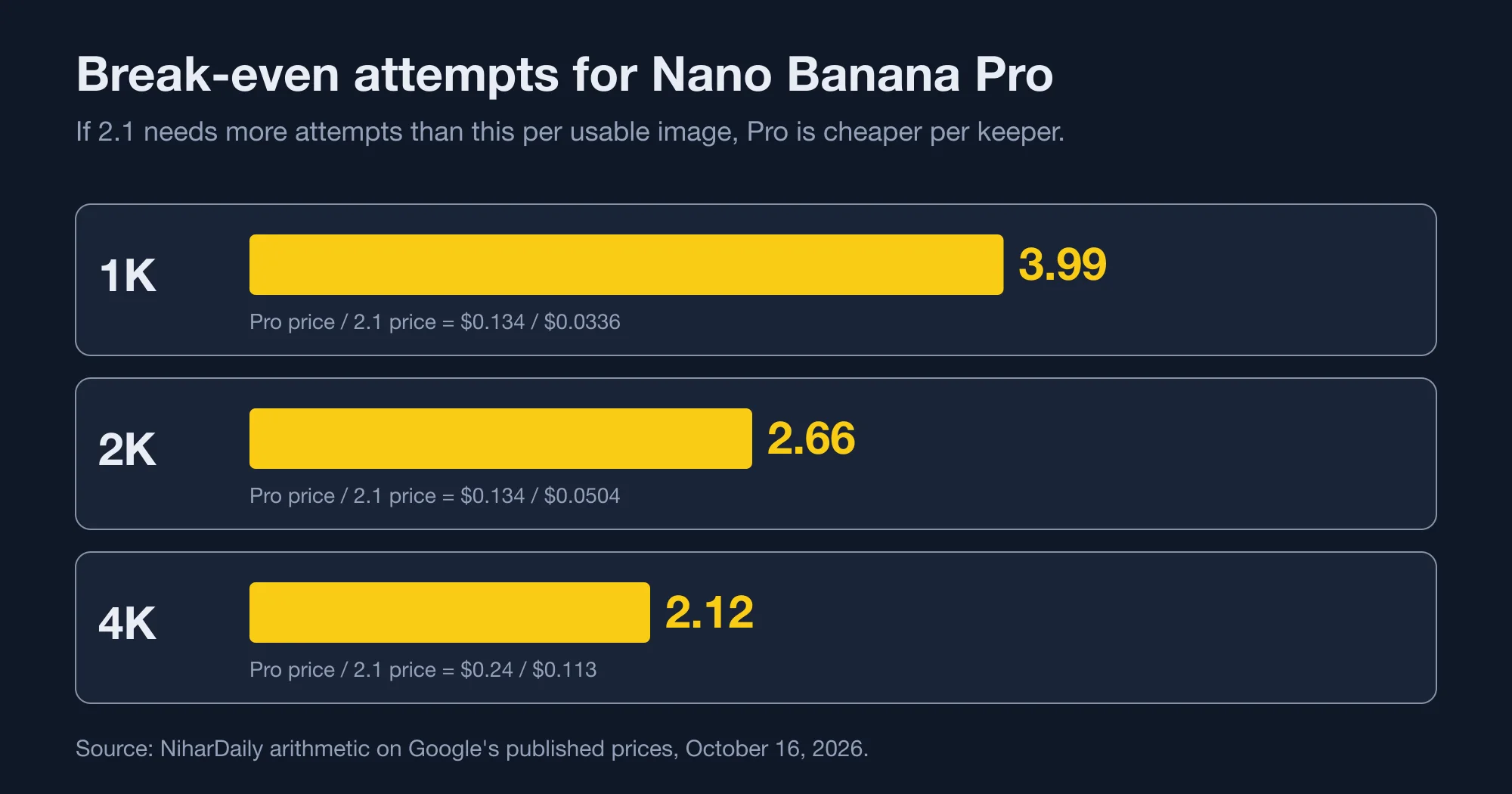
The ratio shrinks as resolution rises. At 4K, 2.1 only needs to miss twice in a row for Pro to be the more economical route. At 1K, 2.1 can miss three times and still cost less.
This matters because the Pro premium is not a fixed multiple. It is steepest at 1K, where a thumbnail or social media card rarely requires Pro. It is thinnest at 4K, where print and hero work happen.
What is your own hit rate?
Measure it systematically. Generate 20 prompts on 2.1 at the size you ship. Count how many outputs you would publish without a retry. Divide 20 by that count to get attempts per keeper.
For example, 8 usable images out of 20 gives 2.5 attempts, which is under the 2.66 line at 2K, so 2.1 stays more economical. Seven usable images gives 2.86, which tips the result to Pro. Your prompts decide this, not ours.
What does each model do differently?
Google positions Pro for complex, professional work and 2.1 for speed and cost. Both support text-to-image and image editing. The documentation lists differences in references, grounding and output types.
| Feature | Pro | 2.1 | 2 Lite |
|---|---|---|---|
| Role per Google | Premium, complex professional tasks | Primary, fast and cost-efficient | Fastest and most economical |
| Multiple reference images | Yes | Yes | No |
| Multi-turn editing | Yes | Yes | No |
| Google Search grounding | Yes | Yes | No |
| Interleaved text and image output | Yes | Not listed | Not listed |
| Sizes | 1K, 2K, 4K | 1K, 2K, 4K | 1K only |
Source: Google Gemini API image generation documentation, read October 16, 2026. "Not listed" means our read of the page did not show it.
The documentation says up to 14 reference images are supported, depending on the model. It also says the Gemini 3 image models always think before they generate, and that setting cannot be switched off. SynthID is Google's invisible watermark, and every image from these models carries it.
The Pro and 2.1 cells are what the page does not exclude, and only Lite's limits are stated outright. Our read of the docs was also partial. The page ran to 174,170 characters and we read the first 100,000. Check the live page for the final feature matrix before you build on one row of our table.
Do the prices on other sites match Google's?
No, and the differences are substantial. Aggregator and reseller pages disagree with each other and with Google. Treat them as hints and read Google's page for any real budget.
We found three conflicting sets of numbers while checking.
- BenchLM's media pricing page lists Pro at $0.134 for 1K or 2K and $0.24 at 4K, matching Google.
- Rangy's comparison lists Pro at about $0.039 for 1K and $0.10 for 2K, which does not match.
- Unifically prices 2.1 at $0.02, $0.03 and $0.045 for 1K, 2K and 4K, which is its own resale rate.
Resellers add commercial margins or promotional discounts, and some still quote obsolete preview prices. Aggregators also convert token rates to image rates with assumptions about token counts. The bottom line is to budget from the vendor page and keep a note of the date you read it.
What should you use for each job?
Adopt Nano Banana 2.1 as your default configuration. Switch to Pro for final production assets where a miss is expensive, or where the more economical model keeps failing the same prompt.
- Blog thumbnails and social cards at 1K: 2.1. The Pro premium is 3.99x here.
- Ad variations at volume: 2.1 in batch. At 2K, 1,000 images cost $25.20.
- Product shots with exact packaging text: test both on 20 prompts. Text accuracy is where reviewers claim Pro leads, though we did not verify it.
- Print and 4K hero images: compare Pro at $0.24 with 2.1 at $0.113. The gap is only 2.12x.
- Anything needing many references or grounded facts: check the feature table first. Lite cannot do either.
Does the draft-then-final workflow save money?
Yes. Generate drafts on 2.1 at 1K, then render the final once on Pro. Five drafts at $0.0336 plus one Pro 2K final at $0.134 costs $0.302. Six Pro generations at $0.134 cost $0.804.
The saving is $0.502 per finished image, so the workflow is about 2.7 times more economical. At 1,000 finished images that is $502. The drafts only work if the composition and prompt carry over, so test that on your own subject first.
How should you budget an image project?
Organize the budget in three consecutive steps: estimate the number of finished images, multiply by your measured attempts per keeper, then multiply by the price for the resolution you actually publish. Most teams skip the middle step, and the middle step is where budgets go wrong.
Consider a team that needs 500 finished product images at 2K. At 2.1 with 2.5 attempts per keeper, the bill is 500 times 2.5 times $0.0504, which is $63. At Pro with one attempt per keeper, it is 500 times $0.134, which is $67. The two routes land within $4 of each other, so quality and turnaround should decide, not price.
Now move the same job to batch pricing. The 2.1 route drops to $31.50 and the Pro route to $33.50. Batch changes the totals but not the comparison, because both rates halve. That is why the break-even ratio holds whichever rate card you use.
Keep a log of attempts per keeper for each prompt family, such as product shots, portraits and diagrams. Families behave differently, and an average across all of them hides the one family that is quietly expensive.
Which claims about quality should you trust?
Be particularly careful with them. Most comparison posts are written by resellers. A Masterconcept comparison says Nano Banana 2 delivers 4K at half the cost and double the speed. On Google's page, Nano Banana 2 at 4K costs $0.151 against Pro's $0.24, which is about 1.6 times more economical, not 2 times.
One vendor comparison we found also gave Pro a one-point lead on text accuracy. A gap that small is within what a modest prompt set could produce by chance. We have no Gemini API key set up for this post, so we ran no image tests and report none.
What we did not test
We did not generate a single image. This analysis concerns prices and decision rules read from Google's documentation, plus our own arithmetic. We did not check quality, speed, content filters or regional availability. We did not test Nano Banana 2 Lite beyond reading its price.
Published prices can change without advance notification. Google labels some related models as preview, and a preview price can move at general availability.
Advertisement
FAQ
How much does Nano Banana Pro cost per image?
On Google's Gemini API, Nano Banana Pro costs $0.134 per image at 1K and 2K and $0.24 at 4K on the standard paid tier. Batch pricing halves those to $0.067 and $0.12. There is no free tier for the Pro image model.
Is Nano Banana 2.1 more economical than Nano Banana Pro?
Yes. Nano Banana 2.1 costs about $0.0336 at 1K, $0.0504 at 2K and $0.113 at 4K. That makes Pro 3.99 times more expensive at 1K, 2.66 times at 2K and 2.12 times at 4K, based on Google's prices on October 16, 2026.
When is Nano Banana Pro worth the extra cost?
Pro is worth it when Nano Banana 2.1 needs more than 2.66 attempts per usable 2K image, or more than 2.12 attempts at 4K. Measure your own hit rate on 20 prompts, divide 20 by the keepers, and compare it with those break-even numbers.
Does batch pricing apply to Nano Banana?
Yes. Google's page lists batch rates for the Pro and Nano Banana 2.1 image models at roughly half the standard price. Batch requests are processed asynchronously, so they suit jobs that can wait, such as overnight catalogue images.
What is the model ID for Nano Banana Pro in the Gemini API?
Google's image generation documentation lists Nano Banana Pro as `gemini-3-pro-image`. Nano Banana 2.1 is `gemini-nano-banana-2.1`, Nano Banana 2 is `gemini-3.1-flash-image`, and Nano Banana 2 Lite is `gemini-3.1-flash-lite-image`.
Comments
Loading…
Sign in to join the conversation.
Related posts
Is your Go MCP server open to DNS rebinding? Check v1.4.0
CVE-2026-34742: Go MCP SDK before 1.4.0 accepts any Host header on localhost HTTP servers. We tested v1.3.1, v1.4.0 and v1.8.0, and show the fix and a proxy trap.
Sat Oct 17 2026 · 9 min read · 0 views
OpenAI shuts down GPT-4 and o1 on October 23: what to do
OpenAI retires gpt-4, gpt-4-turbo, o1, o3-mini, o4-mini and fine-tunes on October 23, 2026. A migration map with real costs: some replacements cost 4 to 5 times more.
Sat Oct 17 2026 · 9 min read · 0 views
Veo 3.1 or Gemini Omni Flash: what 30 seconds of video costs
Veo 3.1 Standard costs 4x Gemini Omni Flash per second at 720p. Google's rates, the cost of a finished 30-second video with retries, and the break-even rule.
Sat Oct 17 2026 · 8 min read · 0 views