Veo 3.1 or Gemini Omni Flash: what 30 seconds of video costs
By Nihar Ranjan Das · Sat Oct 17 2026 · 8 min read · 0 views
View as a Web StoryAI#gemini api#veo 3.1#pricing#ai video#gemini omni flash#sora
Veo 3.1 or Gemini Omni Flash: what 30 seconds of video costs
How much does Veo 3.1 cost per second?
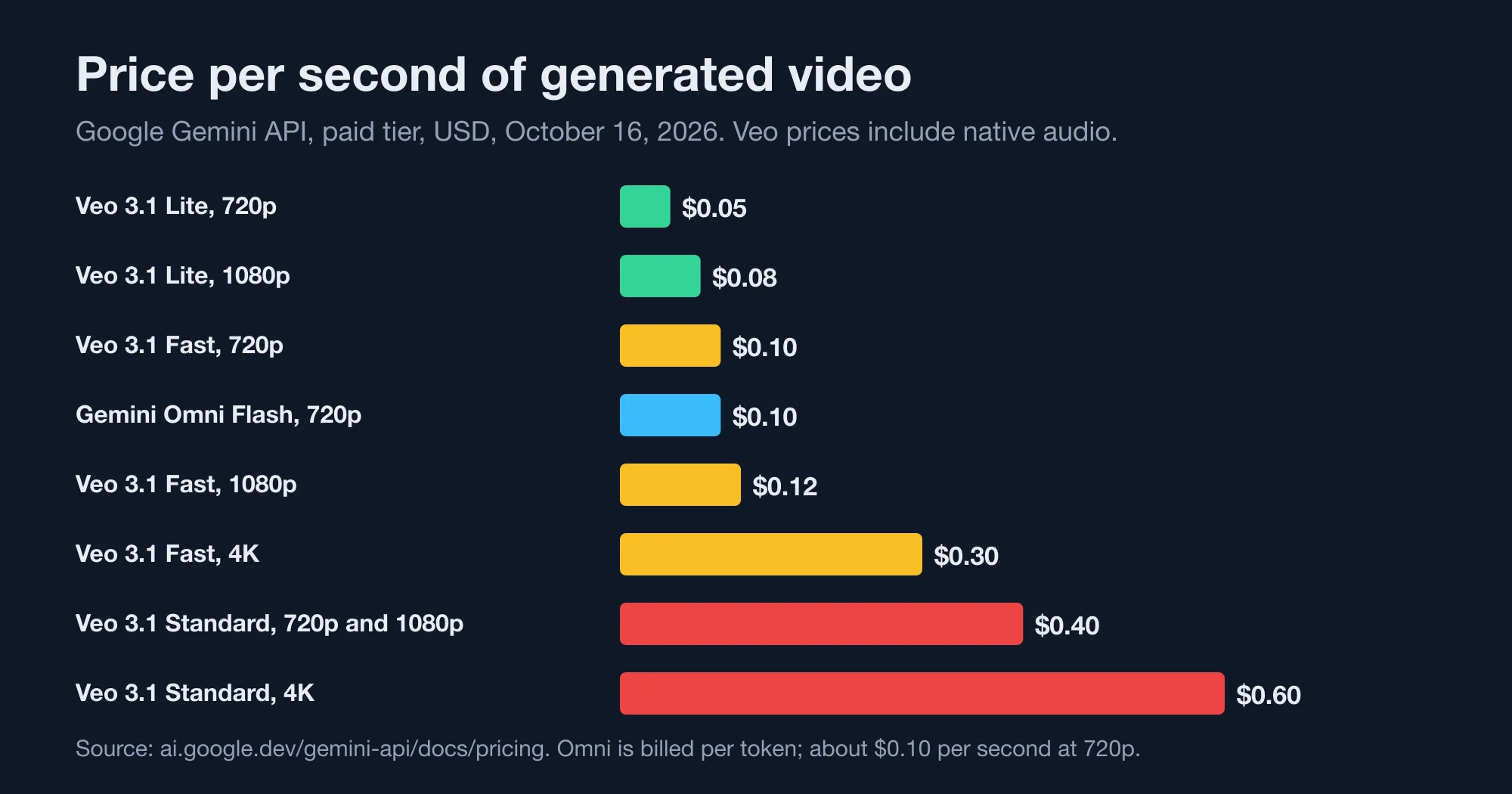
Veo 3.1 costs between $0.05 and $0.60 per second depending on the tier and resolution. Standard is $0.40 at 720p and 1080p and $0.60 at 4K. Fast is $0.10, $0.12 and $0.30. Lite is $0.05 at 720p and $0.08 at 1080p, with no 4K option.
Veo 3.1 is Google's video generation model family in the Gemini API, available as Standard, Fast and Lite tiers. The default prices include native audio. Google's page also says you are charged only if the video is successfully generated.
| Tier | Model ID | 720p | 1080p | 4K |
|---|---|---|---|---|
| Veo 3.1 Standard | veo-3.1-generate-preview |
$0.40 | $0.40 | $0.60 |
| Veo 3.1 Fast | veo-3.1-fast-generate-preview |
$0.10 | $0.12 | $0.30 |
| Veo 3.1 Lite | veo-3.1-lite-generate-preview |
$0.05 | $0.08 | n/a |
Source: Google Gemini API pricing page, paid tier, USD per second, read October 16, 2026. All three model IDs carry a preview suffix.
Google lists no batch discount for Veo, unlike its image models. Independent price trackers such as BenchLM's Veo page and InVideo's pricing comparison report the same Standard and Fast figures, which is a useful cross-check.
What does Gemini Omni Flash cost?
Gemini Omni Flash costs about $0.10 per second at 720p on Google's page. It is priced by token, at $17.50 per million output video tokens, and Google states 5,792 output tokens for each second of 720p video.
Gemini Omni Flash is Google's newer video model in the Gemini API. Google's video generation documentation calls it the default for video generation, and keeps Veo 3.1 as the recommendation for scene extension, last-frame control and older pipelines.
We checked the arithmetic. At 5,792 tokens per second and $17.50 per million tokens, one second costs $0.1014. That rounds to Google's $0.10 figure, so the page is internally consistent.
| Item | Price |
|---|---|
| Input, text, image, video or audio | $1.50 per million tokens |
| Output, text | $9.00 per million tokens |
| Output, video | $17.50 per million tokens |
| Video at 720p | about $0.10 per second |
Source: Google Gemini API pricing page, read October 16, 2026. Paid tier only. No batch rate is listed.
The model name matters. Google's page lists gemini-omni-1.1-flash as generally available on the paid tier, and a separate gemini-omni-flash-preview row for the same family.
What about other resolutions for Omni?
Google's page gives only the 720p figure. Third-party sources report more. The Decoder's coverage of Gemini Omni 1.1 Flash and Apidog's pricing explainer describe $0.03 at 360p, $0.10 at 720p, $0.15 at 1080p and $0.30 at 4K.
Advertisement
Treat those extra tiers as unconfirmed until they appear on Google's own page. We use only the 720p rate in our totals, with 1080p shown as a labelled estimate.
How much does a finished 30-second video cost?
A single pass over 30 seconds costs $12.00 on Veo 3.1 Standard at 1080p, $3.60 on Fast, $2.40 on Lite and $3.00 on Gemini Omni Flash at 720p. Real projects need retries, so the table below also shows three attempts per usable clip.
The retry count is our assumption, not a measured rate. Generative video rarely succeeds on the initial attempt, and an honest production budget includes the unsuccessful generations. Adjust the multiplier to your own hit rate.
| Option | Rate per second | 30 s, one attempt | 30 s, three attempts |
|---|---|---|---|
| Veo 3.1 Standard, 4K | $0.60 | $18.00 | $54.00 |
| Veo 3.1 Standard, 1080p | $0.40 | $12.00 | $36.00 |
| Veo 3.1 Fast, 4K | $0.30 | $9.00 | $27.00 |
| Veo 3.1 Fast, 1080p | $0.12 | $3.60 | $10.80 |
| Veo 3.1 Fast, 720p | $0.10 | $3.00 | $9.00 |
| Gemini Omni Flash, 720p | about $0.10 | $3.00 | $9.00 |
| Veo 3.1 Lite, 1080p | $0.08 | $2.40 | $7.20 |
| Veo 3.1 Lite, 720p | $0.05 | $1.50 | $4.50 |
Source: NiharDaily arithmetic on Google's published per-second rates, October 16, 2026. The attempt count is an assumption.
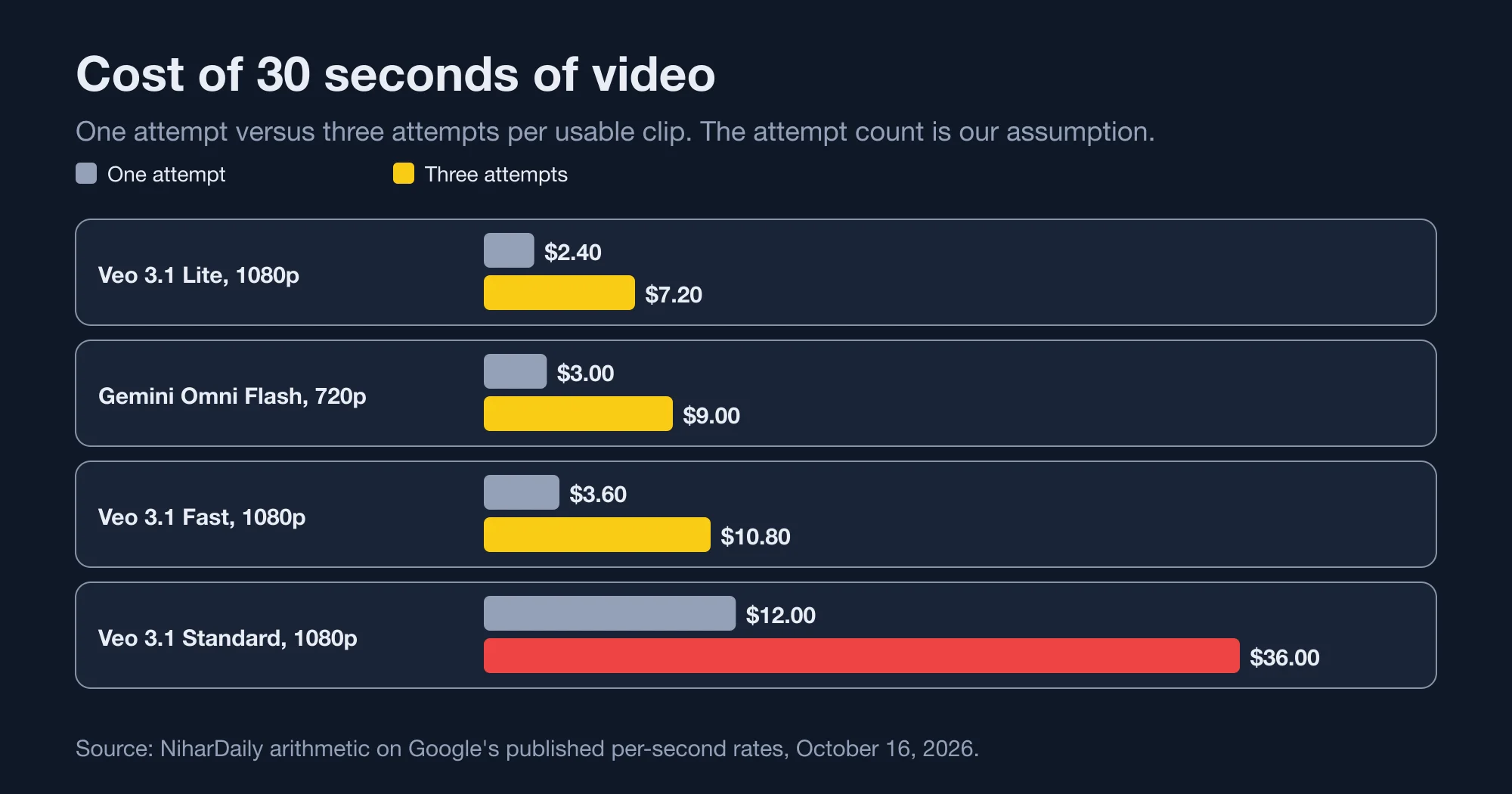
The spread is large. At three attempts, the most expensive row costs $54.00 and the least expensive costs $4.50, a twelve-fold difference for the same 30 seconds of footage. Resolution and tier drive almost all of it.
When is Veo 3.1 Standard worth the premium?
Standard is worth it only when the more economical tier misses often enough to erase the price gap. The test is a ratio. At 1080p, Standard costs $0.40 and Fast costs $0.12, so the break-even is 3.33 attempts.
Here is the governing rule. If Fast needs more than 3.33 attempts per usable clip, Standard is cheaper per keeper. If Fast needs fewer, Fast wins on cost.
| Comparison | Standard rate | Other rate | Break-even attempts |
|---|---|---|---|
| Standard vs Fast, 1080p | $0.40 | $0.12 | 3.33 |
| Standard vs Lite, 1080p | $0.40 | $0.08 | 5.00 |
| Standard vs Fast, 720p | $0.40 | $0.10 | 4.00 |
| Standard vs Omni Flash, 720p | $0.40 | $0.10 | 4.00 |
| Standard vs Fast, 4K | $0.60 | $0.30 | 2.00 |
Source: NiharDaily arithmetic, October 16, 2026. Break-even attempts is the Standard rate divided by the comparison rate.
Notice the 4K row particularly. The gap narrows to 2.00, because Fast also climbs at 4K. A team delivering 4K should be less reluctant to pay for Standard than a team shipping 720p social clips.
The same logic applied to image models in our comparison of Nano Banana Pro and Nano Banana 2.1, where the break-even at 2K was 2.66.
What is your attempts-per-keeper number?
Measure it systematically on 20 prompts that resemble your real production work. Count the clips you would publish unedited. Divide 20 by that count. A result of 4 means four attempts for every keeper, and Standard is then cheaper than Fast at 1080p.
Subjective criteria matter, so write them down first. Typical pass marks include correct physics, no garbled text, a steady subject and clean audio. A written rubric prevents inconsistent evaluation as reviewers become fatigued, and it makes the resulting measurement reproducible when a colleague repeats the experiment with different prompts. Record the date, the model identifier and the resolution alongside each result, because pricing and behavior both change between preview releases.
Which model should you pick for each job?
Choose Omni Flash or Veo Lite for high-volume production and preliminary drafts. Choose Veo Fast for balanced 1080p production. Choose Veo Standard for final delivery at high resolution, or for jobs that need Veo's extension features.
- Social clips at 720p: Gemini Omni Flash or Veo Lite. Both land near $0.05 to $0.10 per second.
- Product videos at 1080p: Veo Fast at $0.12 per second, with Lite for early drafts at $0.08.
- Final hero footage at 1080p or 4K: Veo Standard, but only after you measure that cheaper tiers miss often.
- Extending a clip or controlling the last frame: Veo 3.1, because Google's documentation reserves those features for it.
- Native audio included: all Veo defaults include it, so no separate audio line appears in the price.
For example, a team making ten 30-second product videos a month at 1080p with three attempts each would spend $108 on Fast and $360 on Standard. The $252 difference buys quality only if Fast actually misses more than 3.33 times per keeper.
Does a draft-then-final workflow save money?
It can. Run four Lite drafts at 720p for one 6-second clip, which costs 4 times 6 times $0.05, or $1.20. Then render the final once on Standard at 1080p for $2.40. The total is $3.60. Five Standard attempts at 1080p would cost $12.00.
That saving depends on a big assumption: that a prompt which works on Lite will also work on Standard. We did not test that, and different tiers may interpret a prompt differently. Verify the carry-over on a handful of prompts before you commit a budget to it.
What happened to Sora 2?
OpenAI removed the Sora 2 API on September 24, 2026, according to several secondary sources, and the consumer app closed earlier. Teams that built on Sora need another route. Our earlier explainer on the Sora 2 API shutdown compares Veo, Kling and self-hosted prices.
Pasquale Pillitteri's report on the Sora 2 API shutdown lists the removed model aliases, including sora-2 and sora-2-pro. Price trackers, including InVideo's pricing roundup, had listed Sora 2 Standard near $0.10 per second at 720p before the shutdown, though we did not verify that figure. We did not check OpenAI's own deprecation page for this post, so confirm the dates there if they matter to you.
The practical consequence is straightforward, and it deserves emphasis for anyone maintaining production infrastructure that depended on a single vendor. Sora's old price no longer anchors the market, and Google's Veo and Omni rates are now the reference points for developers on a major US cloud.
Which price claims should you distrust?
Distrust any figure that lacks a publication date and an identifiable source. Our search for Veo and Omni prices returned conflicting numbers. One page listed Veo at roughly $0.75 per second with audio. Another listed $0.20 for standard and $0.03 for Lite, video only.
These are probably different configurations or outdated listings. Google's page lists Veo 3.1 at $0.40 for Standard and $0.05 for Lite at 720p, and it is the only source that can change the bill you actually receive. Budget from it, and note the date you read it.
Models also change names remarkably quickly. Google's own documentation now names Omni Flash as the default and Veo 3.1 as the specialist choice. A budget built on last quarter's recommendation may point to the wrong model.
What we did not test
We generated no videos for this post, so we report nothing about visual quality, generation latency, content moderation filters or geographic availability in individual European countries. We did not verify the attempts-per-keeper multiplier, which is an assumption. We did not read OpenAI's pages on Sora. We did not test Veo's extension feature.
Prices can change without notice, and the Veo model IDs carry a preview suffix. Re-read Google's documentation before committing a budget, because preview models frequently receive revised pricing at general availability.
Advertisement
FAQ
What is the Veo 3.1 price per second in the Gemini API?
On Google's Gemini API, Veo 3.1 Standard costs $0.40 per second at 720p and 1080p and $0.60 at 4K. Fast costs $0.10, $0.12 and $0.30. Lite costs $0.05 at 720p and $0.08 at 1080p. Prices include native audio and apply only to successfully generated videos.
How much does Gemini Omni Flash cost?
Google's pricing page lists Gemini Omni Flash at about $0.10 per second of 720p video. It is billed at $17.50 per million output video tokens, with 5,792 tokens per second of 720p video. Third-party sources report higher prices at 1080p and 4K.
Is Veo 3.1 or Gemini Omni Flash cheaper?
Gemini Omni Flash at about $0.10 per second matches Veo 3.1 Fast at 720p and is four times cheaper than Veo 3.1 Standard at $0.40. Veo 3.1 Lite is cheaper still at $0.05 per second at 720p, based on Google's prices on October 16, 2026.
How much does a 30-second AI video cost?
On Google's rates, 30 seconds costs $12.00 on Veo 3.1 Standard at 1080p, $3.60 on Fast, $2.40 on Lite and about $3.00 on Gemini Omni Flash at 720p. Retries multiply those figures. Three attempts per usable clip makes them $36.00, $10.80, $7.20 and $9.00.
Is the Sora 2 API still available?
No. Secondary sources report that OpenAI removed the Sora 2 API and its model aliases on September 24, 2026, after announcing the deprecation on March 24, 2026. Confirm the dates on OpenAI's deprecation page. Google's Veo 3.1 and Gemini Omni Flash are the current options in the Gemini API.
Comments
Loading…
Sign in to join the conversation.
Related posts
Is your Go MCP server open to DNS rebinding? Check v1.4.0
CVE-2026-34742: Go MCP SDK before 1.4.0 accepts any Host header on localhost HTTP servers. We tested v1.3.1, v1.4.0 and v1.8.0, and show the fix and a proxy trap.
Sat Oct 17 2026 · 9 min read · 0 views
OpenAI shuts down GPT-4 and o1 on October 23: what to do
OpenAI retires gpt-4, gpt-4-turbo, o1, o3-mini, o4-mini and fine-tunes on October 23, 2026. A migration map with real costs: some replacements cost 4 to 5 times more.
Sat Oct 17 2026 · 9 min read · 0 views
Nano Banana Pro or 2.1: which image model to pay for
Nano Banana Pro costs 2 to 4 times more per image than Nano Banana 2.1. Google's own prices, cost per 1,000 images, and the break-even point where Pro pays for itself.
Sat Oct 17 2026 · 8 min read · 0 views