Copilot Pro at $10: how far do 1,500 AI credits go?
By Nihar Ranjan Das · Sun Oct 18 2026 · 10 min read · 0 views
View as a Web StoryAI#developer tools#github copilot#ai credits#claude#pricing
Copilot Pro costs $10 a month and includes 1,500 GitHub AI Credits. How far that goes depends almost entirely on the model you pick. On GitHub's published rates, the same agent session costs 3.4 credits on Claude Haiku 5.5 and 302.8 credits on Claude Fable 5.1, a gap of nearly ninety to one. So 1,500 credits can mean 440 sessions or 5. This guide prices a chat question and an agent session on six models, shows what happens when caching fails, and tells you when to upgrade instead of paying overage.
What is a GitHub AI Credit?
A GitHub AI Credit is the billing unit Copilot uses for any feature that calls an AI model, and one credit equals $0.01. Copilot converts the tokens you use into credits at each model's per-token price, according to GitHub's models and pricing page. Input tokens, output tokens and cached tokens each have their own price.
Copilot Pro is GitHub's $10-a-month individual plan. GitHub moved every Copilot plan from premium requests to this credit system on June 1, 2026, as its announcement from April 27 laid out. Plan prices did not change. Code completions and next edit suggestions still cost no credits on paid plans.
How many credits does each plan include?
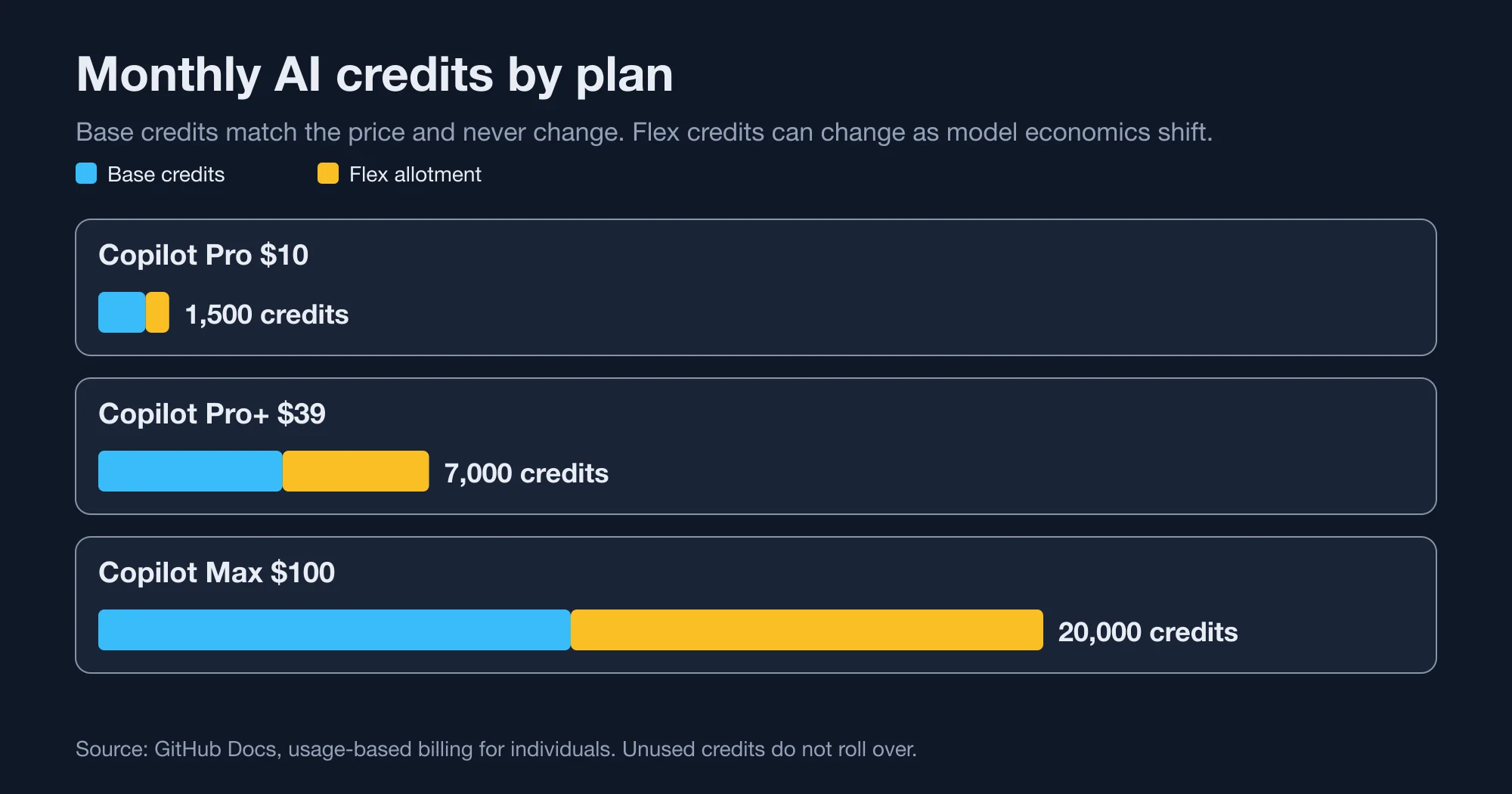
Each paid plan includes base credits that match its price, plus a flex allotment that can change. GitHub's documentation lists the current totals, and the chart below plots them.
| Plan | Price per month | Base credits | Flex allotment | Total |
|---|---|---|---|---|
| Copilot Pro | $10 | 1,000 | 500 | 1,500 |
| Copilot Pro+ | $39 | 3,900 | 3,100 | 7,000 |
| Copilot Max | $100 | 10,000 | 10,000 | 20,000 |
GitHub says base credits "match with your subscription price and they never change." The flex allotment "is a variable part of your included usage" and is designed to adapt as model prices and efficiency change. Plan around the base number, and treat flex as a bonus that could shrink. The flex allotment is the extra monthly credits GitHub adds on top of base credits, and it can change.
Credits do not roll over. Your allowance resets at 00:00:00 UTC on the first day of each calendar month, and unused credits are forfeited. That reset date does not follow your billing date.
How do I calculate the credits for one task?
Multiply each token count by that model's price per million tokens, then add the three parts together and convert the dollar total into credits by multiplying it by one hundred, since a single credit is worth exactly one cent. In words, the calculation is fresh input times the input price, plus cached input times the cached price, plus output times the output price, all divided by one million.
For example, take Claude Sonnet 5.5, which GitHub lists at $2.00 per million input tokens, $0.10 cached and $10.00 output. A chat question with 6,000 input tokens and 800 output tokens costs (6,000 × 2.00 + 800 × 10.00) ÷ 1,000,000 × 100, which is 2.0 credits.
GitHub's rate card also shows cache write prices for Anthropic and newer OpenAI models. We priced all fresh input at the plain input rate and left out cache writes. For Sonnet 5.5 that understates a session by about 5 credits.
Advertisement
What does a chat question cost, and what does an agent session cost?
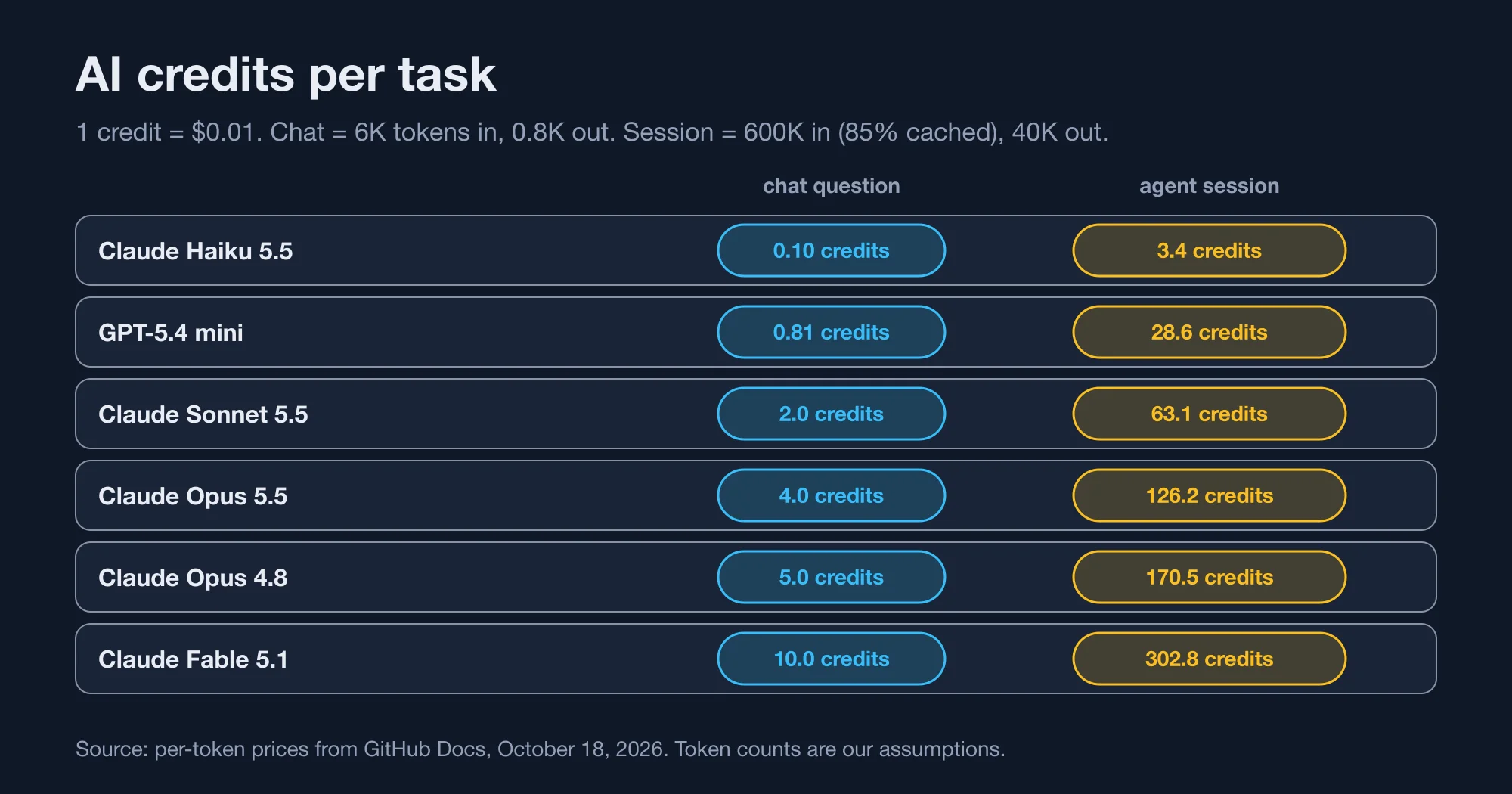
An agent session is one long task where Copilot reads files, edits code and runs commands across many model calls. A chat question is a single prompt and answer. Our test setup used two token budgets for them, and they are our assumptions, not GitHub figures. We priced a chat question at 6,000 input tokens and 800 output tokens, with no caching. We priced an agent session at 600,000 input tokens, of which 85 percent are cached, plus 40,000 output tokens. Why so much cache? Agent sessions send the same long context at every step, so most of it is reused.
| Model | Input / cached / output per 1M tokens | Chat question | Agent session |
|---|---|---|---|
| Claude Haiku 5.5 | $0.10 / $0.01 / $0.50 | 0.10 credits | 3.4 credits |
| GPT-5.4 mini | $0.75 / $0.075 / $4.50 | 0.81 credits | 28.6 credits |
| Claude Sonnet 5.5 | $2.00 / $0.10 / $10.00 | 2.0 credits | 63.1 credits |
| Claude Opus 5.5 | $4.00 / $0.20 / $20.00 | 4.0 credits | 126.2 credits |
| Claude Opus 4.8 | $5.00 / $0.50 / $25.00 | 5.0 credits | 170.5 credits |
| Claude Fable 5.1 | $10.00 / $0.25 / $50.00 | 10.0 credits | 302.8 credits |
All prices come from GitHub's models and pricing page as of October 18, 2026. Some models charge more for a long-context tier above a per-request input threshold. We assume each request in a session stays under that threshold.
How many sessions fit in 1,500 credits?
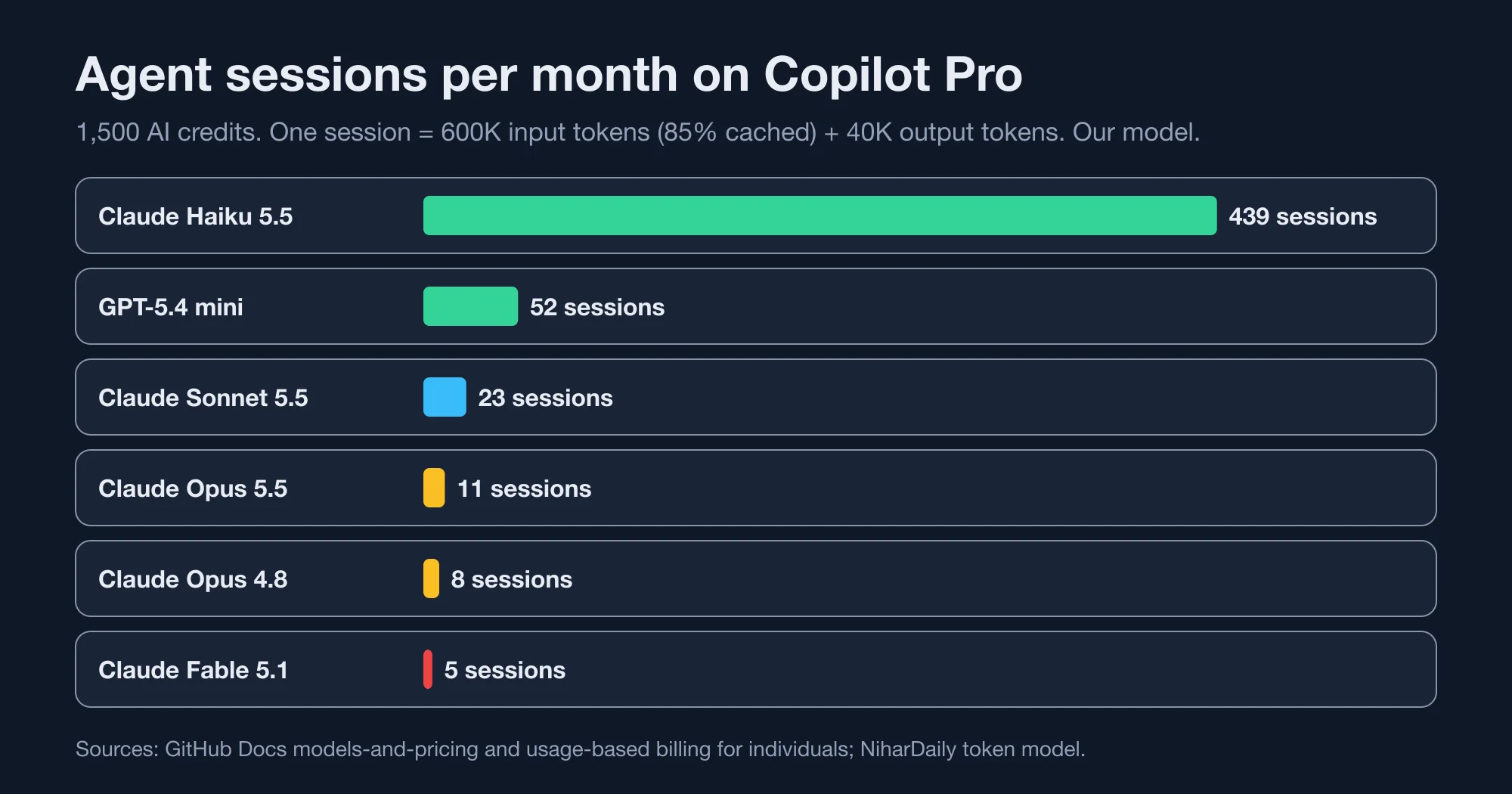
Divide 1,500 by the session cost. On Copilot Pro that gives the counts in the chart and table below.
| Model | Agent sessions on 1,500 credits | On 1,000 base credits only | Chat questions on 1,500 credits |
|---|---|---|---|
| Claude Haiku 5.5 | 439 | 293 | 15,000 |
| GPT-5.4 mini | 52 | 35 | 1,851 |
| Claude Sonnet 5.5 | 23 | 15 | 750 |
| Claude Opus 5.5 | 11 | 7 | 375 |
| Claude Opus 4.8 | 8 | 5 | 300 |
| Claude Fable 5.1 | 5 | 3 | 150 |
The bottom line: Copilot Pro comfortably covers daily chat on any model. It covers heavy agent work only on the cheaper models. Running a premium model as your default agent will burn the month's credits in a handful of sessions.
Why does Opus 5.5 cost less than Opus 4.8?
Claude Opus 5.5 is cheaper than Claude Opus 4.8 on GitHub's rate card, so newer does not mean pricier. Opus 5.5 lists $4.00 input, $0.20 cached and $20.00 output. Opus 4.8 lists $5.00, $0.50 and $25.00. On our session, that is 126.2 credits against 170.5, a saving of 44.3 credits every time.
If your editor still defaults to an older premium model, check the picker. Switching from Opus 4.8 to Opus 5.5 gives you roughly one extra session for every three, with no change in how you work. We did not compare output quality, so run your own task on both before you switch.
What happens when caching fails?
A weak cache raises the bill faster than any model swap saves it. Cached input is priced at a tenth of fresh input or less on these models, so a session that loses its cache pays full price for hundreds of thousands of tokens.
We re-priced the same session with 50 percent and then 0 percent cached input, keeping 600,000 input tokens and 40,000 output tokens.
| Model | 85 percent cached | 50 percent cached | 0 percent cached |
|---|---|---|---|
| Claude Haiku 5.5 | 3.4 credits | 5.3 credits | 8.0 credits |
| Claude Sonnet 5.5 | 63.1 credits | 103.0 credits | 160.0 credits |
| Claude Opus 5.5 | 126.2 credits | 206.0 credits | 320.0 credits |
| Claude Fable 5.1 | 302.8 credits | 507.5 credits | 800.0 credits |
The underlying economics are straightforward but easy to overlook: providers discount repeated context heavily because reusing previously processed tokens requires considerably less computation than processing them from scratch, so any workflow that interrupts that reuse, such as repeatedly restarting conversations or modifying the beginning of a long prompt, forfeits the discount and inflates consumption disproportionately. A Sonnet 5.5 session with no caching costs 160 credits, which is more than a well-cached Opus 5.5 session at 126.2. Cache behavior is up to the tool, not you, but you can influence it. Long, stable conversations cache better than constant context resets. Starting a fresh session for every small edit is the expensive pattern.
What does a realistic month look like?
Our example developer runs 20 Sonnet 5.5 agent sessions, 300 Haiku 5.5 chat questions and 4 Opus 5.5 sessions. That month costs 1,797 credits, which is 297 over the Copilot Pro pool.
The overage is 297 credits at $0.01 each, or $2.97. That is cheap, so one overspent month is no reason to change plans. GitHub lets you set a budget in US dollars, and "a $10 budget covers 1,000 AI credits," per its documentation. Until you set a budget or upgrade, you wait for the monthly reset.
If you use the Auto model setting, GitHub gives paid plans a 10 percent discount on model costs. Our Sonnet session drops from 63.1 to 56.8 credits with that discount. The discount applies in Copilot Chat, the CLI and the cloud agent, according to GitHub.
When should I upgrade instead of paying overage?
Upgrade once your regular overage would exceed roughly 2,900 credits a month. Pro+ costs $29 more than Pro and adds 5,500 credits, which works out to about 0.53 cents per added credit. Overage costs 1 cent per credit. At 2,900 extra credits, the overage bill equals the $29 price difference.
GitHub's rules help here. If you upgrade mid-month, "the upgrade cost is only the price difference between your current plan and the new plan," and your earlier usage counts toward the larger allowance. So you can wait until you are close to the limit.
| Plan | Price | Total credits | Effective price per credit |
|---|---|---|---|
| Copilot Pro | $10 | 1,500 | $0.0067 |
| Copilot Pro+ | $39 | 7,000 | $0.0056 |
| Copilot Max | $100 | 20,000 | $0.0050 |
The figures count flex credits, which GitHub can change. Using base credits alone, each plan costs exactly one cent per credit, so the upgrade case rests on flex staying in place.
How do I make 1,500 credits last longer?
Five habits stretch a Copilot Pro month without hurting your work, and each follows from the numbers above.
- Use a light model for chat and a stronger one only for hard agent tasks.
- Keep agent sessions long and focused so the cache keeps working.
- Pick Opus 5.5 over Opus 4.8 when you need a premium model.
- Use Auto model selection for the 10 percent discount where quality allows.
- Watch the usage dashboard in the first week to learn your own per-session cost.
Understanding these relationships transforms credit management from guesswork into a predictable engineering decision, because the variables that determine consumption, specifically model selection, conversation length and caching behavior, are all observable in the usage dashboard once you know which ones to examine. Remember that code completions cost nothing on paid plans, so lean on them for routine typing and save credits for work that needs reasoning.
What is the short answer?
The answer depends on your model choice. Picking a lightweight model makes Copilot Pro feel effectively unlimited, whereas choosing a premium model for every agent task exhausts the monthly allowance early. Most developers land somewhere in the middle, chatting often, running a handful of agent tasks, and occasionally paying a few dollars of additional usage, which Copilot Pro accommodates without much trouble.
Is Copilot Pro enough for you?
Yes if you chat often, run a few agent sessions a week on a mid-priced model, and accept a few dollars of overage in busy months. No if you run a premium model as your default agent every day. That pattern uses a month of credits in under two weeks.
Our token budgets are estimates, so measure your own first. Run one typical agent task, read its credit cost on the usage page, and divide 1,500 by that number. That single measurement beats any average we can give you.
Advertisement
FAQ
How many credits does Copilot Pro include?
Copilot Pro includes 1,500 GitHub AI Credits per month: 1,000 base credits matching the $10 price plus a 500-credit flex allotment GitHub can change. One credit equals $0.01, and unused credits are forfeited when the allowance resets at 00:00 UTC on the first of each month.
How many agent sessions can I run on Copilot Pro?
In our model, 1,500 credits cover about 439 sessions on Claude Haiku 5.5, 23 on Claude Sonnet 5.5 and 5 on Claude Fable 5.1. The token counts are our assumptions, so read your own session cost on the usage dashboard before relying on these numbers.
What happens when I run out of AI credits?
You can upgrade, pay for more usage within a budget you set, or wait for the monthly reset. Extra usage draws down your budget at one cent per credit, so a $10 budget covers 1,000 credits. Until you act, you wait for the reset.
Do code completions use AI credits?
No. GitHub states that code completions and next edit suggestions are not billed in AI credits and stay unlimited on paid plans. Chat, the CLI, the cloud agent, Spaces and Spark do use credits, so save them for work that needs reasoning.
Is Copilot Pro+ worth it over Pro?
Pro+ is worth it once you regularly need about 2,900 credits more than Pro includes. It adds 5,500 credits for $29, roughly half a cent per credit, against one cent for overage. Below that level, a few dollars of overage costs less than the upgrade.
Comments
Loading…
Sign in to join the conversation.
Related posts

Is your Go MCP server open to DNS rebinding? Check v1.4.0
CVE-2026-34742: Go MCP SDK before 1.4.0 accepts any Host header on localhost HTTP servers. We tested v1.3.1, v1.4.0 and v1.8.0, and show the fix and a proxy trap.
Sat Oct 17 2026 · 9 min read · 1 views
OpenAI shuts down GPT-4 and o1 on October 23: what to do
OpenAI retires gpt-4, gpt-4-turbo, o1, o3-mini, o4-mini and fine-tunes on October 23, 2026. A migration map with real costs: some replacements cost 4 to 5 times more.
Sat Oct 17 2026 · 9 min read · 3 views

Nano Banana Pro or 2.1: which image model to pay for
Nano Banana Pro costs 2 to 4 times more per image than Nano Banana 2.1. Google's own prices, cost per 1,000 images, and the break-even point where Pro pays for itself.
Sat Oct 17 2026 · 8 min read · 2 views