Relational Databases: Top 10 Ranked and How They Work
By Nihar Ranjan Das · Fri Oct 09 2026 · 9 min read · 1 views
View as a Web StorySoftware#postgresql#database#sql#relational databases#db-engines
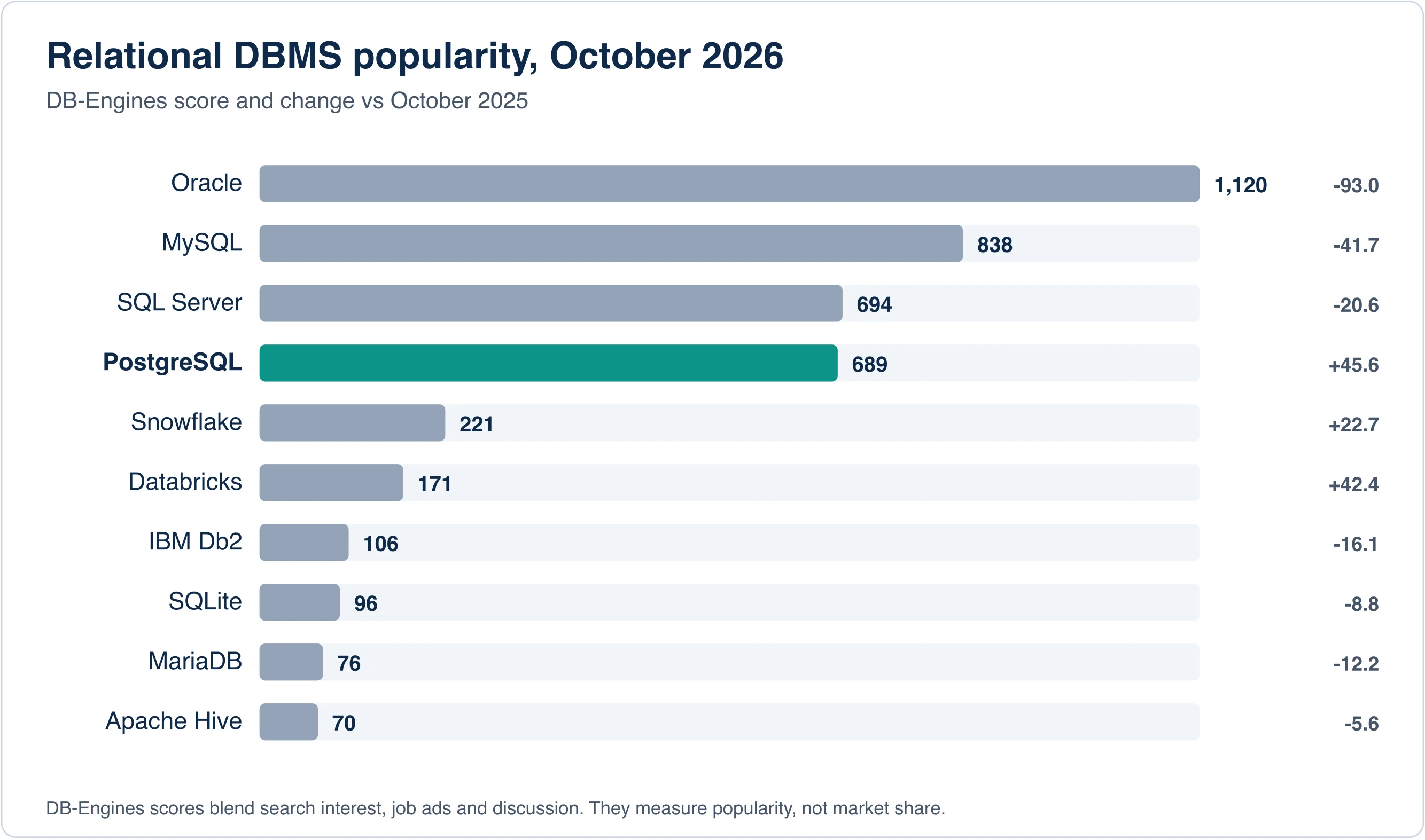
Oracle still leads the October 2026 DB-Engines list of relational databases, but PostgreSQL is the only top-four system that gained ground this year. PostgreSQL scored 688.75, up 45.56 points from October 2025. Oracle, MySQL and SQL Server all lost points over the same twelve months.
This guide ranks the ten most popular relational systems, explains how a relational database turns your SQL into rows, and shows a measured test on a two-million-row table. The test answers a question most explainers skip: what does an index actually buy you?
Key takeaways
- Oracle, MySQL, SQL Server and PostgreSQL hold the top four spots in October 2026, and only PostgreSQL is growing.
- A relational database stores data in linked tables, and the planner decides how fast a query runs.
- In our test, one index cut a lookup from about 31 ms to about 0.09 ms in PostgreSQL 18.1.
- Pick by workload, not by rank, and test your slowest queries before you commit.
What is a relational database?
A relational database is a database that stores data in tables made of rows and columns, and links those tables through shared key values. Edgar Codd described the model in a 1970 paper, A Relational Model of Data for Large Shared Data Banks, published in Communications of the ACM. Nearly every business system built since then relies on it.
A relational database management system (RDBMS) is the software that stores those tables, enforces the rules, and answers queries. Oracle, MySQL, SQL Server, PostgreSQL, Db2, SQLite and MariaDB are all RDBMS products.
SQL is the language you use to ask an RDBMS for data. The same query shape works across products, with dialect differences at the edges. Lists of relational systems are easy to find. The harder question is which one fits your job.
The building blocks you will meet
Every relational database uses the same few parts. Learn them once and any product feels familiar.
- A table is a named grid of rows and columns, such as
customersororders. - A primary key is a column whose value is unique for every row, such as
id. - A foreign key is a column that points at another table's primary key, such as
orders.customer_id. - An index is a sorted lookup structure that lets the database find rows without reading the whole table.
- A transaction is a group of changes that succeed or fail together.
Consider an online shop. A customers table holds one row per person. An orders table holds one row per purchase and stores the customer's id. A join then answers questions such as "how much did each country spend?" without copying customer data into every order.
Which relational databases are most popular in 2026?
Oracle, MySQL, SQL Server and PostgreSQL hold the top four spots in the October 2026 DB-Engines ranking of relational systems. The site tracks 170 relational systems and scores each on search interest, job ads and developer discussion.
| Rank | System | Score | Change vs Oct 2025 |
|---|---|---|---|
| 1 | Oracle | 1,119.79 | -92.98 |
| 2 | MySQL | 837.96 | -41.70 |
| 3 | Microsoft SQL Server | 694.47 | -20.58 |
| 4 | PostgreSQL | 688.75 | +45.56 |
| 5 | Snowflake | 221.30 | +22.65 |
| 6 | Databricks | 171.24 | +42.44 |
| 7 | IBM Db2 | 106.29 | -16.08 |
| 8 | SQLite | 95.73 | -8.82 |
| 9 | MariaDB | 75.60 | -12.16 |
| 10 | Apache Hive | 69.58 | -5.64 |
Source: the DB-Engines relational ranking, October 2026.
Advertisement
Two readings matter here. First, the gap between third and fourth place is only 5.72 points, so PostgreSQL may pass SQL Server soon. Second, the fast risers below the top four are cloud data platforms. Snowflake and Databricks are built for analytics, not for running a shop's checkout.
DB-Engines measures popularity. It does not measure market share or quality. A high score means people search for, hire for and discuss a system. That is still a useful signal when you must find developers or answers.
How does SQL work inside a relational database?
SQL runs as four steps: the parser checks your text, the planner chooses a strategy, the executor reads rows, and the result returns to you. The planner is the interesting step, because it decides how much data the database must touch.
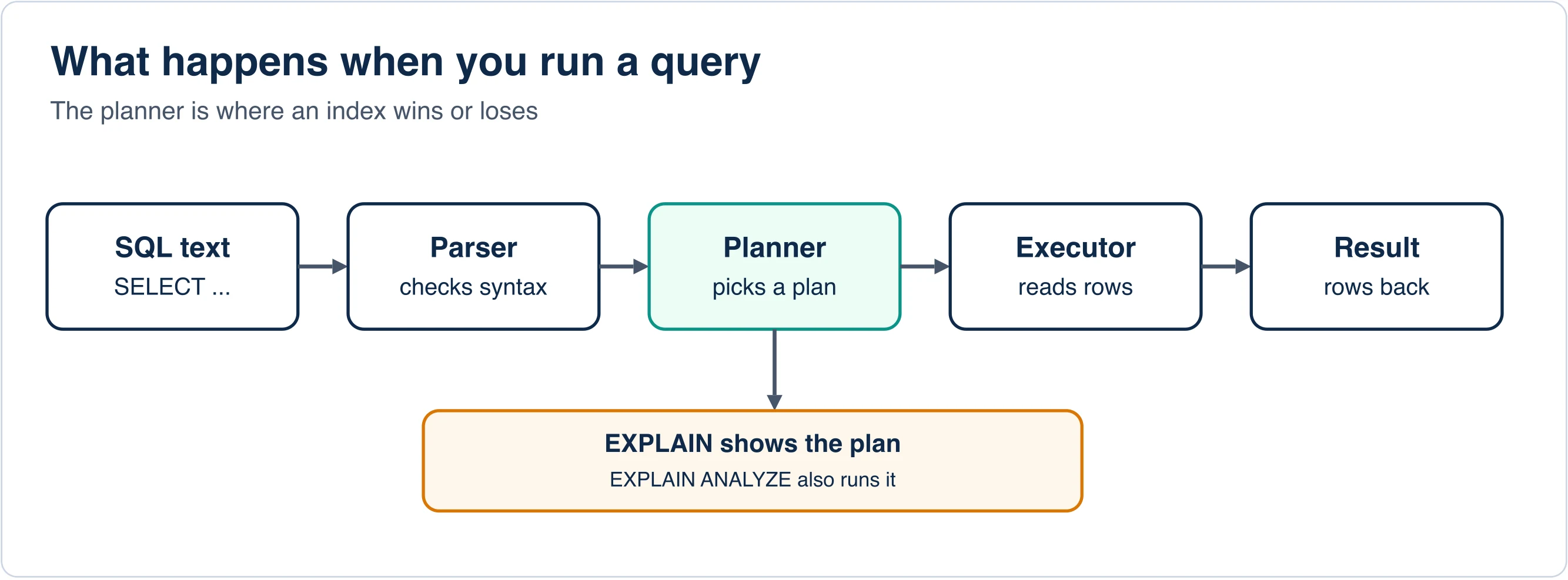
You declare what you want, not how to get it. Consider a query for one customer's orders. The planner can scan every row and discard the misses. Or it can jump straight to the matching rows through an index. Both return identical results. Only one is fast.
You can watch the choice happen. Put EXPLAIN in front of any query in PostgreSQL and it prints the plan. Use EXPLAIN ANALYZE and it also runs the query and reports real timings. SQLite offers EXPLAIN QUERY PLAN for the same purpose.
How to read an EXPLAIN plan
A plan is a tree of steps, read from the innermost line outward. The PostgreSQL documentation on EXPLAIN shows that each node reports an estimated cost and, with ANALYZE, the actual time and row count. Three words are worth memorizing:
- Seq Scan means the database reads every row in the table.
- Index Scan or Bitmap Index Scan means it used an index to jump to matching rows.
- Hash Join means it built a lookup table in memory to match rows from two tables.
SQLite documents the same idea in its page on EXPLAIN QUERY PLAN, where SCAN signals a full pass and SEARCH signals an index lookup. If a slow query shows a scan over a big table, an index is the first fix to try.
What does an index actually buy you? A tested example
An index cut a one-customer lookup from about 31 milliseconds to about 0.09 milliseconds in PostgreSQL 18.1, and from 65 milliseconds to 0.011 milliseconds in SQLite 3.50.1. Both tests used a two-million-row orders table on one laptop.
Our test setup used PostgreSQL 18.1 on a laptop with default settings. We measured the server's own execution time over 3 runs of each query. The table holds 2 million orders spread across 100,000 customers:
CREATE TABLE orders (
  id bigserial PRIMARY KEY,
  customer_id int REFERENCES customers(id),
  total numeric(10,2),
  created date
);

EXPLAIN (ANALYZE)
SELECT count(*), sum(total) FROM orders WHERE customer_id = 4242;
Without an index, PostgreSQL ran a parallel sequential scan. It read the whole 100 MB table and reported an execution time near 31 ms across three runs (30.2, 30.7 and 31.7 ms). Then we added one index:
CREATE INDEX orders_customer_idx ON orders (customer_id);
ANALYZE orders;
The planner switched to a bitmap index scan. It touched only the 18 matching rows. Execution time fell to 0.076, 0.089 and 0.120 ms. The index itself took 15 MB of disk, about 15 percent of the table size.
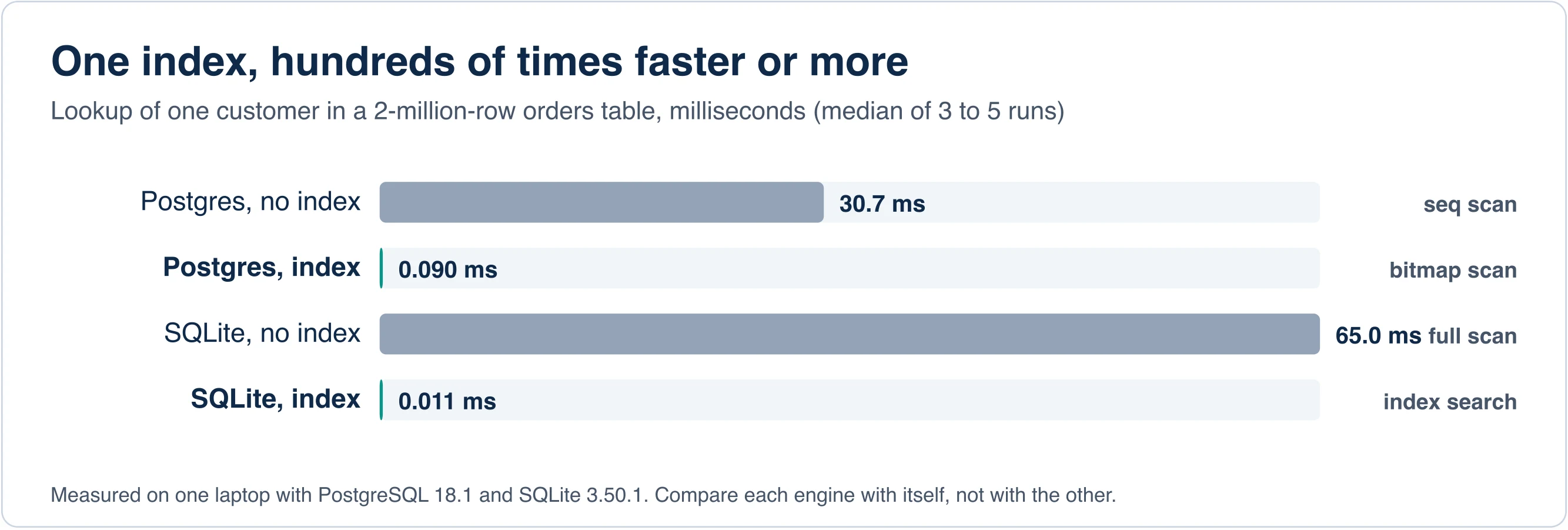
SQLite showed the same shape. A full scan took a median 65 ms, and the indexed search took 0.011 ms. SQLite's plan line read SEARCH orders USING INDEX oc (customer_id=?).
Do not compare the two engines against each other. The SQLite numbers came from a Python wrapper, and the PostgreSQL numbers came from the server's own timer. Compare each engine with itself.
The lesson is cost and benefit. An index speeds reads and costs disk space and write time. Add indexes to columns you filter or join on often. Do not index everything.
Joins stay cheap when the planner has statistics
We ran a join between orders and a 100,000-row customers table, grouped by country. PostgreSQL used a hash join and finished in about 184 ms for all two million rows. Running ANALYZE after loading data matters, because the planner relies on those statistics to pick between plans.
What makes a relational database dependable?
A dependable relational database guarantees ACID behavior: atomicity, consistency, isolation and durability. ACID means a transaction either fully happens or leaves no trace, even if the server crashes mid-way. PostgreSQL's feature overview states it has been ACID-compliant since 2001.
You can see atomicity in two lines. We ran this against a five-row table whose salaries summed to 475:
BEGIN;
UPDATE emp SET salary = 0;
ROLLBACK;
SELECT sum(salary) FROM emp;  -- still 475
Both PostgreSQL and SQLite returned 475. The rollback erased the update completely. That behavior is what protects payments, inventory and bookings.
Dependability also depends on replication, backups and tested recovery. PostgreSQL lists write-ahead logging, replication and point-in-time recovery among its features. Check that your chosen product and hosting plan offer all three.
Which relational database is best for collaboration?
PostgreSQL, MySQL, SQL Server and Oracle suit many users writing at once. SQLite does not, because it allows only one writer at a time. The SQLite documentation on appropriate uses says it supports many simultaneous readers but only one writer at any instant.
PostgreSQL uses multi-version concurrency control, which it lists on its About page. That lets readers keep working while writers change data. For a team app with many concurrent users, a client-server system is the safer base.
That does not make SQLite a bad choice. It is excellent for a mobile app, a desktop tool or a small site with light writes. It needs no server and no admin.
How should you pick one? A decision table
Pick by workload and by who must operate it. The table below gives a first pass.
| Your situation | Strong fit | Why |
|---|---|---|
| New web app, open-source preference | PostgreSQL | Rich features, permissive license, growing demand |
| WordPress or older PHP stack | MySQL or MariaDB | Default choice in that ecosystem |
| Microsoft shop with .NET | SQL Server | Tight tooling and licensing fit |
| Embedded, mobile or desktop app | SQLite | One file, no server |
| Large analytics workloads | Snowflake, Databricks, BigQuery | Built for scans over huge data |
| Existing Oracle estate | Oracle | Migration cost often outweighs savings |
Notice what is missing: a claim that one product wins. Each row names a workload. Switching later is possible but costly, so spend an afternoon testing your real queries first.
Test your own data in an hour
Load a copy of your tables into the candidate system. Run your ten slowest queries with EXPLAIN ANALYZE. Add the indexes the plans ask for. Then compare timings, backup steps and monthly cost. That hour beats any ranking.
Common mistakes to avoid
- Skipping primary keys. Every table needs one, or updates and joins become guesswork.
- Indexing every column. Each index slows inserts and updates.
- Skipping
ANALYZE. Stale statistics make the planner pick poor plans. - Storing lists in one column. Use a second table and a foreign key instead.
- Treating rankings as advice. Popularity helps hiring, but your workload decides.
Key takeaways for choosing
Relational databases remain the default for structured data because they pair a simple model with strong guarantees. The ranking shows the big four still dominate, with PostgreSQL gaining while its three larger rivals lose points. The test shows why the planner and indexes matter more than brand. Learn to read an EXPLAIN plan, and you will diagnose most slow queries yourself.
Advertisement
FAQ
What is a relational database?
A relational database stores data in tables of rows and columns and links the tables through shared key values. Edgar Codd described the model in 1970. Products such as Oracle, MySQL, SQL Server, PostgreSQL and SQLite all follow it and are queried with SQL.
Which relational database is most popular in 2026?
Oracle ranks first in the October 2026 DB-Engines relational ranking with 1,119.79 points. MySQL is second, SQL Server third and PostgreSQL fourth at 688.75. PostgreSQL is the only top-four system that gained points over the past year.
How does SQL work inside a database?
SQL text passes through a parser, a planner and an executor. The parser checks syntax, the planner picks the cheapest way to find the rows, and the executor reads them. EXPLAIN shows the plan, and EXPLAIN ANALYZE also runs the query and reports real timings.
What is the most dependable relational database?
Dependability comes from ACID transactions, replication and tested backups, not from one brand. PostgreSQL has been ACID-compliant since 2001, and Oracle, SQL Server, MySQL and Db2 also offer ACID transactions. Check replication and recovery options on your hosting plan.
Is SQLite a relational database?
Yes. SQLite is a relational database that stores everything in one file and needs no server. It supports SQL, joins and transactions. It allows only one writer at any instant, so it suits embedded and light-write apps better than busy multi-user systems.
Comments
Loading…
Sign in to join the conversation.
Related posts
What Is PostgreSQL? A Plain-English Guide With Real Tests
PostgreSQL is a free, open-source relational database that stores data in tables and answers questions written in SQL. It began in 1986 as the POSTGRES project at the University of California,
Fri Oct 09 2026 · 8 min read · 0 views
Serverless Databases Compared: What They Cost in 2026
A serverless database costs the least when your app sits idle, and the most when it runs all day. That single fact decides most purchases. A hobby app can run free on Neon, Turso or Cloudflare D1. An
Fri Oct 09 2026 · 9 min read · 0 views
Firebase Alternatives: What to Switch To and What It Costs
The best Firebase alternative for most teams is Supabase, because it swaps Firestore's per-read billing for Postgres and a flat plan. But Firebase itself is cheap for tidy apps. In our model, a
Fri Oct 09 2026 · 8 min read · 0 views