Stripe bought OpenRouter. Should you still route through it?
By Nihar Ranjan Das · Tue Aug 18 2026 · 7 min read · 3 views
View as a Web StoryAI#openrouter#llm api#ai-infrastructure#ai pricing#stripe#ai gateway
Stripe bought OpenRouter. Should you still route through it?
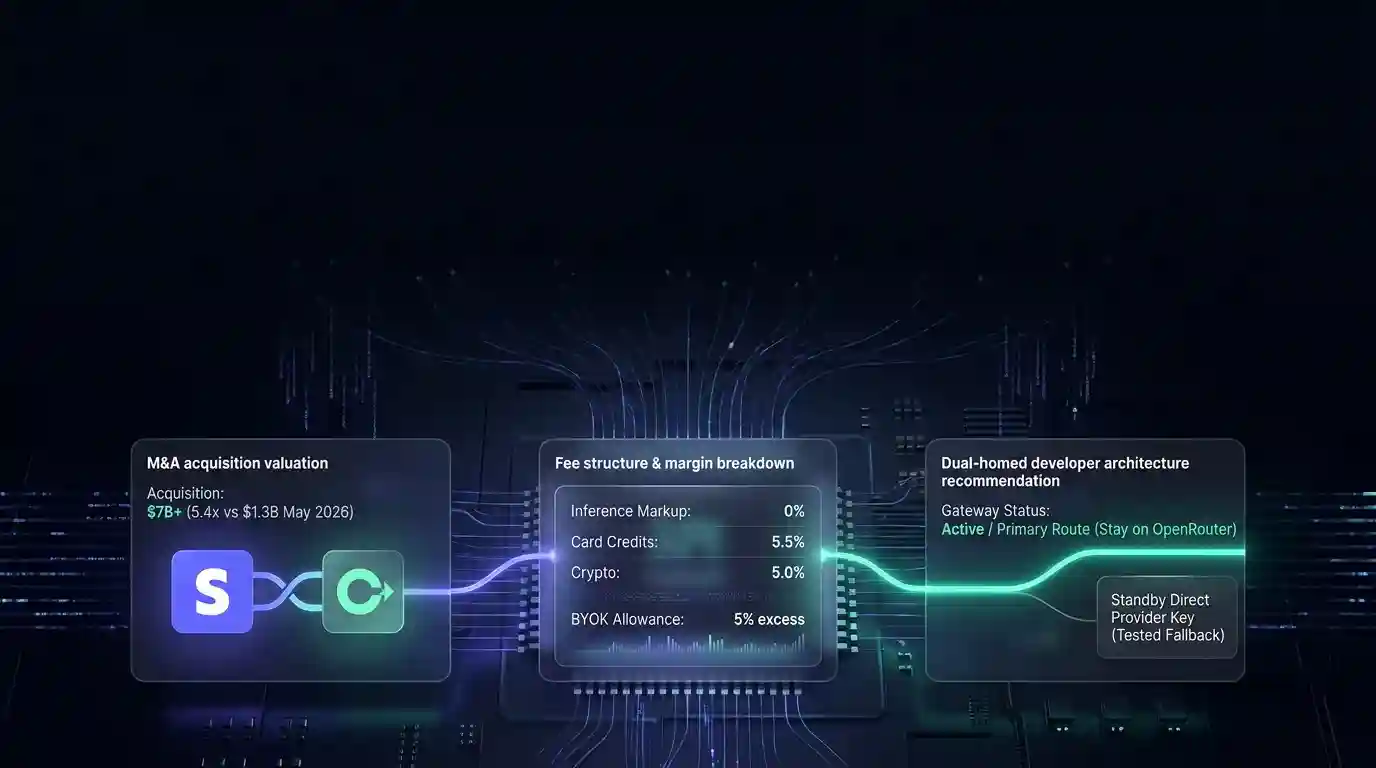
Stripe has finalized a deal to acquire OpenRouter for more than $7 billion, Bloomberg reported on August 16, 2026. If your product calls a large language model through OpenRouter, nothing breaks this week. The question is what you do over the next two quarters.
The short answer: stay, but stop treating the gateway as neutral infrastructure. Keep one direct provider key working, and know your fee number before the integration terms change.
Key takeaways
- Stripe is paying more than $7 billion for OpenRouter, roughly 5.4 times the $1.3 billion valuation OpenRouter carried in May 2026, according to TechCrunch.
- OpenRouter does not mark up inference. It charges a credit purchase fee of 5.5% on card payments, per its own documentation.
- The payments company that processes those card payments now owns the router, so the fee and the checkout sit inside one company.
What is OpenRouter, and what did Stripe actually buy?
An AI gateway is a single API endpoint that sits between your application and several model providers, so one integration reaches all of them.
OpenRouter is the largest of them: one endpoint that forwards your request to whichever model provider you name. One key, one bill, more than 400 models from OpenAI, Anthropic, Google, Meta and DeepSeek. TechCrunch reports the company claimed 8 million users at its Series B in May 2026.
Stripe is a payments company that processes card and bank transactions for online businesses. It did not buy a model. It bought the layer that decides which model gets the traffic, plus the billing relationship attached to it.
That combination is the story. OpenRouter's CEO has described the platform as "the equivalent of Stripe for AI," a line TechCrunch quoted in its report on the deal. Stripe appears to have agreed with the comparison and removed the metaphor.
What the $7 billion price tag really says
A 5.4x markup in three months is not a price for current revenue. OpenRouter raised $113 million at a $1.3 billion valuation in May 2026, with Sequoia, Andreessen Horowitz, Menlo Ventures and Alphabet's CapitalG on the cap table, TechCrunch reported.
Three months later the number is above $7 billion. Nothing about token routing changed that fast. What Stripe is buying is position. Model routing is turning into a billing problem, and Stripe already owns billing.
For a developer, that reframes the gateway. You were using a neutral switch between vendors. You are now using a distribution channel owned by the company that also processes your customers' payments.
Does an AI gateway cost more than calling providers directly?
Not on inference. OpenRouter passes through provider list pricing with no markup on model usage, its published FAQ states. The cost sits in two other places.
Advertisement
BYOK, or bring your own key, is the setup where you hold the provider contract and the gateway only routes the call. OpenRouter charges 5% on BYOK usage above a monthly allowance, its documentation says, and nothing below it.
| Cost item | OpenRouter | Direct provider key |
|---|---|---|
| Inference rate | Provider list price | Provider list price |
| Credit purchase fee | 5.5% on card, 5% on crypto | None |
| Bring-your-own-key fee | 5% above the monthly allowance | Not applicable |
| Free BYOK allowance | $25,000 per month pay-as-you-go, $200,000 enterprise | Not applicable |
| Billing relationship | One invoice, many models | One contract per provider |
Run the arithmetic on your own spend. A team burning $2,000 a month in tokens pays about $110 a month for the convenience at the 5.5% card rate. That is cheap next to the engineering time of maintaining four provider integrations. A team burning $60,000 a month pays about $3,300, which buys a contractor for a week.
The crossover is not a fixed number. It is the point where your fee exceeds the cost of the integration work you are avoiding.
What changes for developers under Stripe
Nothing technical, in the near term. Acquisitions of this size take months to close, and the reported deal was still being described as finalized rather than completed when Bloomberg and Dataconomy covered it. A Stripe spokesperson declined to comment on the report.
Three things are worth watching, and none of them is a reason to migrate today.
- Fee structure. The 5.5% credit purchase fee exists because OpenRouter pays a payment processor. When the processor and the router are the same company, that cost line becomes an internal transfer. It can go down. It can also stay exactly where it is and become margin.
- Neutrality. A router's value is that it has no favorite. Stripe has commercial relationships across the AI industry. Watch the default model ordering and the routing preferences, not the press release.
- Data handling. Your prompts already pass through a third party when you use a gateway. The list of parties is about to change. If you handle regulated data under the EU AI Act or state privacy law, the data processing agreement is the document to re-read, not the blog post.
Should you switch off OpenRouter?
For most teams, no. The gateway still reaches every model in its public model catalog through one key, and switching costs real engineering time. But the deal is a good reason to stop being single-homed.
Do this instead, in roughly this order:
- Keep one direct provider key live and tested. Not documented. Tested, in a code path that runs weekly.
- Measure your actual fee. Pull last quarter's credit purchases and multiply by 5.5%. Compare it against a week of integration work.
- If you are over the BYOK allowance, price the 5% overage against a direct contract. Consider a hybrid: direct keys for your two highest-volume models, gateway for the long tail.
- Read the data processing terms when they are reissued. Ownership changes usually reissue them.
The cheapest AI API is not the cheapest to run, and that logic applies to gateways too. A fee you can see is often better than an integration you have to maintain. The point is to know which one you are choosing.
Who this deal is actually aimed at
Not you, probably. A gateway that sells to 8 million developers is interesting to Stripe because of what sits underneath it: usage-metered billing for AI, in a form other companies want to resell.
That is a different business from "help a startup try Claude and Gemini in the same afternoon." Both can be true at once. But when a product's most valuable customer changes, the roadmap follows. Consider how quickly usage-based pricing swept developer tools this year, from AI coding agents to model APIs. Stripe buying the meter is the same trend, one layer down.
Frequently asked questions
What did Stripe pay for OpenRouter?
More than $7 billion, according to Bloomberg's August 16, 2026 report, which TechCrunch and other outlets followed. OpenRouter was valued at $1.3 billion in May 2026 after a $113 million Series B. That makes the reported price roughly 5.4 times the valuation from three months earlier.
Does OpenRouter add a markup to model pricing?
No. OpenRouter states in its documentation that it passes through the underlying providers' pricing without a markup on inference. Its revenue comes from a 5.5% fee on credit purchases made by card, 5% on crypto, and a 5% fee on bring-your-own-key usage above the monthly allowance.
Should I move off OpenRouter after the Stripe acquisition?
Not immediately. The deal changes ownership, not the API. The sensible response is to keep one direct provider key tested and ready, measure what the credit purchase fee costs you per quarter, and re-read the data processing terms when they are reissued after the deal closes.
Is an AI gateway cheaper than direct provider keys?
It depends on volume. At $2,000 a month in tokens, the 5.5% card fee costs about $110, which is far less than maintaining several provider integrations. At $60,000 a month it costs about $3,300, which starts to rival the engineering time you are avoiding.
When will the Stripe and OpenRouter deal close?
No closing date has been announced. Bloomberg reported the deal as finalized on August 16, 2026, and Stripe declined to comment on the report. Deals of this size normally take months to complete and may require regulatory clearance in the United States and the European Union.
Advertisement
FAQ
What did Stripe pay for OpenRouter?
More than $7 billion, according to Bloomberg's August 16, 2026 report. OpenRouter was valued at $1.3 billion in May 2026 after a $113 million Series B, so the reported price is roughly 5.4 times that valuation three months later.
Does OpenRouter add a markup to model pricing?
No. OpenRouter's documentation states it passes through the underlying providers' pricing with no markup on inference. Its revenue comes from a 5.5% fee on card credit purchases, 5% on crypto, and 5% on bring-your-own-key usage above the monthly allowance.
Should I move off OpenRouter after the Stripe acquisition?
Not immediately. The deal changes ownership, not the API. Keep one direct provider key tested and ready, measure what the credit purchase fee costs you per quarter, and re-read the data processing terms when they are reissued after the deal closes.
Is an AI gateway cheaper than direct provider keys?
It depends on volume. At $2,000 a month in tokens the 5.5% card fee costs about $110, far less than maintaining several provider integrations. At $60,000 a month it costs about $3,300, which starts to rival the engineering time you are avoiding.
When will the Stripe and OpenRouter deal close?
No closing date has been announced. Bloomberg reported the deal as finalized on August 16, 2026, and Stripe declined to comment. Deals of this size normally take months and may need regulatory clearance in the United States and the European Union.
Comments
Loading…
Sign in to join the conversation.
Related posts
Claude Sonnet 5.5 migration: which changes return a 400
Claude Sonnet 5.5 launched on September 28, 2026 at the same price as Claude Sonnet 5, $2 per million input tokens and $10 per million output tokens. Moving to it is not a model-ID swap. Several
Tue Sep 29 2026 · 6 min read · 2 views
OpenAI shuts off GPT-4, o1 and o4-mini on October 23
OpenAI shuts off GPT-4, GPT-3.5 Turbo, GPT-4 Turbo, o1, o1-pro, o3-mini, o4-mini and several other models on its API on October 23, 2026. That is 24 days away. Any call that names one of those models
Tue Sep 29 2026 · 6 min read · 6 views

AI SDK 7 Changed usage. Your Token Counts Are Now Wrong
If a project upgraded to AI SDK 7 and its per-request token costs suddenly look higher than before, nothing is actually costing more. result.usage used to report only the final step's tokens. In AI
Tue Sep 29 2026 · 6 min read · 1 views