Claude's 30% token inflation: does your bill actually rise?
By Nihar Ranjan Das · Wed Oct 14 2026 · 9 min read · 0 views
View as a Web StoryAI#anthropic#claude#api pricing#tokenizer#sonnet 5.5
Does Claude's new tokenizer make your bill higher?
It depends on the model you are leaving. For the same text, Claude Sonnet 5.5 costs about 13% less than Sonnet 4.6, and Claude Haiku 5.5 costs about 87% less than Haiku 4.5. Claude Opus 5.5 costs about 4% more than Opus 4.6. The extra tokens are real, but only Opus users end up paying more.
Those figures come from Anthropic's published list prices, multiplied by the roughly 30% extra tokens its pricing page describes. They assume a workload with equal input and output tokens, so treat them as a guide and not a quote. The sections below show the arithmetic so you can redo it for your own mix.
What exactly changed in the tokenizer?
A tokenizer is the component that splits text into the numeric pieces a model reads and bills for. Anthropic changed its tokenizer with Claude Opus 4.7. The pricing page says Claude 4.7 and later models use a newer tokenizer that produces approximately 30% more tokens for the same text, and that Claude Sonnet 4.6 and earlier models use the previous one.
The token counting documentation adds two details. First, Claude Fable 5.1, Claude Mythos 5.1, Claude Fable 5 and Claude Mythos 5 share the tokenizer introduced with Claude Opus 4.7, so a prompt counts the same on all four. Second, the exact increase depends on content and workload shape, so Anthropic tells you to recount prompts instead of reusing old numbers.
The tokenizer is not the only thing that moved. The list prices moved at the same time, and that is why the bill can fall while the token count rises.
How much does the same text cost on each model pair?
Take a workload of 1 million input tokens and 1 million output tokens on the old tokenizer. On the new tokenizer, the same text becomes about 1.3 million tokens each way. Multiply the new list price by 1.3 and compare with the old list price.
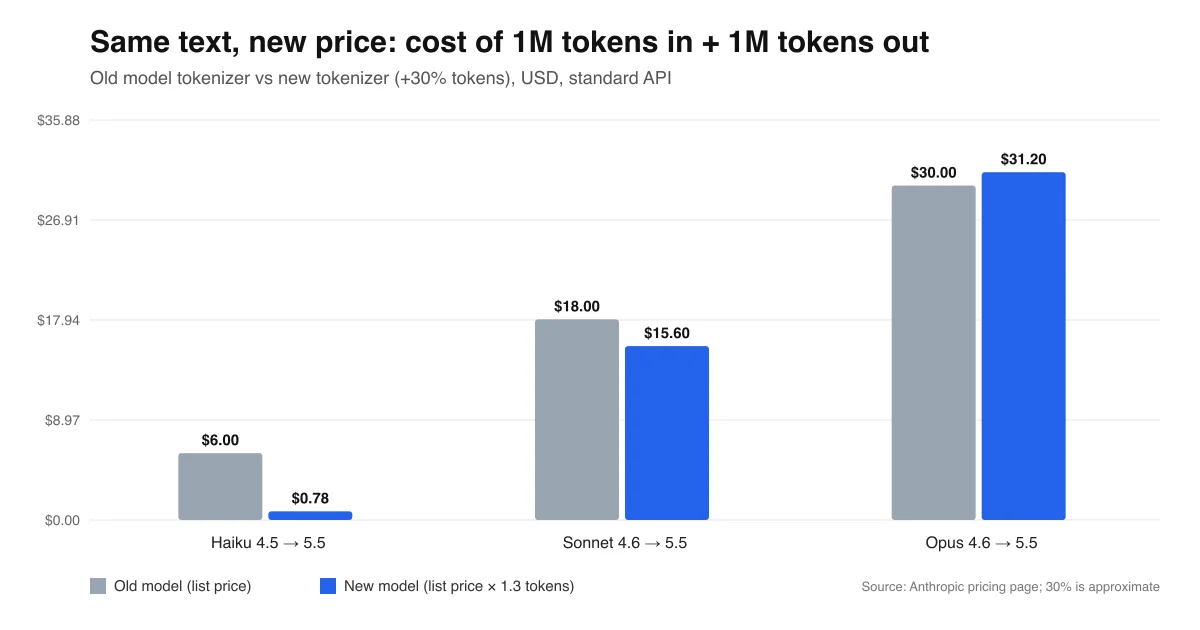
The table shows the same numbers with the list prices that produce them. All list prices come from Anthropic's pricing page and are in US dollars per million tokens, input then output.
| Model pair | Old list price | New list price | Old cost, 1M in + 1M out | New cost with 1.3x tokens | Change |
|---|---|---|---|---|---|
| Haiku 4.5 to Haiku 5.5 | $1 / $5 | $0.10 / $0.50 | $6.00 | $0.78 | about -87% |
| Sonnet 4.6 to Sonnet 5.5 | $3 / $15 | $2 / $10 | $18.00 | $15.60 | about -13% |
| Opus 4.6 to Opus 5.5 | $5 / $25 | $4 / $20 | $30.00 | $31.20 | about +4% |
Two cautions apply. The Haiku 5.5 price shown is the tier for prompts up to 100,000 tokens, and the pricing page lists a higher tier of $0.50 and $2.50 for prompts above that size. The 30% figure is also an average, so a code-heavy or non-English workload can land above or below it.
What does this look like on a real monthly bill?
Take a support assistant that sends 50 million input tokens and generates 10 million output tokens a month, counted on the old tokenizer. After the move, the same traffic becomes about 65 million input and 13 million output tokens, using the 30% figure from Anthropic's pricing page. Here is the monthly cost before and after, at list price with no caching or batch discount.
Advertisement
| Move | Old monthly cost | New monthly cost | Change |
|---|---|---|---|
| Haiku 4.5 to Haiku 5.5 | $100 | $13 | about -87% |
| Sonnet 4.6 to Sonnet 5.5 | $300 | $260 | about -13% |
| Opus 4.6 to Opus 5.5 | $500 | $520 | about +4% |
The Sonnet row works like this. Before: 50 million input tokens at $3 per million is $150, and 10 million output tokens at $15 per million is $150, for $300. After: 65 million at $2 is $130, and 13 million at $10 is $130, for $260. The Opus row follows the same steps with $5 and $25 before, and $4 and $20 after.
Output-heavy workloads shift the balance, because output tokens cost five times the input price on every model here. If your traffic is mostly generation, such as long reports or translation, the extra 30% lands on the expensive side of the bill. Run the same arithmetic with your own input and output split before you decide.
What if you are already on Opus 4.7 or later?
Then the tokenizer change is behind you, and only the list price matters. Opus 5.5 is priced at $4 per million input tokens and $20 per million output tokens, while Opus 5, Opus 4.8 and Opus 4.7 are all $5 and $25, according to the pricing page.
That makes Opus 5.5 about 20% cheaper than Opus 5 for identical text, since both use the same tokenizer. Our arithmetic is $24 against $30 for one million tokens each way. If you run Opus 5 today, the move to Opus 5.5 is a straight saving with no tokenizer penalty.
How much text fits in a million tokens now?
Less than it used to. Anthropic's model overview says 1M tokens is roughly 555,000 words on the current tokenizer, while models before Opus 4.7 fit about 750,000 words. It also says 200,000 tokens is roughly 150,000 words.
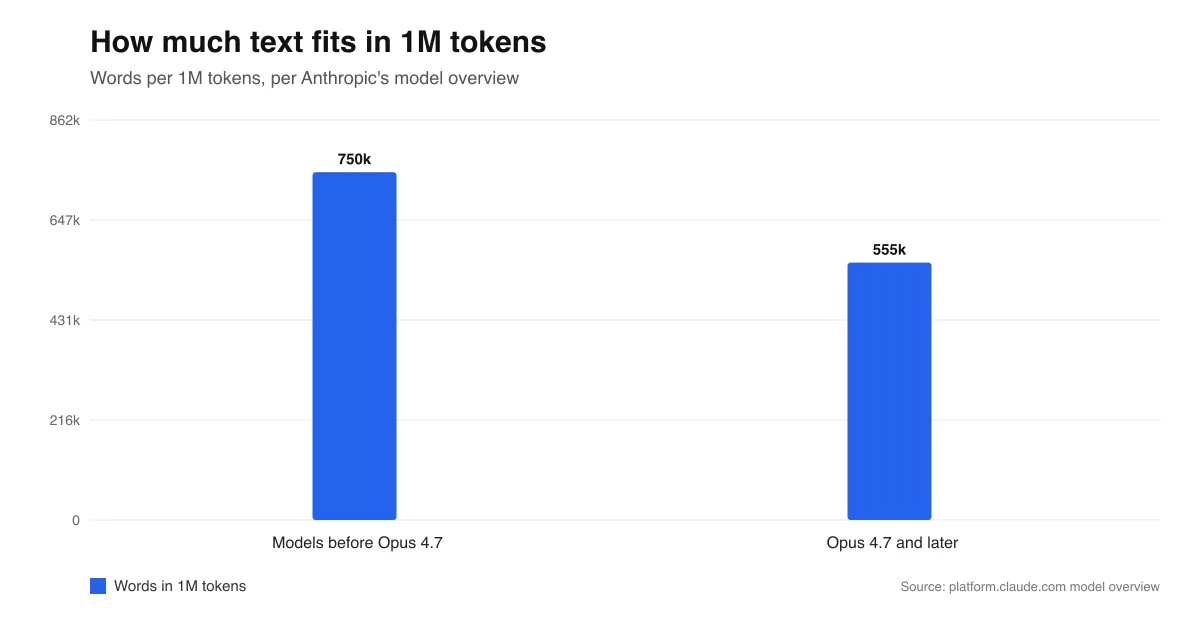
The context window itself did not shrink. Claude Sonnet 5.5, Opus 5.5, Fable 5.1 and Haiku 5.5 all list a 1M-token context window and a 128K-token maximum output, per the overview. The window holds fewer words, which matters for long documents, codebases and chat histories.
Our arithmetic from those two numbers shows a drop of about 26% in words per window (555 divided by 750). The same arithmetic shows about 35% more tokens per word (750 divided by 555). Anthropic's rounder figure is 30%, which sits between the two measures.
Why would an output limit suddenly truncate replies?
A reply that fit under your old max_tokens can now need more tokens, because the same words cost about 30% more. If you set max_tokens close to the old length, the model stops mid-answer. Recount a sample of your real outputs on the new model and leave headroom.
For example, a summary that used 800 tokens on Sonnet 4.6 may need about 1,040 on Sonnet 5.5. A limit of 1,000 would cut it off. This is our inference from the 30% figure, not a documented failure mode, so test your own prompts.
How do you measure your own increase?
Count the same request on both models and compare. The token counting endpoint is free, but it has separate rate limits of 5,000 requests per minute on the Start tier, 10,000 on Build and 20,000 on Scale, according to Anthropic. The count is an estimate, and it can differ by a small amount from the tokens billed.
Here is the request from Anthropic's docs, with the model ID as a variable so you can run it twice:
curl https://api.anthropic.com/v1/messages/count_tokens \
  -H "x-api-key: $ANTHROPIC_API_KEY" \
  -H "content-type: application/json" \
  -H "anthropic-version: 2023-06-01" \
  -d '{
    "model": "'"$MODEL"'",
    "messages": [{"role": "user", "content": "Paste a real prompt here"}]
  }'
The response is a small JSON object such as { "input_tokens": 14 }. Run it once with your current model ID and once with claude-opus-5-5 or the model you plan to use. Divide the second count by the first to get your own multiplier.
Count at least 100 real prompts, not one sample. Weight the result by how often each prompt type runs, then plug your multiplier into the table above in place of 1.3.
How do caching and batch discounts change the math?
They shrink the bill a lot, and the newest models discount cached input the most. On Claude Sonnet 5.5 and Claude Opus 5.5, a cache hit costs 0.05 times the base input price, according to the pricing page. That is $0.10 per million tokens on Sonnet 5.5 and $0.20 on Opus 5.5.
On Claude Fable 5.1 the cache hit multiplier is 0.025, and the other models use the standard 0.1. The Batch API takes 50% off both input and output tokens, so a job that does not need an instant reply costs half as much. Batch discounts stack with the other pricing modifiers, per the same page.
Cached tokens still count under the new tokenizer, so a 30% longer prompt means 30% more cached tokens. Because cache reads are so cheap, the inflation costs little on a heavily cached workload. A support bot with a large fixed system prompt feels the change far less than a tool that sends fresh text each time.
What other pricing news came with these models?
Several changes landed around the same time, and they affect the decision more than the tokenizer does.
- The Sonnet 5 price rise was cancelled. A scheduled increase to $3 and $15 on September 1, 2026 did not happen. Sonnet 5 stays at $2 and $10, according to Anthropic's docs.
- Sonnet 5 is now a legacy model. It launched on June 30, 2026 and is not retiring before June 30, 2027, but Anthropic recommends Sonnet 5.5, which has the same $2 and $10 price.
- Opus 5.5 is cheaper than Opus 5. The new Opus lists $4 and $20 against $5 and $25.
- Haiku 5.5 has a two-tier price. Prompts up to 100,000 tokens cost $0.10 and $0.50, and longer prompts cost $0.50 and $2.50.
- US-only inference costs more. Setting
inference_geoto"us"on Claude 4.6 and later models applies a 1.1x multiplier to every price category, per the pricing page.
The last point matters to buyers with data-residency needs. A US-only deployment of Sonnet 5.5 at 1.1 times the base price costs $2.20 and $11 per million tokens. Add the 30% token effect and the same text costs about 43% more than the old tokenizer would have at base price, by our arithmetic (1.1 times 1.3).
Which Claude model should you pick now?
Use the same-text cost as the tiebreaker, then check quality on your own tasks. The numbers favor the newer Sonnet and Haiku models, and they favor Opus 5.5 over Opus 5. Here is how that plays out.
- You run Haiku 4.5. Move to Haiku 5.5 after a quality test. The cost falls by about 87% even with the extra tokens, so only a quality regression should stop you.
- You run Sonnet 4.6. Move to Sonnet 5.5. You save about 13% on identical text and get the current model.
- You run Opus 4.6. The move costs about 4% more per same-text workload, so move for quality gains, not savings.
- You run Opus 5 or 4.8. Move to Opus 5.5 for a straight 20% saving on identical tokens.
- Your prompts are mostly cached. The inflation hardly matters. Check your cache hit rate first.
Remember that price is not quality. We did not test output quality here, only cost, so run your own evaluation before you switch a production workload.
Does language change the 30%?
Yes, probably. Anthropic says the increase depends on content, and a separate measurement shows tokenizers treat languages very differently. Our test of OpenAI's tokenizers found that German needs about 18% more tokens than English, and Hindi about 54% more, on the newer GPT-4o encoding. See our measurement in the post on LLM token cost by language.
A research paper on Indian languages, The Tokenizer Tax, reports an average of 8.0 times English on OpenAI's older tokenizer. Anthropic does not publish per-language ratios, so a team serving Polish or Hindi should count its own text. Do not assume the 30% applies to your language.
Advertisement
FAQ
Does Claude Sonnet 5.5 cost more than Sonnet 4.6?
No, for most workloads. Sonnet 5.5 lists $2 and $10 per million tokens against $3 and $15 for Sonnet 4.6. Even with about 30% more tokens for the same text, our estimate is about 13% cheaper for equal input and output.
How many more tokens does the new Claude tokenizer use?
Approximately 30% more tokens for the same text, according to Anthropic's pricing page. The exact increase depends on the content and workload shape, so count your own prompts with the token counting endpoint before you budget.
Is Claude token counting free?
Yes. Anthropic says token counting is free, with separate rate limits of 5,000, 10,000 and 20,000 requests per minute on the Start, Build and Scale tiers. It returns an estimate that can differ slightly from the billed count.
Which Claude models share the newer tokenizer?
Claude Opus 4.7 and later models use it, including Opus 5.5, Fable 5.1 and Mythos 5.1, according to Anthropic. Sonnet 4.6 and earlier models use the previous tokenizer, so a move from Sonnet 4.6 changes your token counts.
Is Claude Opus 5.5 cheaper than Opus 5?
Yes. Opus 5.5 lists $4 per million input tokens and $20 per million output tokens. Opus 5 lists $5 and $25. Both use the same tokenizer, so the saving is about 20% on identical text.
Comments
Loading…
Sign in to join the conversation.
Related posts
LLM token cost by language: we measured 14 of them
LLM token cost by language, measured: the same sentences cost 7% to 54% more tokens in German, Polish or Hindi than in English on GPT-4o's tokenizer.
Wed Oct 14 2026 · 9 min read · 0 views

EU AI Act Article 50: what chatbots must disclose now
EU AI Act Article 50 chatbot disclosure requirement, in force since 2 August 2026: what it covers, what the Digital Omnibus delayed, and the fines.
Wed Oct 14 2026 · 9 min read · 0 views
Translating a 100,000-word book with Claude: what it costs
Translating 100,000 English words into German costs about $2.49 on Claude Sonnet 5.5, $0.12 on Haiku 5.5 and $4.97 on Opus 5.5, by our estimate.
Wed Oct 14 2026 · 9 min read · 0 views