EU AI Act Article 50: what chatbots must disclose now
By Nihar Ranjan Das · Wed Oct 14 2026 · 9 min read · 0 views
View as a Web StoryAI#eu ai act#article 50#chatbots#compliance#transparency
Do EU chatbot disclosure rules apply now?
Yes. The AI Act's Article 50 transparency duties have applied since 2 August 2026, and the Digital Omnibus did not postpone them. If your chatbot talks to people in the EU, those people must be clearly told they are dealing with an AI system, unless that is obvious from context. This article is an explainer, not legal advice.
The EU AI Act is the European Union regulation that sets risk-based rules for artificial intelligence systems. Article 50 is the part of it that covers transparency: telling people when they talk to an AI and marking AI-generated content.
What does Article 50 require?
Article 50 contains three duties that matter to most product teams, according to Goodwin's client alert:
- Chatbots and virtual assistants: providers must ensure people are "clearly informed they are dealing with an AI system," unless this is obvious from context.
- Synthetic content: providers and deployers must mark audio, image, video and text outputs in a machine-readable, detectable format. Deployers must also disclose deepfakes that depict real persons, places or events.
- Emotion recognition and biometric categorisation: deployers must inform exposed individuals how the system operates and process personal data under EU data protection law.
The same alert assigns the chatbot duty to providers, the deepfake disclosure duty to deployers, and the marking duty to both. A provider is the company that builds or places an AI system on the market, and a deployer is the company that uses it. A company that builds a support bot and offers it to EU customers is likely its provider.
What did the Digital Omnibus actually delay?
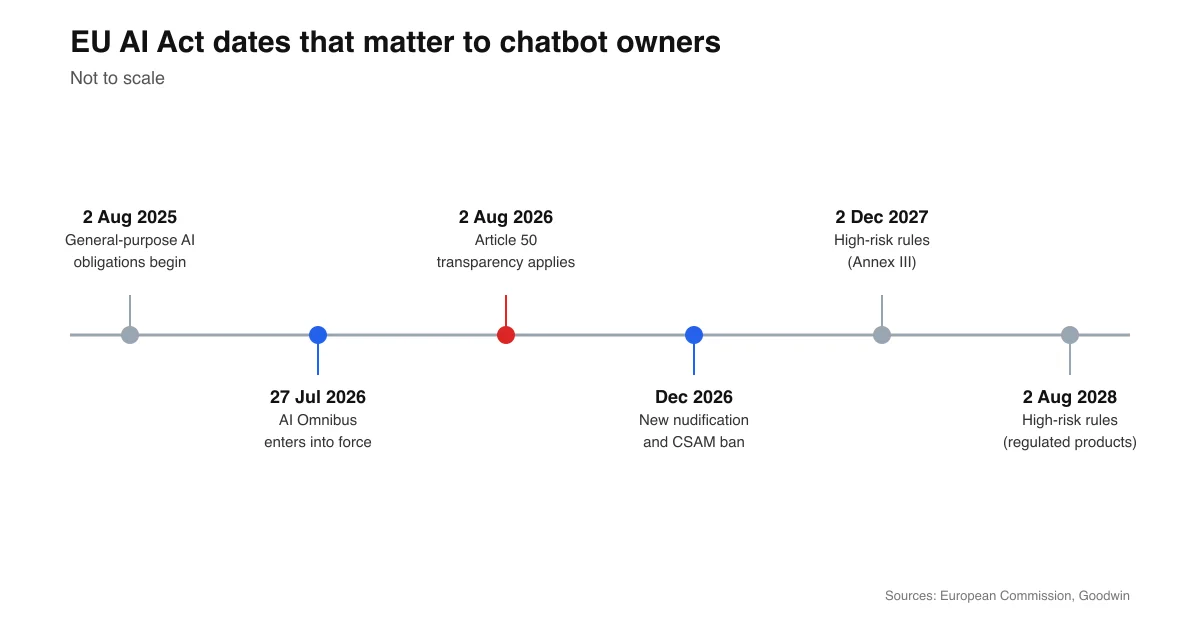
The Digital Omnibus delayed the high-risk rules, to 2 December 2027 for Annex III uses and 2 August 2028 for embedded products per the Commission's high-risk dates, and gave older generative systems extra time to mark their output. It did not delay chatbot disclosure. The Digital Omnibus on AI, formally Regulation (EU) 2026/1744, entered into force on 27 July 2026, according to the European Commission's AI Act page.
The table below combines the Commission's timeline with the Goodwin alert. Each row shows what applies and when.
| Date | What applies | Source |
|---|---|---|
| 2 August 2025 | General-purpose AI model obligations begin | European Commission |
| 27 July 2026 | AI Omnibus enters into force | European Commission |
| 2 August 2026 | Article 50 transparency duties apply, including chatbot disclosure | Goodwin, Gornitzky |
| December 2026 | New ban on nudification and child abuse material generators | European Commission |
| 2 December 2027 | High-risk rules for Annex III uses such as employment and education | European Commission |
| 2 August 2028 | High-risk rules for AI embedded in regulated products | European Commission |
Which marking deadline is right for older generative systems?
Sources disagree, and this is the one date to verify against the official text. Goodwin says providers of generative systems already on the market before 2 August 2026 must meet the marking duty by 2 December 2026. The law firm Gornitzky says the Omnibus gives those legacy systems until 2 December 2027 to meet the output detection and marking requirement.
Both agree on the core point, as Gornitzky's Omnibus update confirms: the duty to tell people they are interacting with an AI system applies from 2 August 2026, including for systems already on the market. Only the marking of generated content has a grace period. If you ship a text or image generator that predates August 2026, read the Omnibus text itself before you rely on either date.
What are the penalties?
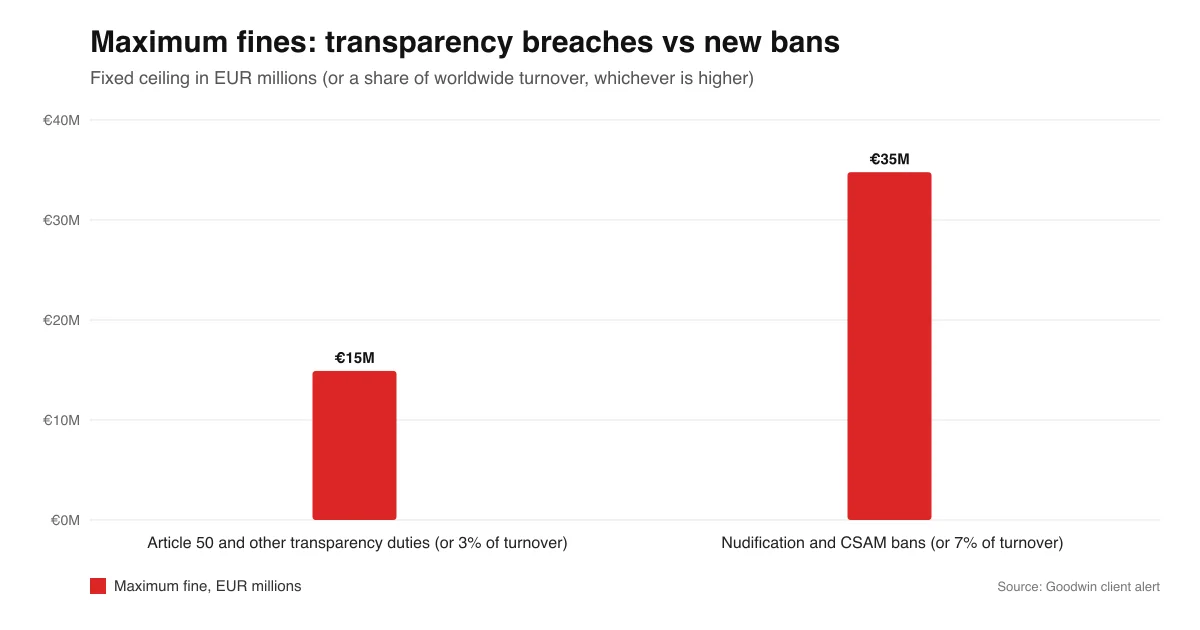
Breaches of Article 50 and other transparency duties carry fines up to €15 million or 3% of worldwide annual turnover, whichever is higher, according to Goodwin's penalties summary. The new prohibition on nudification and child abuse material generators carries a higher ceiling of €35 million or 7% of worldwide turnover.
Advertisement
Enforcement runs through the AI Office and member-state authorities. The Commission's application timeline says both took on implementation, supervision and enforcement duties from 2 August 2026. The Commission also adopted its transparency guidelines on 20 July 2026, according to Goodwin's timeline.
What counts as "obvious from context"?
The chatbot duty has one built-in exception: disclosure is not needed when it is obvious from context that the user is dealing with an AI system. Goodwin's alert states this exception in the same sentence as the duty. The sources we read do not define "obvious", so treat the exception narrowly.
A site that brands its widget "AI Assistant" and opens with a robot avatar is closer to obvious than one that names the bot "Anna" and writes in a casual human tone. A voice agent on a phone line is harder to judge, because a caller cannot see a label. When in doubt, say it out loud at the start of the call.
Here are three plain-language opening lines that make the status clear without legal wording:
- "You are chatting with an AI assistant. A person can join if you ask."
- "This is an automated assistant powered by AI."
- "I'm an AI. I can answer questions about your order."
These are examples, not approved compliance text. The Commission adopted transparency guidelines on 20 July 2026, according to Goodwin, so read those before finalizing wording.
Who counts as a provider and who counts as a deployer?
The two roles carry different duties, and one company can hold both. A provider builds an AI system or places it on the market. A deployer uses an AI system under its own authority. The table shows how Goodwin's alert assigns the Article 50 duties.
| Duty | Provider | Deployer |
|---|---|---|
| Tell people they are dealing with an AI system (chatbots) | Yes | Not assigned in the alert |
| Mark synthetic audio, image, video and text in machine-readable form | Yes | Yes |
| Disclose deepfakes of real persons, places or events | Not assigned in the alert | Yes |
| Inform people exposed to emotion recognition or biometric categorisation | Not assigned in the alert | Yes |
A business that licenses a model from a vendor and wraps it in its own support chat is probably a deployer of the model and the provider of the chat product. Which role applies depends on the facts, so this is one for counsel.
What else did the Digital Omnibus change?
The Omnibus did more than delay dates, and several changes help small teams. All of the following come from Goodwin's client alert, and the Commission's page confirms the dates and the main additions.
- AI literacy (Article 4). The duty shifted from requiring a sufficient level of literacy to requiring measures that support its development.
- EU database registration. The information required for systems assessed as not high-risk was reduced.
- Post-market monitoring. The mandatory Commission template for high-risk providers was removed.
- Small mid-caps. Simplified measures now extend to a new "small mid-cap" category.
- Sandboxes. National regulatory sandboxes expanded, and an EU-level sandbox was added.
- Bias detection. The legal basis for processing special category data to detect bias was broadened to deployers and to providers of other AI systems and models.
- Governance. The AI Office now holds direct supervisory authority over general-purpose AI-based systems and AI features in designated very large online platforms and search engines.
The Commission's AI Act page lists the Omnibus milestones: adopted 19 November 2025, political agreement on 7 May 2026, and entry into force on 27 July 2026.
What is the new nudification and child abuse material ban?
The Omnibus added a ninth prohibited practice. It bans AI systems that generate or manipulate non-consensual intimate material depicting identifiable people, often called nudification apps, and systems that generate child sexual abuse material. The Commission's page says this prohibition takes effect in December 2026.
Goodwin adds that the new ban carries the higher fine tier, up to €35 million or 7% of worldwide turnover, whichever is higher. Transparency breaches sit in the lower tier of €15 million or 3%. This is relevant to any team that ships an image or video generator, even if it never builds a chatbot.
What mistakes are teams making?
Several wrong assumptions are circulating, and each leads to either wasted work or a gap. Here are the five most common ones, based on the sources above.
- "The whole AI Act was delayed." Only the high-risk rules moved, to 2 December 2027 and 2 August 2028. Article 50 did not.
- "Our bot is obviously a bot." The exception turns on context, and a human-sounding persona weakens it.
- "A footer link is enough." The duty is to inform people clearly, and a notice buried in a footer is hard to defend. Put the notice where the conversation starts.
- "Only chatbots are covered." Article 50 also covers synthetic audio, image, video and text outputs, plus deepfakes and emotion recognition.
- "We launched before August, so we are exempt." Both law firms say the chatbot disclosure duty applies to legacy systems too. Only the marking duty has a grace period, and the date is disputed.
What other AI news matters alongside this?
Two other stories help put the rules in context for anyone shipping language features. Both appeared in the last few months.
- Translation tools are going real-time. DeepL Voice launched on April 16, 2026, and its API targets customer-facing uses such as contact centers, according to DeepL. See our comparison, "AirPods Live Translation vs Google Translate vs DeepL Voice," for the details.
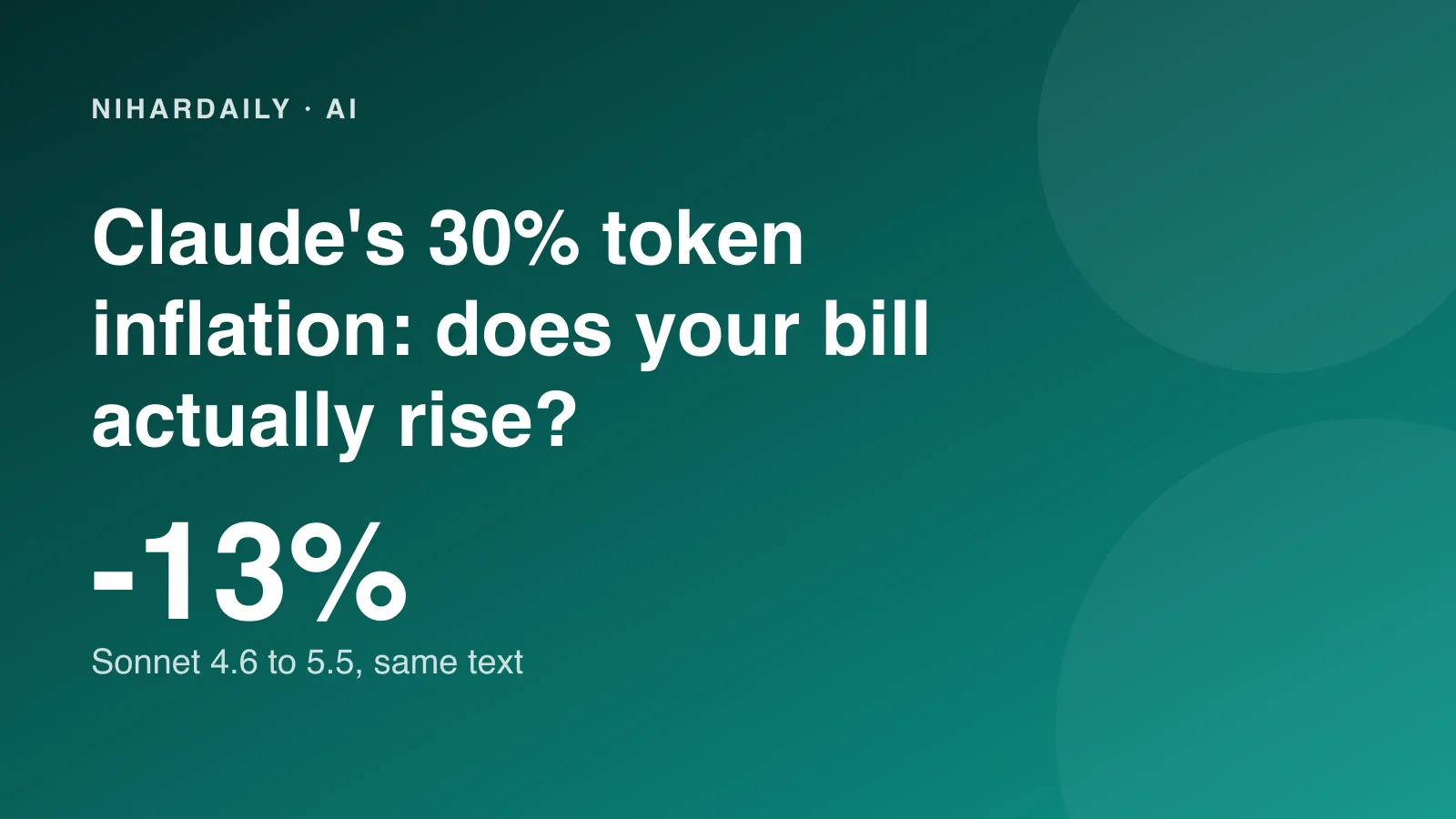
- Claude's tokenizer made text longer. Anthropic's pricing page says newer Claude models produce approximately 30% more tokens for the same text. See "Claude's 30% token inflation: does your bill actually rise?" for the bill math.
If your product translates speech or text for EU users, check whether your tooling marks synthetic output. Article 50's marking duty includes text, per Goodwin's alert.
What should you do next?
Do the cheap thing now and the careful thing this quarter. The cheap thing is a visible AI notice on every chatbot. The careful thing is an inventory and a legal read of your marking duties.
- This week: add an AI notice to each chatbot and voice agent that EU users can reach.
- This month: list every generator of audio, image, video or text, and note when each was first marketed.
- This quarter: read the Commission's transparency guidelines and the Omnibus text, and settle the legacy marking date with counsel.
- Ongoing: watch for the December 2026 prohibition and the 2027 high-risk dates if you build anything in employment or education.
What should a team with a chatbot do this week?
Start with the cheapest fix: a visible line at the start of every conversation. Consider a short banner such as "You are chatting with an AI assistant" above the first message. That is a reasonable first step, because the user is told before the first reply.
Then work through this list:
- List every chatbot, voice agent or assistant that EU users can reach.
- Add a clear AI notice at the start of each one, unless the context already makes it obvious.
- Check whether you generate audio, images, video or text that needs machine-readable marking.
- Confirm whether any of your generative systems predate 2 August 2026, and verify the grace-period date.
- Ask counsel about emotion recognition or biometric features before you ship them in the EU.
Advertisement
FAQ
Is the EU AI Act chatbot disclosure rule in force?
Yes. Article 50 transparency duties have applied since 2 August 2026, including the duty to clearly tell people they are dealing with an AI system. The Digital Omnibus, which entered into force on 27 July 2026, did not change that date.
What did the Digital Omnibus delay?
The Digital Omnibus delayed high-risk AI rules to 2 December 2027 for Annex III uses and 2 August 2028 for AI in regulated products. It also gave some legacy generative systems extra time to mark their output. Chatbot disclosure was not delayed.
Does Article 50 apply to US companies?
The sources we read do not spell out territorial scope. They say the duties fall on providers and deployers of AI systems, so a US company whose chatbot reaches EU users should ask counsel whether it is in scope. This article is not legal advice.
How big are the fines for breaking Article 50?
Up to €15 million or 3% of worldwide annual turnover, whichever is higher, according to Goodwin. The higher €35 million or 7% ceiling applies to the new nudification and child abuse material prohibitions, not to chatbot disclosure.
Comments
Loading…
Sign in to join the conversation.
Related posts
LLM token cost by language: we measured 14 of them
LLM token cost by language, measured: the same sentences cost 7% to 54% more tokens in German, Polish or Hindi than in English on GPT-4o's tokenizer.
Wed Oct 14 2026 · 9 min read · 0 views
Claude's 30% token inflation: does your bill actually rise?
Claude's newer tokenizer makes the same text about 30% longer in tokens. We priced it model by model: Haiku and Sonnet get cheaper, Opus about 4% dearer.
Wed Oct 14 2026 · 9 min read · 0 views
Translating a 100,000-word book with Claude: what it costs
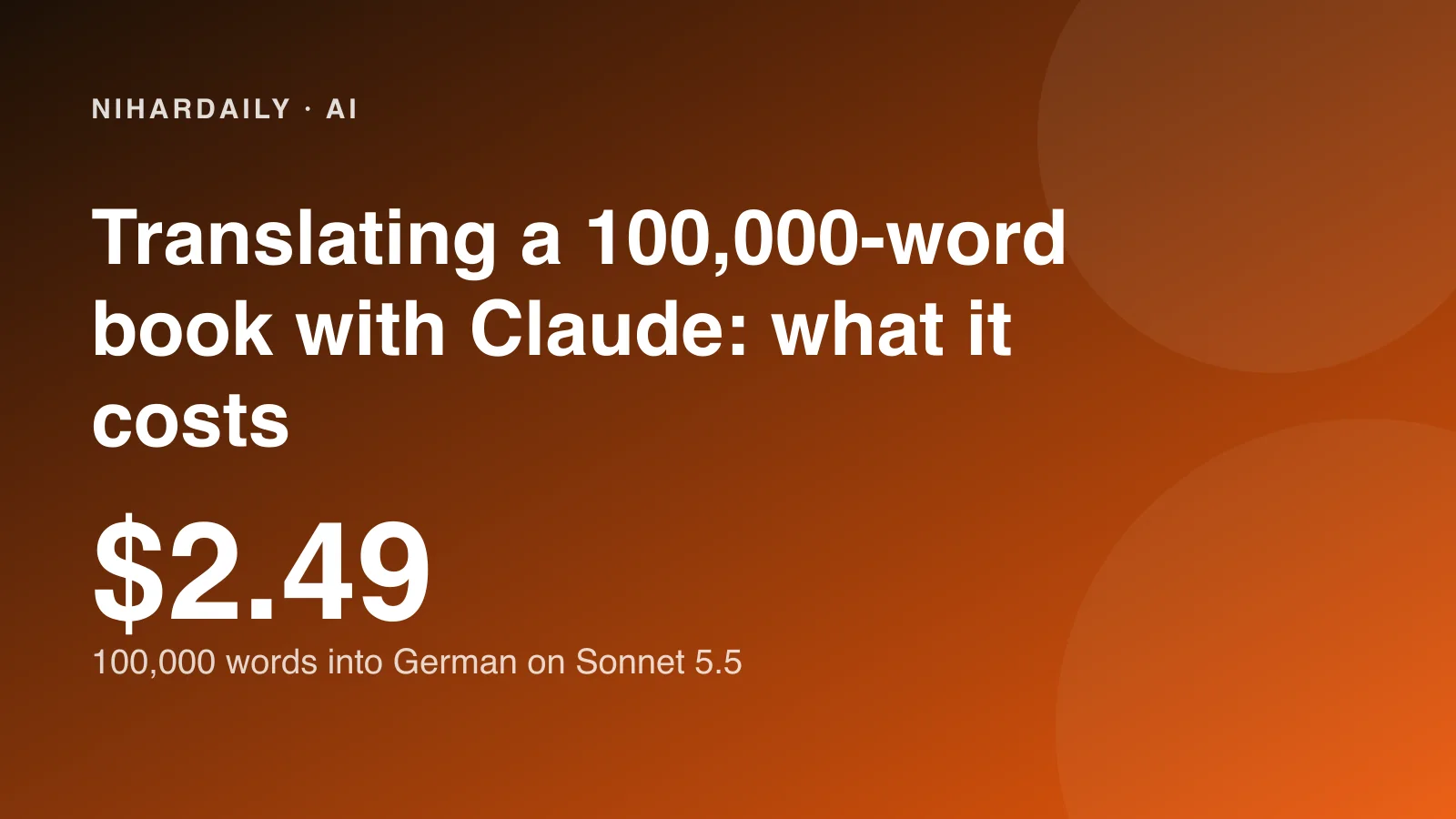
Translating 100,000 English words into German costs about $2.49 on Claude Sonnet 5.5, $0.12 on Haiku 5.5 and $4.97 on Opus 5.5, by our estimate.
Wed Oct 14 2026 · 9 min read · 0 views