Translating a 100,000-word book with Claude: what it costs
By Nihar Ranjan Das · Wed Oct 14 2026 · 9 min read · 0 views
View as a Web StoryAI#claude#api pricing#multilingual#translation#localization
How much does it cost to translate a book with Claude?
For a 100,000-word English book translated into German, we estimate $2.49 on Claude Sonnet 5.5, $4.97 on Claude Opus 5.5 and $12.43 on Claude Fable 5.1. Claude Haiku 5.5 comes to about $0.12 if you keep each request under 100,000 tokens. The Batch API halves any of those figures.
These are estimates, not quotes. They cover input and output tokens at list price and nothing else. They leave out your instructions, glossary, retries and any review pass, so budget a margin on top. Cost also says nothing about translation quality, which we did not test.
How did we estimate the cost?
We converted words to tokens, priced them, and scaled the output by language. Each step uses a published or measured number, so you can redo the math with your own.
A token is the unit of text a model reads and bills for, usually a short word or a piece of one. Anthropic's Claude Sonnet 5 overview says 1M tokens is roughly 555,000 words on the current tokenizer. A 100,000-word book therefore needs about 180,180 input tokens (100,000 times 1,000,000 divided by 555,000).
For the output we scaled by language. In our measured test of 14 languages, German needed about 1.18 times the English token count on OpenAI's o200k_base tokenizer. We applied that ratio to Claude's token count as a stand-in. Anthropic does not publish per-language ratios, so the output side is the least certain part of this estimate.
Prices come from Anthropic's pricing page, in US dollars per million tokens, input then output:
| Model | Input | Output |
|---|---|---|
| Claude Haiku 5.5 (prompts up to 100,000 tokens) | $0.10 | $0.50 |
| Claude Sonnet 5.5 | $2 | $10 |
| Claude Opus 5.5 | $4 | $20 |
| Claude Fable 5.1 | $10 | $50 |
For example, the Sonnet 5.5 job into German is 180,180 input tokens at $2 per million, which is $0.36. Output is about 212,613 tokens at $10 per million, which is $2.13. The total is $2.49.
What does the cost look like across models?
The next chart shows the German job on each model, standard and batch. Haiku 5.5 is so cheap that its bar is barely visible, and Fable 5.1 costs about five times as much as Sonnet 5.5.
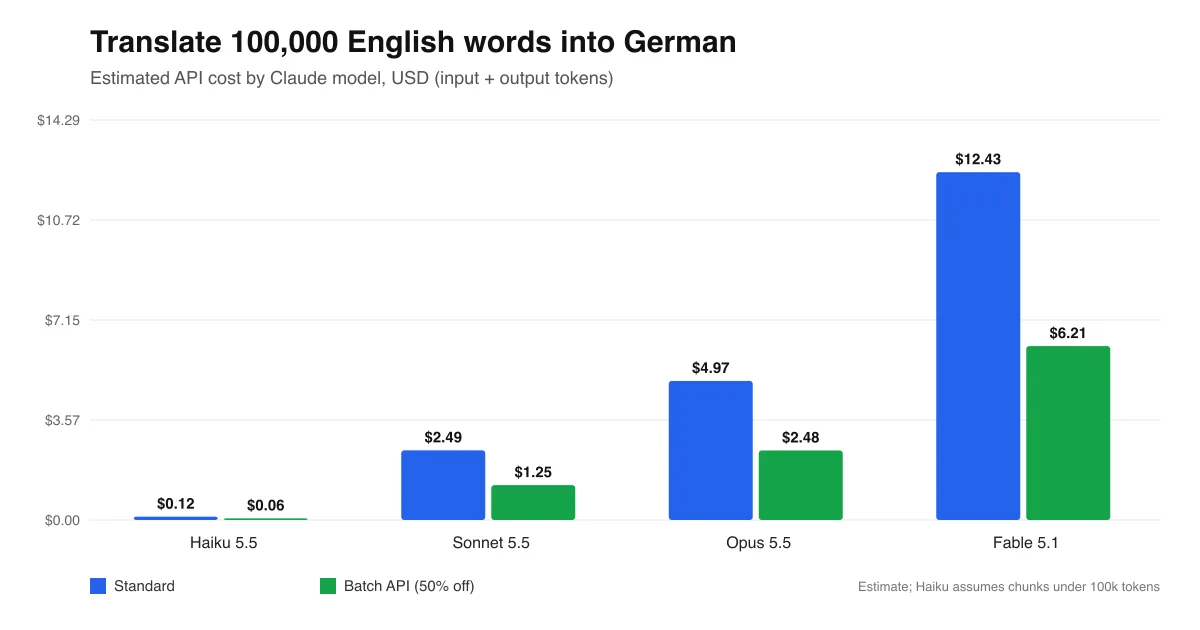
The Batch API gives a 50% discount on input and output tokens, per the pricing page. That makes the Sonnet 5.5 German job about $1.25 and the Opus 5.5 job about $2.49. Batch work finishes asynchronously, so it suits a book you do not need back in the next minute.
Advertisement
Does the target language change the price?
Yes, because languages split into different numbers of tokens. A language that needs more tokens per sentence costs more on the output side, even when the source text is identical. Our test measured that spread on OpenAI's tokenizer, and it is the best proxy we have. A separate study, The Tokenizer Tax on arXiv, found the gap can be far larger for Indian languages on older tokenizers.
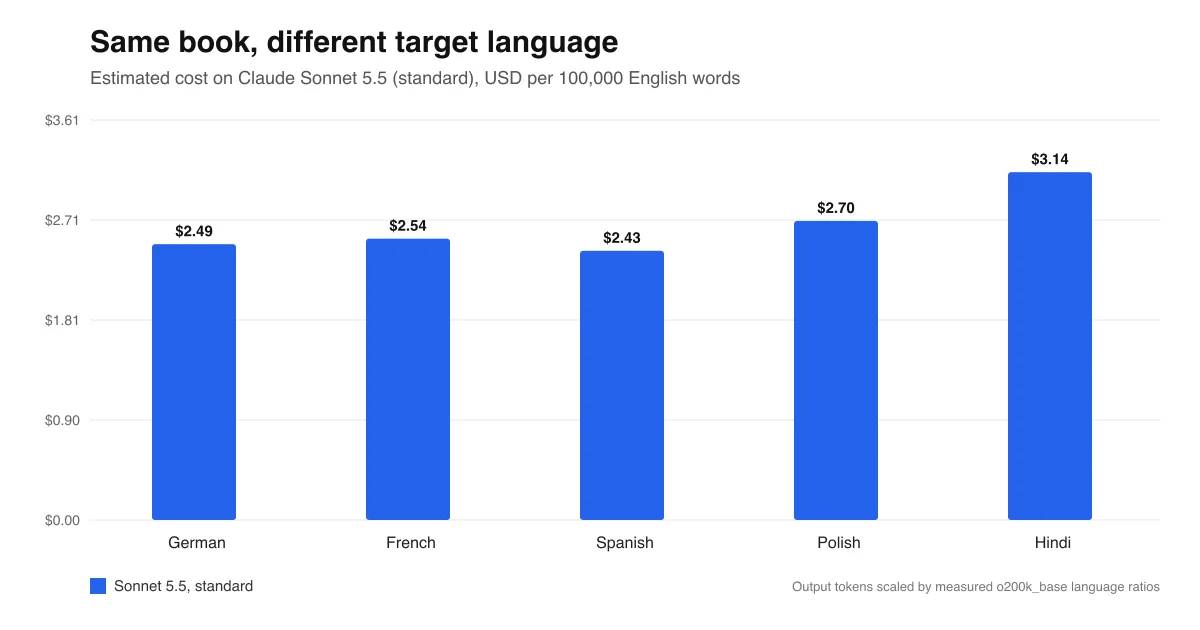
This table gives the full estimate for five target languages, in US dollars per 100,000 English words, at standard prices:
| Target language | Token ratio vs English | Haiku 5.5 | Sonnet 5.5 | Opus 5.5 | Fable 5.1 |
|---|---|---|---|---|---|
| Spanish | 1.15 | $0.12 | $2.43 | $4.86 | $12.16 |
| German | 1.18 | $0.12 | $2.49 | $4.97 | $12.43 |
| French | 1.21 | $0.13 | $2.54 | $5.08 | $12.70 |
| Polish | 1.30 | $0.14 | $2.70 | $5.41 | $13.51 |
| Hindi | 1.54 | $0.16 | $3.14 | $6.27 | $15.68 |
The spread inside one model is about 29% from Spanish to Hindi. The spread between Sonnet 5.5 and Opus 5.5 is 100%. For a European or Indian-language book, the model tier moves the bill more than the language does, but the language still adds a real surcharge.
Can you send the whole book in one request?
No. Claude Sonnet 5.5, Opus 5.5, Fable 5.1 and Haiku 5.5 each list a 128K-token maximum output, according to the overview. Our German output is about 212,613 tokens, well above that limit. Split the book into chunks.
Chunking also protects your budget on Haiku 5.5. The pricing page lists a higher tier of $0.50 and $2.50 per million tokens for Haiku prompts over 100,000 tokens. A whole-book prompt of about 180,180 tokens would fall in that tier and cost five times more on input.
A practical plan looks like this:
- Split the book by chapter or by section, aiming for 3,000 to 5,000 words per request.
- Put your glossary, style guide and instructions in a fixed system prompt.
- Send each chunk with the same system prompt, so the prefix can be cached.
- Collect the outputs in order and run a consistency pass for names and terms.
At 4,000 words per chunk, the book is 25 requests. Each request carries about 7,200 input tokens and returns about 8,500 output tokens in German, far inside every limit.
How much can prompt caching save on a glossary?
A lot, if the glossary is long. Prompt caching lets you pay a small fraction of the input price for a prefix that repeats. On Claude Sonnet 5.5 and Opus 5.5, a cache hit costs 0.05 times the base input price, according to the pricing page. That is $0.10 per million tokens on Sonnet 5.5.
Consider a 5,000-token glossary repeated across 25 requests. Uncached, that is 125,000 input tokens, or $0.25 on Sonnet 5.5. With caching, the first request writes the cache and the other 24 read it at $0.10 per million, so the repeated part costs only a few cents. The saving is small on a $2.49 job, but it grows with longer style guides and bigger books.
Cache writes cost more than base input. On Sonnet 5.5, a five-minute cache write is $2.50 per million tokens, per the pricing page, against $2 for normal input. Caching only pays off when a prefix is reused soon after it is written.
How does this compare with classic machine translation APIs?
It is cheaper per book than at least one traditional API, though the services are not the same product. Amazon Translate charges $15.00 per million characters for standard text translation, according to AWS's pricing page. Amazon also lists a free tier of 2 million characters per month for 12 months.
English averages about 6.1 characters per word in our UDHR sample (9,888 characters across 1,618 words), so 100,000 words is about 611,000 characters. At $15 per million characters, that is about $9.17. The Sonnet 5.5 German estimate of $2.49 is lower, and Haiku 5.5 is far lower.
Free tiers change the picture for small jobs. Microsoft's Azure pricing page lists a free tier with 2 million characters of translation per month, and DeepL's website lists a free Translator version at 50,000 characters per user per month. A short document costs nothing on those plans, so the cost case for an LLM is strongest on long books and bulk content.
Quality is the other half of the choice. A cheaper price per word is irrelevant if the output needs a heavy rewrite. Run a pilot on three or four chapters, have a native speaker review them, and price the editing time alongside the API bill.
What does this estimate leave out?
Several real costs sit outside the per-word figure, and each is small next to the model tier you choose. Adding them up gives a more honest budget.
- Instruction overhead. A 500-token system prompt repeated across 25 chunks adds 12,500 input tokens, which is about $0.03 on Sonnet 5.5.
- Retries. If 1 chunk in 20 fails a check and runs again, add about 5% to the total.
- A review pass. A second model call that checks terminology and numbers roughly doubles token use for that step. Price it as a second job.
- Human review. Paying a native speaker to review the output usually costs far more than the API bill. Budget for it first.
For a catalogue of 10 such books, 1 million words in total, the German estimate scales to about $24.90 on Sonnet 5.5 at standard prices, or about $12.45 on the Batch API. On Haiku 5.5 the same catalogue is about $1.20. That is roughly $0.025 per 1,000 words on Sonnet 5.5 into German, and the scale is linear, so you can multiply it to any size.
What else is new in AI translation this month?
Translation tools for people on the move also advanced this year, and several matter to European readers. We cover the details in our comparison of AirPods Live Translation, Google Translate and DeepL Voice, and here are the headlines.
- Google Translate headphones reached iPhone. MacRumors reported on March 26, 2026 that Live Translate with headphones works on iPhone, supports more than 70 languages and is free.
- DeepL launched real-time speech translation. According to DeepL's press release, DeepL Voice launched on April 16, 2026 with more than 40 languages, including all 24 official EU languages.
- Apple's AirPods Live Translation reached the EU. It arrived with iOS 26.2 after a delay Apple tied to the Digital Markets Act, per MacRumors.
- The EU's chatbot disclosure rule is live. Article 50 of the AI Act has applied since 2 August 2026. Goodwin's client alert says it also requires machine-readable marking of synthetic outputs, text included.
The EU lists 24 official languages. A publisher that translates into several of them should read the Article 50 marking rules before choosing tooling, and the legacy-system grace period is disputed between law firms.
Should you translate a book with Claude?
Use it for drafts, bulk content and first passes, and keep a human reviewer for anything customers or readers will judge. The cost is low enough that price should not decide the model. Quality should.
Here is a simple decision rule:
- You need speed and nothing is public yet: use Haiku 5.5 in chunks and review the results.
- You want a strong default: use Sonnet 5.5, around $2.49 into German per 100,000 words.
- You publish literary or legal text: test Opus 5.5 on a sample chapter and compare against Sonnet.
- You can wait for results: add the Batch API and halve the bill.
Before you commit, count your own tokens. Anthropic's token counting endpoint is free, and it counts tokens under the tokenizer of the model you pass. Our per-language ratios came from another vendor's tokenizer, so a real count on your own text will replace the weakest number in this estimate.
Advertisement
FAQ
What does a full book translation on Claude cost?
About $2.49 for 100,000 English words into German on Claude Sonnet 5.5 at standard prices, by our estimate. Haiku 5.5 comes to about $0.12 and Opus 5.5 to about $4.97. The Batch API takes 50% off.
Which Claude model is best for translation?
Cost is the easy part: Haiku 5.5 is cheapest and Fable 5.1 is dearest. Quality is a separate question we did not test. Pilot a few chapters on Sonnet 5.5 and Opus 5.5, and have a native speaker compare the results.
Why can't Claude translate a whole book in one request?
Claude's maximum output is 128K tokens, according to Anthropic's model overview. A 100,000-word German translation needs about 212,613 output tokens by our estimate, so the book has to be split into chapters or sections.
Does translating into Hindi or Polish cost more than German?
Yes, by our estimate. On Sonnet 5.5 the same book costs about $2.70 in Polish and $3.14 in Hindi, against $2.49 in German. Languages that need more tokens per sentence cost more on the output side.
Is Claude cheaper than Amazon Translate?
For a full book, our estimate says yes. Amazon Translate lists $15.00 per million characters, which is about $9.17 for 100,000 words, against $2.49 for Sonnet 5.5. The two services differ in features and quality, so compare output as well as price.
Comments
Loading…
Sign in to join the conversation.
Related posts
LLM token cost by language: we measured 14 of them
LLM token cost by language, measured: the same sentences cost 7% to 54% more tokens in German, Polish or Hindi than in English on GPT-4o's tokenizer.
Wed Oct 14 2026 · 9 min read · 0 views
Claude's 30% token inflation: does your bill actually rise?
Claude's newer tokenizer makes the same text about 30% longer in tokens. We priced it model by model: Haiku and Sonnet get cheaper, Opus about 4% dearer.
Wed Oct 14 2026 · 9 min read · 0 views

EU AI Act Article 50: what chatbots must disclose now
EU AI Act Article 50 chatbot disclosure requirement, in force since 2 August 2026: what it covers, what the Digital Omnibus delayed, and the fines.
Wed Oct 14 2026 · 9 min read · 0 views