X API bills per post now. A link costs 13x more.
By Nihar Ranjan Das · Thu Sep 24 2026 · 5 min read · 0 views
View as a Web StorySoftware#x api#twitter api#pay-per-use#api pricing
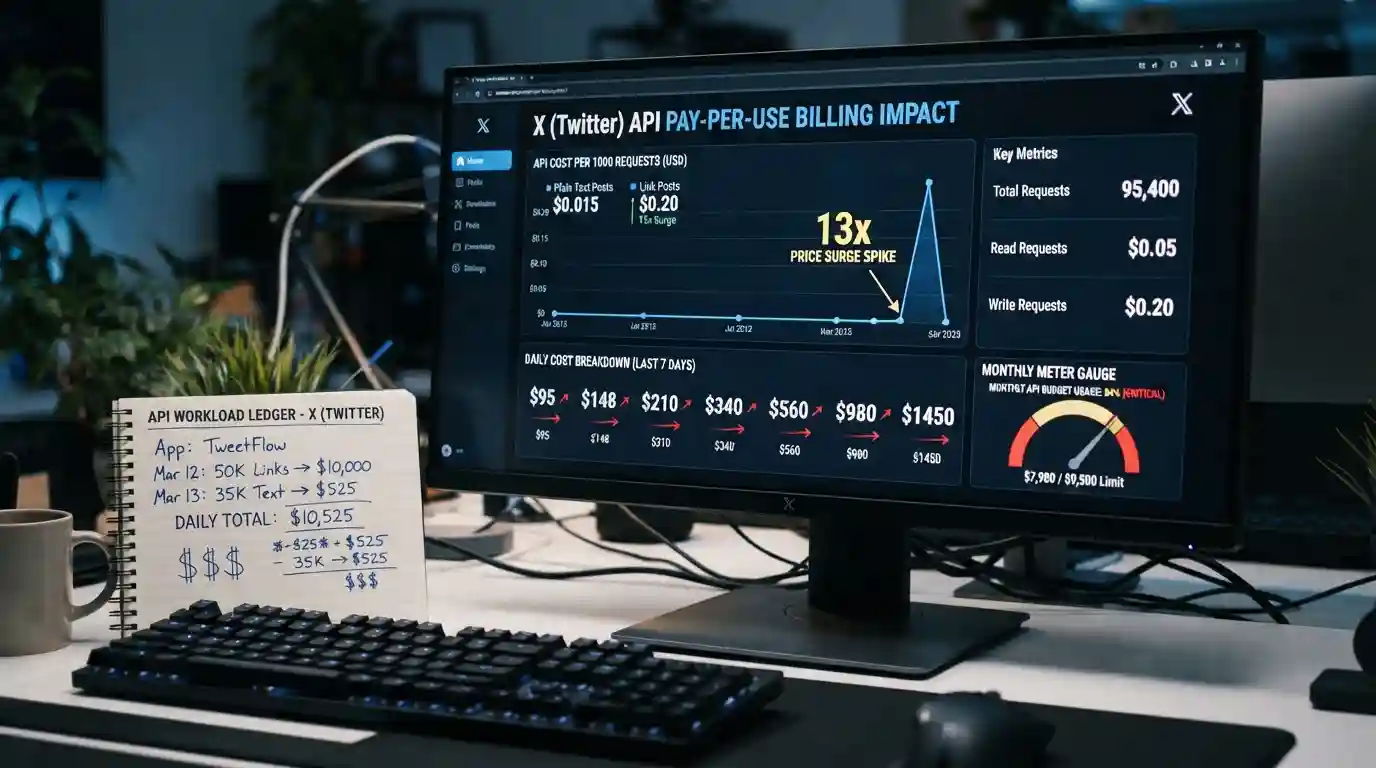
X's API now charges $0.015 for a plain post and $0.20 for a post that contains a link, which makes the link 13 times more expensive than the text around it. If your automation shares URLs, your monthly bill will be far larger than the headline rate suggests, and this guide shows exactly how much larger.
What does the X API cost per action?
The X API is the programming interface that developers use to read and create posts on X, and it is now billed per use. You buy credits in the Developer Console, and X deducts credits for each request, according to the current prices in Outstand's rate guide.
| Action | Price |
|---|---|
| Create a plain post | $0.015 |
| Create a post with a URL | $0.20 |
| Summoned reply | $0.010 |
| Read a post | $0.005 per post returned |
| Read a user | $0.010 per user returned |
| Read your own data | $0.001 per resource |
X Developers announced the change to $0.015 per post and $0.20 for URL posts in a post on X. The same announcement said following, likes and quote-posts via API writes would leave all self-serve tiers. Blotato's pricing guide dates that removal to April 20, 2026. X states its prices are subject to change, and its pay-per-use launch announcement introduced the model, which GIGAZINE's coverage describes as a move away from fixed monthly fees.
Reads are deduplicated within a 24-hour UTC day, according to Outstand, so fetching the same post ten times in a single day costs $0.005 rather than $0.05.
What happened to the Basic and Pro plans?
Both flat plans are deprecated, so no fixed monthly tier remains for self-serve developers. Basic, at $200 a month, moved to pay-per-use from June 1, 2026, following X's Basic migration notice, and Pro, at $5,000 a month, moves after September 1, 2026, according to Outstand and Blotato.
X's Pro migration notice says monthly Pro subscribers receive a $5,000 initial credit and a default $10,000 spend cap per billing cycle, while annual subscribers receive their remaining prorated value as credits instead.
Where does the old plan break even?
Divide the old plan price by the new rate, and the result shows what a legacy plan would have bought at today's prices.
| Old plan | Buys in link posts | Buys in plain posts | Buys in post reads |
|---|---|---|---|
| Basic, $200 | 1,000 | about 13,300 | 40,000 |
| Pro, $5,000 | 25,000 | about 333,300 | 1,000,000 |
These figures are simple division of the plan price by each rate. For example, a Basic user who published fewer than 1,000 link posts a month now pays less than before, while a user who read more than 40,000 posts a month pays more than the old flat fee.
What does real usage cost?
Link posts dominate the bill in almost every workload, such as the four below, which are priced directly from the rate table.
| Workload | Monthly math | Monthly cost |
|---|---|---|
| Founder, 10 plain posts a day | 300 × $0.015 | $4.50 |
| Same founder, every post has a link | 300 × $0.20 | $60.00 |
| Blog auto-poster, 3 link posts a day | 90 × $0.20 | $18.00 |
| Agency, 100 posts a day, half with links | 1,500 × $0.015 + 1,500 × $0.20 | $322.50 |
Blotato's own examples agree with this arithmetic, since it puts a founder posting 10 updates a day at roughly $5 a month and a 20-client agency at about $325.
Advertisement
Consider what happens when a link is added to every post, because it multiplies the same founder's bill by 13, and the agency's $322.50 is almost entirely link cost, because only $22.50 of it pays for the plain posts.
How do you cut the bill?
Start with the largest cost, which is links, because these changes, such as caching and trimming links, reduce spending without breaking your product.
- Count your link posts. Log every create call together with whether it carries a URL, because you cannot manage a cost that you do not measure.
- Drop links where they add nothing. A post that reads well without a URL costs $0.015, while the identical post with a URL costs $0.20.
- Cache reads. Reads are deduplicated per UTC day, but an application cache still protects you from repeated calls and unexpected charges.
- Set a spending cap. Migrated plans carry default caps, so configure a lower limit for each billing cycle to prevent a software bug from running up a large bill overnight.
- Watch the read ceiling. Outstand and Blotato report a limit of 3 million post reads per month for self-serve developers, although one other pricing guide cites 2 million, so confirm the current ceiling in the Developer Console. Beyond the limit you need an Enterprise contract, which Blotato estimates at roughly $42,000 a month.
Should you stay on the X API?
Stay if your workload is mostly plain posts or low-volume reads, because pay-per-use is much cheaper for small users than the old flat plans were. The $4.50 founder above would have paid $200 a month on Basic.
Rethink the integration if links drive your posting, if you read heavily, or if you relied on follows and likes, since those actions are gone from self-serve tiers. Consider budgeting for further change as well, because X says prices are subject to revision, as the earlier increase from $0.01 to $0.015 shows.
Is there a cheaper route for European researchers?
Only for a narrow group, and only for research rather than products. Under Article 40 of the EU Digital Services Act, vetted researchers can request data from very large online platforms to study systemic risks in the EU, according to the European Commission's delegated act on data access. Applicants must be independent from commercial interests, disclose their funding, and meet data security requirements.
A company building a scheduling bot or a social listening tool does not qualify, so the pay-per-use rates above still apply to commercial work, and academic teams should check the Commission's portal before they budget for API credits.
Advertisement
FAQ
How much does the X API cost per post in 2026?
Through the X API, a plain post costs $0.015, a post that contains a URL costs $0.20, a summoned reply costs $0.010, and reading a post costs $0.005 per post returned, although these prices are published on docs.x.com and X may change them at any time.
What happened to the X API Basic plan?
The $200 a month Basic plan is deprecated, and Basic subscribers moved to pay-per-use from June 1, 2026. Outstand reports an initial $200 credit and a $400 spending cap for migrated Basic accounts.
What happened to the X API Pro plan?
The $5,000 a month Pro plan is deprecated, and monthly Pro subscribers migrate to pay-per-use after September 1, 2026, with a $5,000 initial credit and a default $10,000 spending cap. Annual subscribers receive their remaining value as prorated credits.
Why do posts with links cost so much more?
X prices posts containing a URL at $0.20 against $0.015 for plain posts, which is about 13 times higher. None of the sources reviewed explains the reasoning in detail, so treat the difference as a fixed surcharge and design your application around it.
Comments
Loading…
Sign in to join the conversation.
Related posts
Windows 11 24H2 stops getting updates Oct 13. Are you on it?
Windows 11 24H2 Home and Pro reach end of updates on Oct 13, 2026. Check your version in 30 seconds and move to 25H2 with one restart.
Thu Sep 24 2026 · 4 min read · 0 views

Office 2021 loses security updates on Oct 13. Now what?
Office 2021 support ends Oct 13, 2026 with no paid extension. Compare keeping it, Office Home 2024 at $149.99, or Microsoft 365 over 3 and 5 years.
Thu Sep 24 2026 · 5 min read · 0 views
KB5124008 breaks USB audio with Code 10. What is fixed?
KB5124008 can trigger 'This device cannot start (Code 10)' on USB audio gear. See which symptoms KB5129195 fixed, which remain, and safe workarounds.
Thu Sep 24 2026 · 4 min read · 0 views