Your AI agent gets worse long before the context fills
By Nihar Ranjan Das · Thu Aug 20 2026 · 5 min read · 4 views
View as a Web StoryAI#ai agents#llm#context engineering#prompt engineering#tokens

Context rot is measurable, not folklore
Context rot is the observed decline in a model's ability to use information as the number of tokens in its window grows. It starts well before the window is full, which is why "we still have headroom" is a bad diagnosis.
Researchers built a benchmark specifically for this. LOCA-bench, published February 8, 2026, extends agent context toward infinity in a controlled way while holding the task fixed. Its finding is direct: agent performance generally degrades as environment state grows, and context management techniques substantially improve success rates.
The second half of that sentence matters as much as the first. Degradation is not a law of nature you accept. It responds to engineering.
Budget tokens per step, not per session
Set a target for what the model sees on any single step, and enforce it. Here is a workable starting budget for a coding or research agent, sized at 40,000 tokens per step:
| Slot | Token budget per step | Notes |
|---|---|---|
| System instructions and rules | 2,000-4,000 | Stable, cacheable, rarely edited |
| Tool definitions | 4,000-6,000 | Trim unused tools; every schema costs tokens |
| Task state and plan | 4,000 | The current goal, not the history of goals |
| Retrieved material | 12,000-16,000 | Loaded for this step only |
| Recent turns and tool output | 12,000 | Older output gets cleared or summarised |
Sourcegraph's practical guide to context engineering makes the same structural point: an agent at step 47 is deciding with the residue of steps 1 through 46 still in view. A budget is what stops that residue growing without limit.
The exact split matters less than having one. Without a budget, tool results accumulate silently, and the agent that worked in testing degrades in week three of production.
Three ways to reclaim tokens, and what each costs
Every context strategy trades one resource for another. A 2026 review of agent externalisation covers the same ground across memory, skills, protocols and harness design (arXiv 2604.08224). Pick with the cost in mind.
- Just-in-time loading. The agent keeps lightweight references, such as file paths or record IDs, and loads content only when a step needs it. Anthropic recommends this as the default for long-running agents. The cost is latency, because each load is a round trip.
- Structured note-taking. The agent writes notes to external storage and reads them back on demand. This preserves progress across long tasks. The cost is a retrieval hop, plus the risk that notes drift from reality.
- Summarisation. Older turns are compressed into a shorter representation. The cost is information loss, and it is not evenly distributed: decisions and constraints survive, while exact identifiers and edge-case details tend not to.
These three appear in Anthropic's guidance on long-running agents as the standard toolkit. A fourth technique is worth naming because it costs almost nothing: deleting stale tool output. Clearing a 20,000-token file dump that the agent already extracted three lines from is pure gain.
Tool definitions are the budget line nobody audits
Tool schemas sit in every request, on every step, for the whole session. An agent with 30 tools loaded pays for 30 tool definitions at step 1 and at step 90.
Two fixes work well. Load tools per phase, so a research phase carries search tools and an editing phase carries file tools. And keep descriptions tight, since a verbose schema is charged on every call.
Advertisement
There is a security reason to trim as well. A February 2026 comparative threat model of agent protocols identified 12 protocol-level risks across MCP, A2A, Agora and ANP, including tools invoked from the wrong provider in multi-server setups. Fewer loaded tools is a smaller surface in both senses.
Why a bigger window is the wrong purchase
Buying a longer context window treats a quality problem as a capacity problem. The window sets an upper bound. It does not set the quality curve inside that bound. Practitioner write-ups reach the same conclusion, including one arguing that more tokens make agents worse.
For example, an agent that fails at step 45 with 180,000 tokens in context will usually fail at step 45 with 900,000 tokens available, because the noise ratio at that step is unchanged. The step budget is what moved, and it moved in the wrong direction.
Cost points the same way. Long contexts are billed on every step of the loop, so a bloated prefix multiplies across the run rather than adding to it once. The cheapest AI API is not the cheapest to run for exactly this reason: per-token price is not per-task cost.
Prompt caching interacts here too. Agent memory that does not wreck your prompt cache is the companion problem: this article decides what belongs in the prefix, and caching decides how much you pay to keep it stable.
What to change this week
Three changes, in order of payoff:
- Log tokens per step, split by slot: instructions, tools, retrieval, history. You cannot budget what you do not measure. Developer discussion of agent harnesses has shifted to exactly this, judging by the Hacker News thread on effective context engineering.
- Clear tool outputs the agent has already used, rather than carrying them to the end of the run.
- Move your largest retrieval source behind a just-in-time load, and measure both quality and latency for a week.
If quality improves and latency rises, that is the trade working as designed. If neither moves, your bottleneck is elsewhere, such as a loop that never terminates. Your agent loops forever. It is probably tool_choice — worth ruling out before you rebuild your retrieval layer.
Advertisement
FAQ
Why does my AI agent get worse in long sessions?
Model recall declines as the token count in context grows, an effect known as context rot. It appears well before the context window is full. The cause is competition for a fixed attention budget, so reducing tokens per step usually restores quality faster than changing models.
Does a 1M-token context window fix agent quality?
No. A larger window raises the ceiling but does not change how quality degrades inside it. Benchmarks such as LOCA-bench show performance falling as context grows, while context management techniques improve success rates. Budget tokens per step instead of buying capacity.
What is just-in-time context loading?
Just-in-time loading means the agent holds lightweight references, such as file paths or record IDs, and fetches content only when a step requires it. It keeps the working context small. The trade-off is added latency, because each fetch is a separate round trip.
Should I summarise conversation history or delete it?
Delete tool output the agent has already used, and summarise turns that carry decisions or constraints. Summarisation preserves reasoning but loses exact identifiers and edge cases. Deletion is cheaper and safer for large, already-extracted payloads such as file dumps or API responses.
How many tools should an AI agent load at once?
Load only the tools the current phase needs, typically a handful rather than dozens. Tool schemas are re-sent on every step, so unused definitions are charged repeatedly. Phase-scoped tool sets cut token spend and reduce the number of tools an attacker can reach.
Comments
Loading…
Sign in to join the conversation.
Related posts
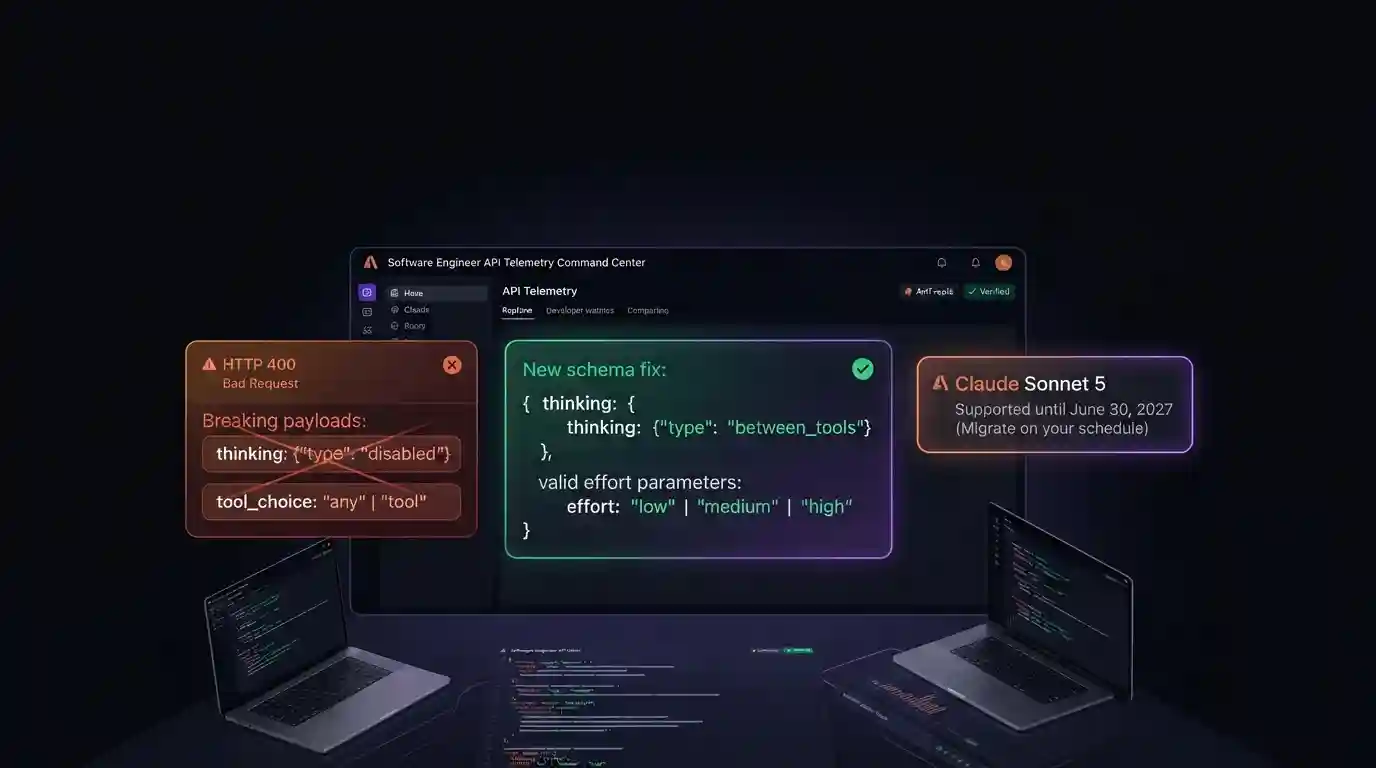
Claude Sonnet 5.5 migration: which changes return a 400
Claude Sonnet 5.5 launched on September 28, 2026 at the same price as Claude Sonnet 5, $2 per million input tokens and $10 per million output tokens. Moving to it is not a model-ID swap. Several
Tue Sep 29 2026 · 6 min read · 2 views
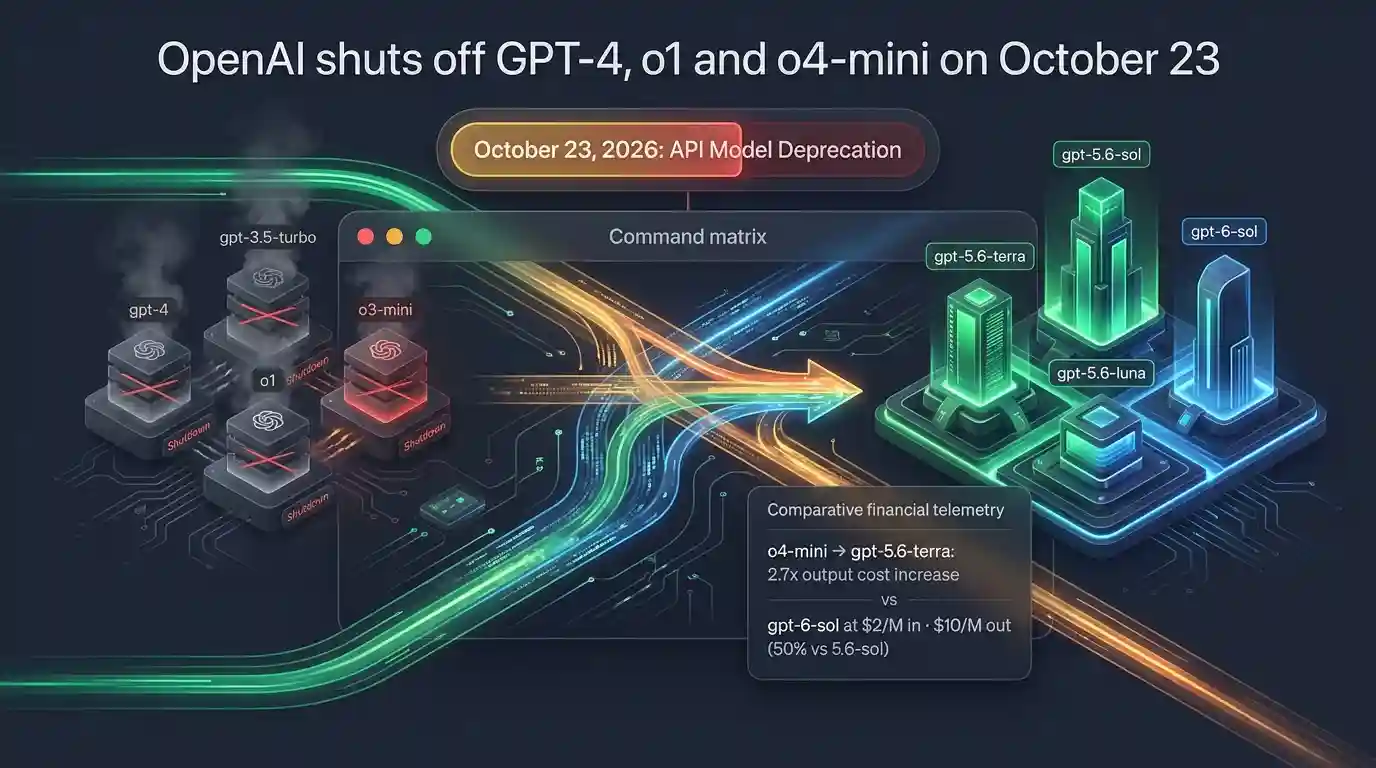
OpenAI shuts off GPT-4, o1 and o4-mini on October 23
OpenAI shuts off GPT-4, GPT-3.5 Turbo, GPT-4 Turbo, o1, o1-pro, o3-mini, o4-mini and several other models on its API on October 23, 2026. That is 24 days away. Any call that names one of those models
Tue Sep 29 2026 · 6 min read · 6 views

AI SDK 7 Changed usage. Your Token Counts Are Now Wrong
If a project upgraded to AI SDK 7 and its per-request token costs suddenly look higher than before, nothing is actually costing more. result.usage used to report only the final step's tokens. In AI
Tue Sep 29 2026 · 6 min read · 2 views