How to Pronounce PostgreSQL (and Why It Is Called That)
By Nihar Ranjan Das · Fri Oct 09 2026 · 7 min read · 0 views
View as a Web StorySoftware#postgresql#database#pronunciation#postgres#history
PostgreSQL is pronounced "post-GRES-Q-L", and the project says plainly that saying just "Postgres" is fine. The official FAQ gives the spelled-out form and links an audio file, then adds that many people find it easier to say "post-GRES". Both are correct. The wrong ones are "Post-gray" and "Postgres-sequel".
The name sounds odd because it is a leftover. It carries three decades of history, a deliberate renaming and a version-number reset. That history is below, along with something most pronunciation guides skip: how to write the name correctly in docs, code and job posts.
How to pronounce PostgreSQL
The official PostgreSQL FAQ answers the question directly: "post-GRES-que-ell", with a link to an audio file at /files/postgresql.mp3. The older wiki FAQ writes it as "Post-Gres-Q-L" and points to the same audio. It also says: "If you find 'PostgreSQL' hard to pronounce, call it 'Postgres' instead."
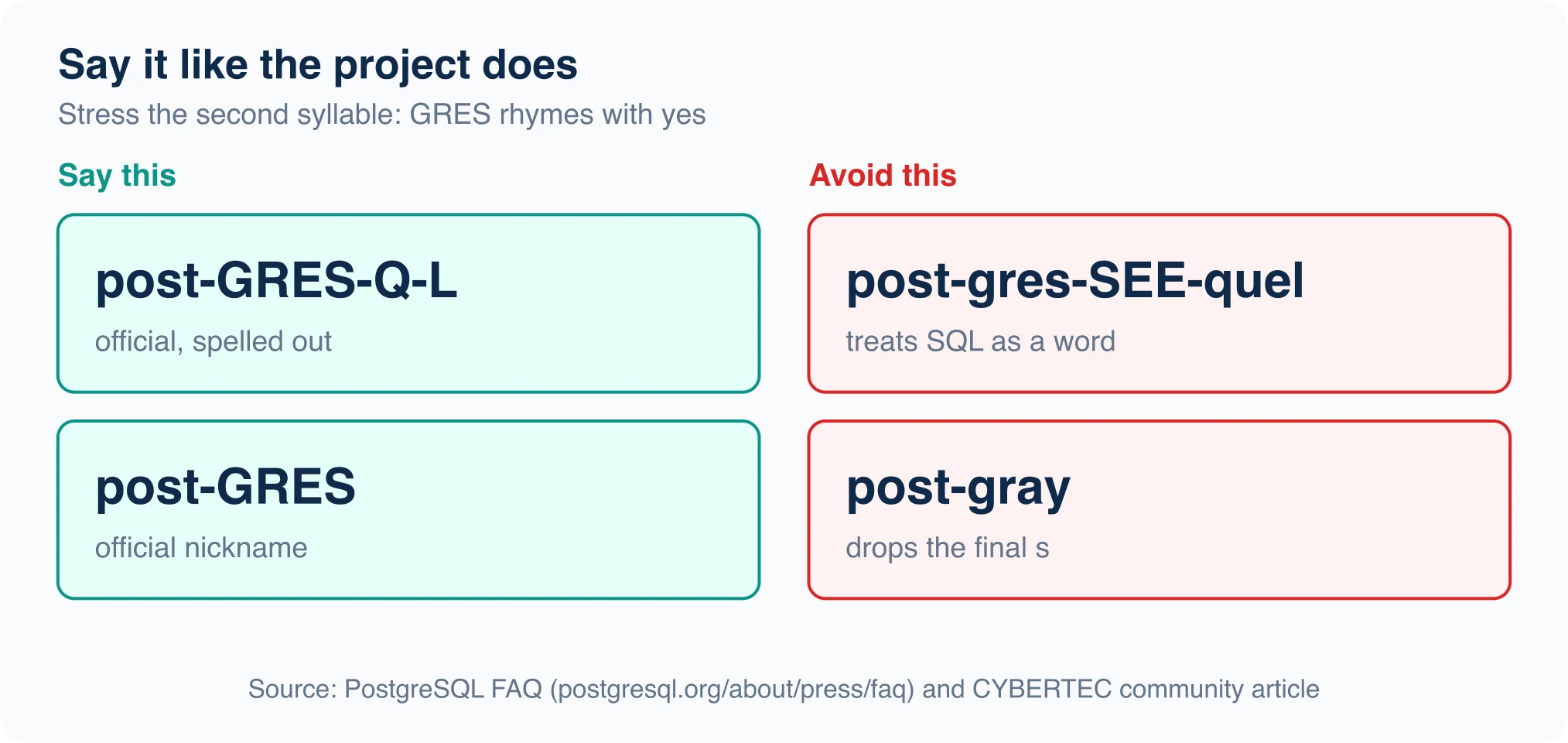
| Say it this way | Verdict | Notes |
|---|---|---|
| post-GRES-Q-L | Correct | Three beats after the stress: "Q-L" spelled out |
| post-GRES | Correct | The official nickname, shortest to say |
| post-gres-SEE-quel | Seen as outsider usage | Treats "SQL" as the word "sequel" |
| post-gray | Seen as outsider usage | Drops the "s", as if it were French |
| P-G | Common in speech | Short for the name, also the file prefix pg_ |
Stress falls on the second syllable. The "gres" rhymes with "yes", not with "grease". If you say "post-GRESS" with a sharp S at the end, you are saying it the way the project does.
The CYBERTEC article on the name calls the pronunciation a shibboleth of the community. It treats "post-gres-cue-ell" and "post-gres" as widely accepted and "Postgre" or "Postgres SQL" as marks of an outsider. A commenter on that article reports that at a 2025 Swiss PGDay talk, "Postgres" led an audience poll, with a surprising number choosing "P-G".
Is "Postgres" or "PostgreSQL" the right name?
Both. The official project name is PostgreSQL, and Postgres is also an official name. The PostgreSQL history page says "Postgres is still considered an official project name, both because of tradition and because people find it easier to pronounce Postgres than PostgreSQL."
Use the full name on first mention in a formal document, then switch to "Postgres" if you like. In code, use the tool's own names exactly: psql for the client, postgres for the server binary, and pg_ for the system catalogs and utilities such as pg_dump.
Why is it called PostgreSQL?
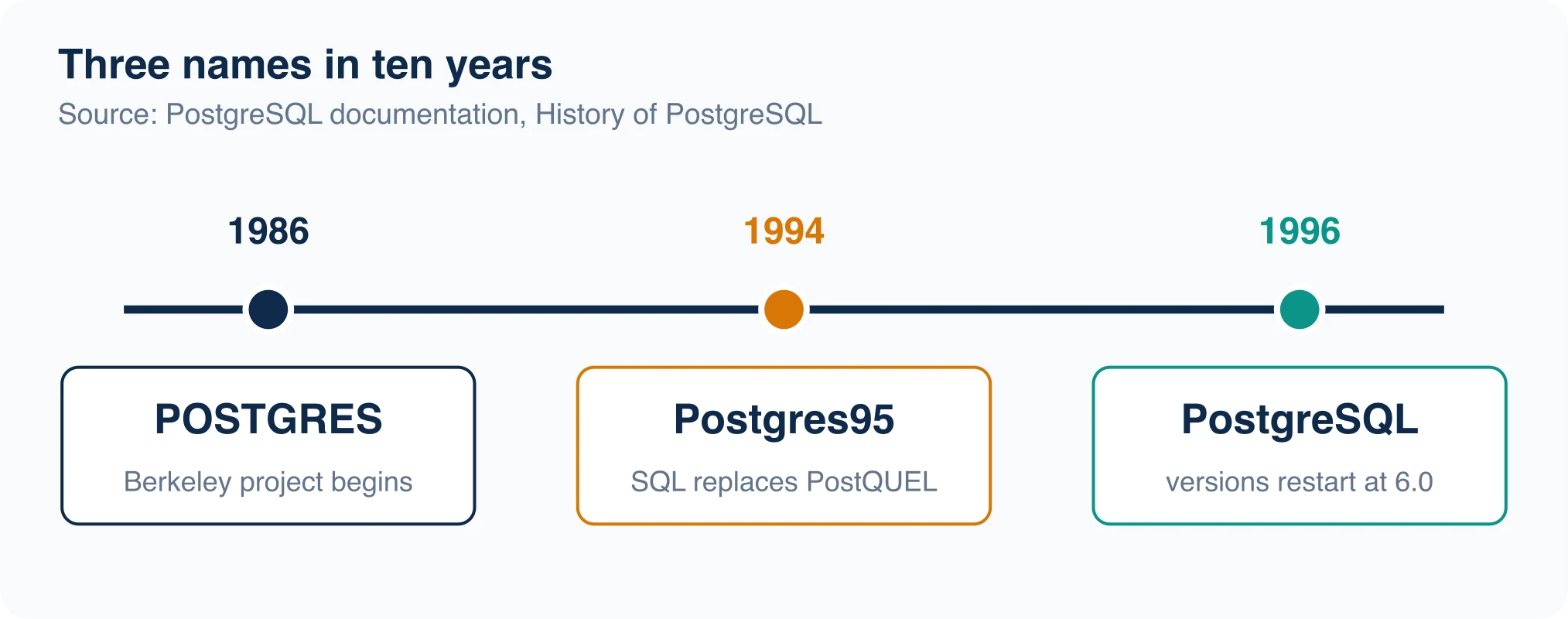
The name is a timeline, and the timeline is short enough to read in a minute.
Advertisement
1986: POSTGRES. Per the project history, "the implementation of POSTGRES began in 1986" at UC Berkeley, and the Berkeley project officially ended with Version 4.2. Illustra Information Technologies later picked up the code and commercialized it.
1994: Postgres95. "In 1994, Andrew Yu and Jolly Chen added an SQL language interpreter to POSTGRES." The original system used its own query language, PostQUEL, which was replaced with SQL. The docs even note that the client library libpq was named after PostQUEL. The SQL-capable project was released to the web under the new name Postgres95, and its 1.0.x releases ran about 30 to 50 percent faster than POSTGRES 4.2 on the Wisconsin Benchmark.
1996: PostgreSQL. "By 1996, it became clear that the name 'Postgres95' would not stand the test of time. We chose a new name, PostgreSQL, to reflect the relationship between the original POSTGRES and the more recent versions with SQL capability."
The suffix is where the pronunciation trouble begins. "SQL" was added to say "this one speaks SQL", not to be said as a separate word. That is why the project spells the letters out, and why the long name reads like "Postgres plus S-Q-L".
The version reset. At the same moment the team "set the version numbering to start at 6.0, putting the numbers back into the sequence originally begun by the Berkeley POSTGRES project." That explains why PostgreSQL's first release under its current name was 6.0, not 1.0. Berkeley had reached 4.2 and Postgres95 had restarted at 1.0.x, so 6.0 put the numbers back in the original sequence.
What the documentation itself uses
We checked how the project writes its own name. The PostgreSQL 18.1 documentation installed on our machine contains 1,144 HTML pages and about 1.14 million words. We counted whole-word matches.
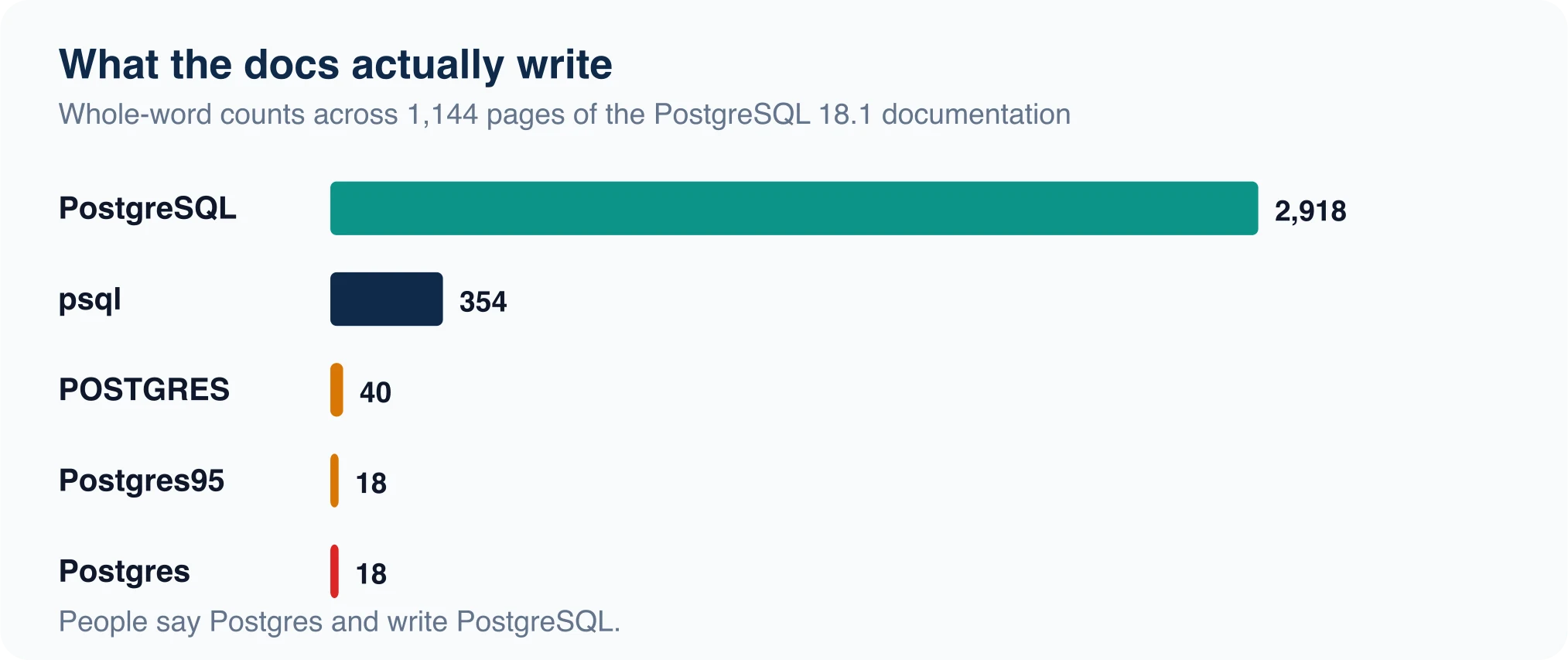
| Spelling | Whole-word matches in the 18.1 docs |
|---|---|
| PostgreSQL | 2,918 |
| psql | 354 |
| POSTGRES (all caps, mostly in history) | 40 |
| Postgres95 | 18 |
| Postgres | 18 |
The full name wins 2,918 to 18 over "Postgres" in written documentation. People say "Postgres" and write "PostgreSQL". If you are writing documentation or a job posting, follow the written habit. If you are talking in a meeting, follow the spoken one. Neither will mark you out.
You can repeat the count on your own install. Open the HTML documentation folder and run a whole-word search. On our machine the folder was /Library/PostgreSQL/18/doc/postgresql/html, though the path differs per installer.
Where the old name still shows up on your machine
The history is not only trivia. It is visible in a fresh install. On the PostgreSQL 18.1 server we used for testing, listing databases returned postgres, template0 and template1 before we created anything of our own. Listing roles returned a superuser called postgres as well, and the server listens on port 5432 by default.
The tool names follow the same pattern. The 18.1 bin folder holds 23 programs that start with pg_, including pg_dump, pg_restore, pg_upgrade, pg_basebackup and pg_isready. The client library is libpq, which the project history says was named after PostQUEL, the original query language that SQL replaced. So three different eras are visible in one folder listing: libpq from the Berkeley language, postgres from the original system, and psql from the SQL era.
Try it yourself with two commands. psql -Atc "select datname from pg_database" lists databases, and ls "$(pg_config --bindir)" | grep '^pg_' lists the utilities. If a command is missing, our PostgreSQL version guide shows how to find the install on each platform.
How to write the name in different places
A short style guide saves arguments later.
- Headlines and first mentions: PostgreSQL. Capital P, capital S, Q and L. Not "PostgresSQL", not "Postgre", not "PostGreSQL".
- Casual speech and chat: Postgres. It is shorter and official.
- Code and commands: exactly as the tool spells it, in code font:
psql,pg_dump,postgres. - Abbreviations: "PG" is common in conversation and in names such as
PGDATA. Avoid it in headlines. - Mixed engines: write "PostgreSQL and MySQL", not "Postgres SQL". The space makes it look like two words.
The same rule applies to related names. "psql" is the interactive terminal. The project does not publish a pronunciation for it, so listen to your colleagues and match them.
Say it so people find you
Spoken names turn into search queries. Our keyword export for this topic shows people search for the spoken forms directly: "postgresql pronunciation" and "how do we pronounce postgresql" about 1,000 times a month each, "pronounce postgres" about 590 and "postgres pronunciation" about 480. The export does not give a date, so treat the volumes as approximate.
That has a practical lesson for anyone writing about the database. If your page only says "PostgreSQL", you miss readers who typed "Postgres", and the reverse is also true. Use the formal name in the title and the nickname in the first paragraph, and readers on both paths land on the same answer.
Why the name matters in practice
A confused name causes real mistakes. People search for "postgre", "postgres sql" and "p database" and land on the wrong page. If you build content or documentation, include both "Postgres" and "PostgreSQL" so readers find you either way. Also, the name sets expectations about licensing: PostgreSQL uses its own permissive license, which is not the same as MySQL's dual license or MongoDB's SSPL. Our PostgreSQL vs MySQL benchmark and PostgreSQL vs MongoDB guide cover those differences.
If you already run PostgreSQL and want to know which release you are on, our guide to checking your PostgreSQL version shows the commands for every platform, and the PostgreSQL 19 breaking changes post lists what to check before the next upgrade.
Advertisement
FAQ
How do you pronounce PostgreSQL?
Say "post-GRES-Q-L", with the stress on the second syllable and the letters Q and L spelled out. The official FAQ links an audio recording. Saying just "post-GRES" is also accepted.
Is it Postgres or PostgreSQL?
Both are official project names. PostgreSQL is the formal name used in documentation, and Postgres is the accepted short form. Pick one per document and stay consistent.
Why is PostgreSQL called that?
The project began as POSTGRES at Berkeley in 1986, became Postgres95 when SQL support was added in 1994, and was renamed PostgreSQL in 1996 to reflect its SQL capability while keeping the link to the original system.
Who owns PostgreSQL?
No single company owns it. The documentation footer lists The PostgreSQL Global Development Group as the copyright holder, and the software is released under the PostgreSQL License. The FAQ points to the project's trademark policy page for naming questions.
Is it wrong to say "Postgre"?
It is not the official name and reads as outsider usage in the community. The project suggests "Postgres" as the short form instead.
Comments
Loading…
Sign in to join the conversation.
Related posts
Relational Databases: Top 10 Ranked and How They Work
Oracle still leads the October 2026 DB-Engines list of relational databases, but PostgreSQL is the only top-four system that gained ground this year. PostgreSQL scored 688.75, up 45.56 points from
Fri Oct 09 2026 · 9 min read · 1 views
What Is PostgreSQL? A Plain-English Guide With Real Tests
PostgreSQL is a free, open-source relational database that stores data in tables and answers questions written in SQL. It began in 1986 as the POSTGRES project at the University of California,
Fri Oct 09 2026 · 8 min read · 0 views
Serverless Databases Compared: What They Cost in 2026
A serverless database costs the least when your app sits idle, and the most when it runs all day. That single fact decides most purchases. A hobby app can run free on Neon, Turso or Cloudflare D1. An
Fri Oct 09 2026 · 9 min read · 0 views