The Pixel 11 price increase is really a RAM shortage
By Nihar Ranjan Das · Wed Aug 05 2026 · 5 min read · 2 views
View as a Web StoryGadgets#android#pixel 11#google#ram prices#made by google#smartphones#buying guide
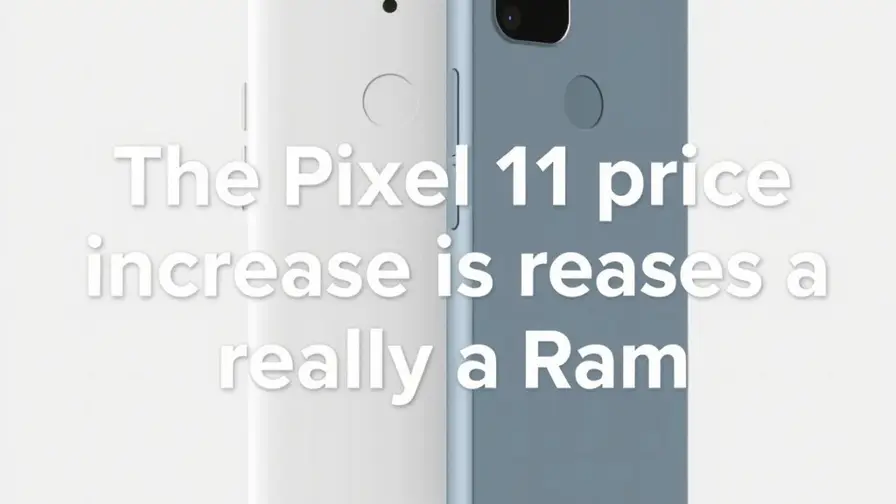
Google has confirmed that the Pixel 11 will cost more than the Pixel 10. The official numbers land on 12 August, when Made by Google takes the stage in New York.
The confirmation itself is not surprising. What makes it worth understanding is the reason Google gave, because it is not the reason people assumed.
This is not a tariff story. It is a memory story. The AI data centre buildout has bid away the memory supply that consumer phones depend on, and the bill has finally reached the shelf.
What Google actually confirmed
Google's VP of Devices publicly acknowledged the increases, as reported by Android Central. The company framed them as a response to hardware costs rather than a repositioning of the brand.
The event itself is set. Made by Google runs on Wednesday 12 August at 6:00 PM ET in New York, according to 9to5Google. Expect the Pixel 11, Pixel 11 Pro, Pixel 11 Pro XL, and Pixel 11 Pro Fold, plus the Pixel Watch 5 line.
Leaks put the increase at about $100 across the range. That would move the base model from $799 to roughly $899. Google is also expected to double baseline storage from 128GB to 256GB, which softens the comparison without erasing it.
Why memory prices did this
Here is the chain, and it is short.
HBM is high bandwidth memory, the stacked chips that sit beside an AI accelerator and feed it data. It sells at a large premium over the plain memory in a phone. When a plant can make either one, the choice is not close.
LPDDR is the low-power memory used in phones and tablets. It comes off many of the same production lines, so it competes directly with HBM for space.
Memory makers responded by redirecting wafer capacity toward HBM for AI data centres. That left less capacity for the LPDDR memory that goes into consumer devices. Prices moved accordingly.
Advertisement
The demand behind that shift is the AI buildout itself, the same wave that produced everything from frontier reasoning models to the agent experiments in Can AI Agents Run a Business? It Lost $447. Phone buyers are now paying a share of that infrastructure bill.
Google pointed to Morgan Stanley figures showing 1GB of RAM rising from $2.80 in 2025 to about $12 this year, detailed by TechRepublic. That is a fourfold move in roughly a year, on a component that a modern flagship uses a lot of.
Consider what that does to a phone with 16GB of RAM. The memory alone swings from a modest line item to a significant one. A hundred dollars stops looking like opportunism and starts looking like arithmetic.
Google's other answer: make Android need less
The price increase is only half the response. Google also said it is reworking Android to use less memory, reported by The Next Web.
This is the more interesting long-term move. If Android can deliver the same performance on a lower memory configuration, Google can hold a price point that competitors cannot.
It also cuts against the direction of travel. On-device AI models are memory-hungry, and every vendor has spent two years adding them. Google is now trying to add AI features and shrink the memory footprint at the same time.
Treat any claim about this at the event with some care. Software efficiency gains are easy to announce and hard to verify on day one.
Should you buy the Pixel 10 instead?
For a lot of people, yes. This is the clearest buying decision the launch creates.
| Situation | Reasonable move |
|---|---|
| You want the lowest price and current features are enough | Buy a discounted Pixel 10 in the weeks after 12 August |
| You keep a phone four or more years | Buy the Pixel 11 for the longer support window and larger storage |
| You want the folding model | Wait for the Pixel 11 Pro Fold, since the Pixel 10 fold pricing will not fall far |
| You are on a Pixel 9 or newer | Skip this cycle; the year-over-year gain does not cover a $100 increase |
| You need maximum RAM for on-device AI | Buy sooner rather than later, since memory pricing is still rising |
The discounting window after a launch is usually the best value in the Pixel calendar. This year it should be better than usual, because carriers and retailers will be clearing stock priced under the old memory costs.
This is not a Google problem
Every Android maker buys memory in the same market. HotHardware noted the surge in memory costs is an industry input, not a Google-specific one.
The industry-wide numbers are stark. Smartphone prices are set to rise 13% in 2026 and PC prices 17%. Shipments fall the other way, smartphones down 8.4%, according to Gartner's February forecast. All three figures are measured against 2025 levels, and buyers keeping phones longer is the main driver of the shipment drop.
Memflation is the industry's nickname for this effect: a price rise driven by one component rather than by a redesign or a new feature. Forbes has tracked it through 2026, including vendors quietly cutting specs instead of raising list prices.
So expect the same conversation at the next Samsung and OnePlus launches. Google is simply first to the microphone this cycle, because its event is first on the calendar.
For example, a mid-range phone with 8GB of RAM absorbs a smaller absolute hit than a 16GB flagship. The squeeze is real across the range, but it is not evenly distributed. Budget phones may hold their prices by holding their specs instead.
Android buyers have had a run of policy-driven changes lately, from Google Play Age Verification: How Android's New Checks Work through to store rule shifts. This one is different in kind. It is a supply constraint, and no policy reversal makes it go away.
Advertisement
FAQ
How much will the Pixel 11 cost?
Google has not published prices. Leaks point to roughly $100 more per model, which would put the base Pixel 11 near $899. Official pricing arrives at the 12 August event.
Why are RAM prices rising so fast?
Memory manufacturers have shifted wafer capacity toward high bandwidth memory for AI data centres. That reduced supply of the memory used in phones and laptops, and prices rose in response.
Is the price increase caused by tariffs?
Google attributed the increase to hardware and memory costs rather than trade policy. Memory pricing is the reason the company put on the record.
Will the Pixel 11 come with more storage?
Baseline storage is expected to double from 128GB to 256GB on the standard models, which offsets part of the higher price.
When is the Made by Google event?
Wednesday 12 August 2026, at 6:00 PM ET in New York, streaming on Google's YouTube channel.
Comments
Loading…
Sign in to join the conversation.
Related posts

Should you buy a GPU now, or wait out 2026?
AMD raised Radeon prices 10% in August 2026 and the RTX 5090 sells near $4,700. Here is when to buy a GPU now and when to wait.
Wed Aug 19 2026 · 6 min read · 25 views

Is there Chinese CXMT memory in your new laptop?
Three of the largest PC makers now ship some notebooks with Chinese memory chips, and the machines that get them are sold outside the United States. That makes this a European shopping question rather
Sun Aug 16 2026 · 5 min read · 3 views

No standard iPhone 18 this fall. What should you buy?
Apple is set to launch three iPhone models in September 2026, and every one of them belongs to the premium tier. The standard iPhone 18 is not among them. That single change rewrites the autumn
Sun Aug 16 2026 · 5 min read · 10 views