What an AI-resolved support ticket really costs in 2026
By Nihar Ranjan Das · Mon Oct 19 2026 · 10 min read · 0 views
View as a Web StoryAI#ai customer support#fin#zendesk#hubspot#agentforce
AI customer support agent pricing per resolution runs from $0.50 to about $4.00 for the same solved ticket. HubSpot charges $0.50 per resolved conversation, Fin charges $0.99, and Zendesk charges $1.50 to $2.00. Salesforce Agentforce charges $2.00 for every conversation, solved or not, so its real price per solved ticket is $2.86 to $4.00 at the resolution rates we modeled. This guide normalizes all four price sheets into one number, shows the monthly bill at 1,000, 5,000 and 10,000 conversations, and explains what Salesforce's $3.6 billion purchase of Fin means for anyone who has not signed yet.
Why can't you compare these prices directly?
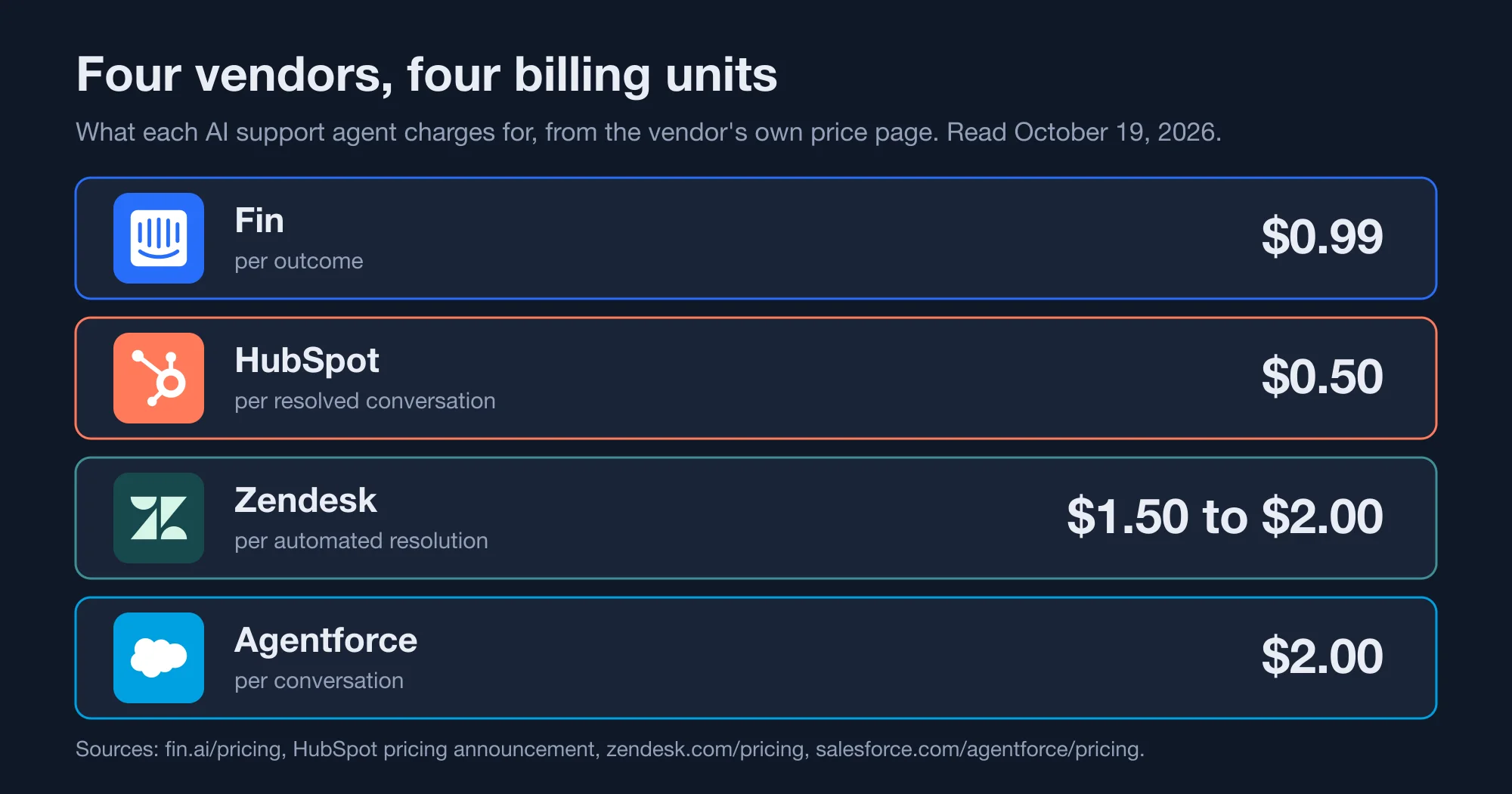
The four vendors bill four different units, so the headline numbers describe different things. Fin bills per outcome. HubSpot bills per resolved conversation. Zendesk bills per automated resolution. Agentforce bills per conversation, or per action if you buy Flex Credits instead.
A resolution is a support conversation the vendor counts as solved by the AI without a human taking over. Each vendor writes its own definition. For example, HubSpot's announcement says only that its agent is paid when it completes the task it was assigned, and it does not define "resolved" any further.
That is why a sticker price of $0.50 next to $2.00 proves nothing on its own. A $2.00 charge on every conversation and a $0.50 charge on solved conversations only are different bets. The first vendor is paid even when the bot fails. The second vendor is paid only when it works.
Our test setup is simple. We took each vendor's public price sheet, fixed a monthly volume of conversations, applied a resolution rate, and computed the bill. The method is shown in every table so you can swap in your own numbers. All prices are in US dollars. None of the vendors lists euro or sterling prices on the pages we used, so European buyers should expect currency conversion and VAT on top.
What does each vendor actually charge?
Each price below comes from the vendor's own pricing page or announcement, read on October 19, 2026. The chart shows the unit each vendor bills.
| Vendor | Billing unit | Published price | Notes |
|---|---|---|---|
| Fin | Outcome | $0.99 | $9.99 for a lead qualification; 50-outcome monthly minimum on non-Intercom helpdesks |
| HubSpot Customer Agent | Resolved conversation | $0.50 | Paid in credits, 50 credits per resolution |
| Zendesk AI agents | Automated resolution | $1.50 committed, $2.00 pay-as-you-go | 5 to 10 resolutions included per agent per month |
| Salesforce Agentforce | Conversation | $2.00 | Or Flex Credits at $500 per 100,000 credits |
Fin is an AI customer service agent from the company formerly known as Intercom. Fin's pricing page lists $0.99 per outcome for resolutions, procedure handoffs, disqualifications and self-serve routing. It lists $9.99 per qualification. If you run Fin on top of the Intercom helpdesk, seats start at $29 per month. If you run Fin on another helpdesk, there are no seat costs, but the 50-outcome monthly minimum applies.
HubSpot Customer Agent is the AI support agent inside HubSpot's Service Hub. On April 14, 2026, HubSpot cut its price from $1.00 per conversation to $0.50 per resolved conversation, according to the company's own announcement. HubSpot's service pricing page says credits cost $0.010 each and that Professional seats include 3,000 credits a month. At 50 credits per resolution, those included credits cover 60 resolved conversations before you pay anything extra.
Zendesk is a customer support platform that sells AI agents as a usage add-on to its plans. Zendesk's pricing page lists automated resolutions at $1.50 each when you commit in advance and $2.00 each on pay-as-you-go. Support Team and Suite Team plans include 5 resolutions per agent per month. Suite Professional includes 10.
Advertisement
Salesforce Agentforce is Salesforce's platform for AI agents inside its CRM. Salesforce's Agentforce pricing lists $2 per conversation for customer-facing agents. The same page lists Flex Credits at $500 per 100,000 credits, where a standard action costs 20 credits, or about $0.10. The page states that Flex Credits and Conversations cannot be used in the same org.
What does one solved ticket cost on each platform?
At a 50 percent resolution rate, one solved ticket costs $0.50 on HubSpot, $0.99 on Fin, $1.50 to $2.00 on Zendesk, and $4.00 on Agentforce's conversation pricing. At a 70 percent resolution rate, Agentforce falls to $2.86. The other three do not change, because they charge only when the bot succeeds.
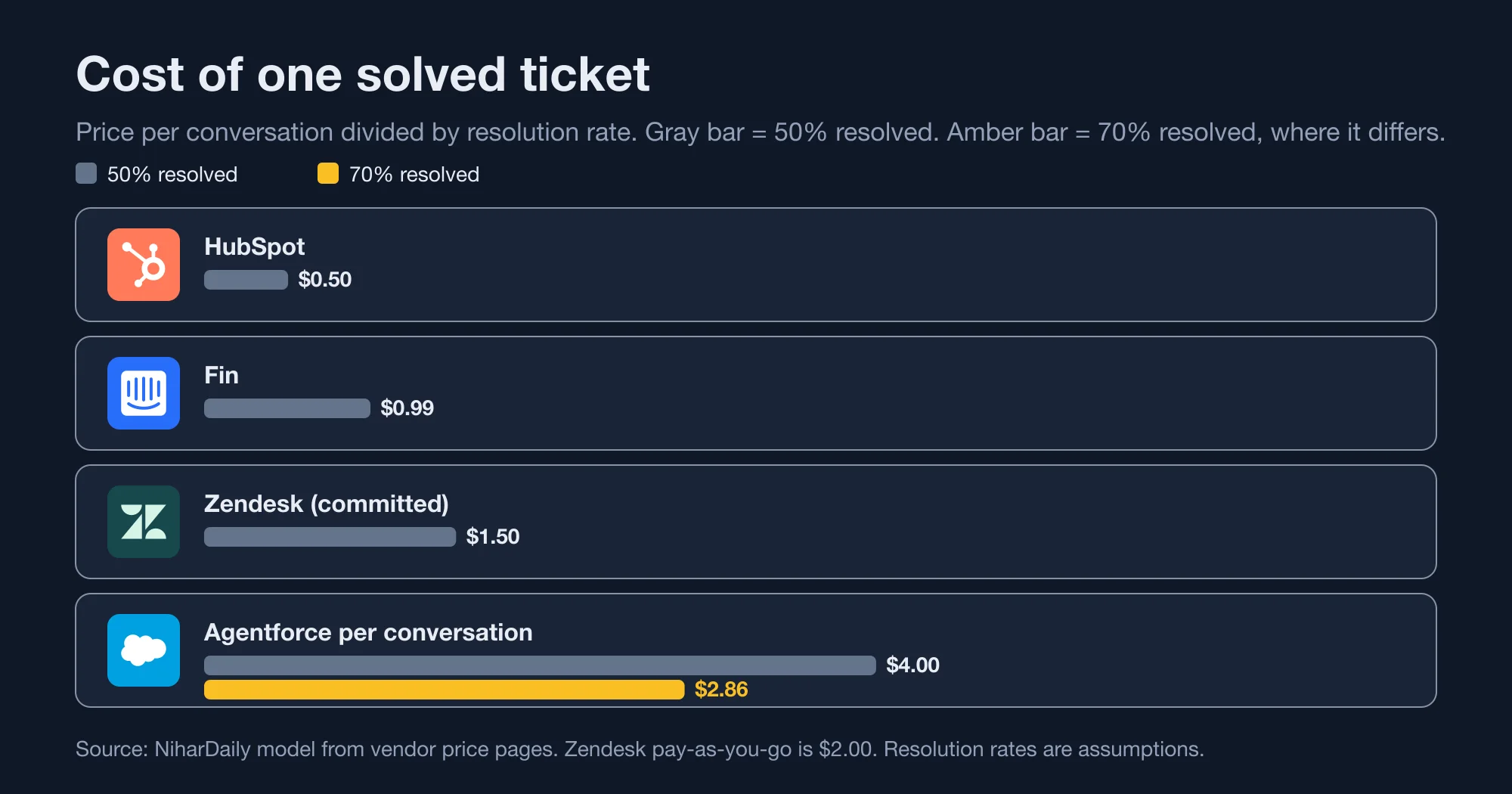
The Agentforce number is the one to understand. The formula is the price per conversation divided by the resolution rate. So $2.00 divided by 0.5 is $4.00, and $2.00 divided by 0.7 is $2.86. Every conversation the bot fails still costs $2.00 before a human picks it up.
This also gives a clean rule. A conversation-priced agent can never beat a resolution-priced agent on price alone unless its price is lower than the rival's price multiplied by the resolution rate. Against Fin's $0.99, Agentforce at $2.00 would need a resolution rate above 200 percent. That is impossible. So Agentforce must win on something other than price.
How much is the monthly bill at 1,000, 5,000 and 10,000 conversations?
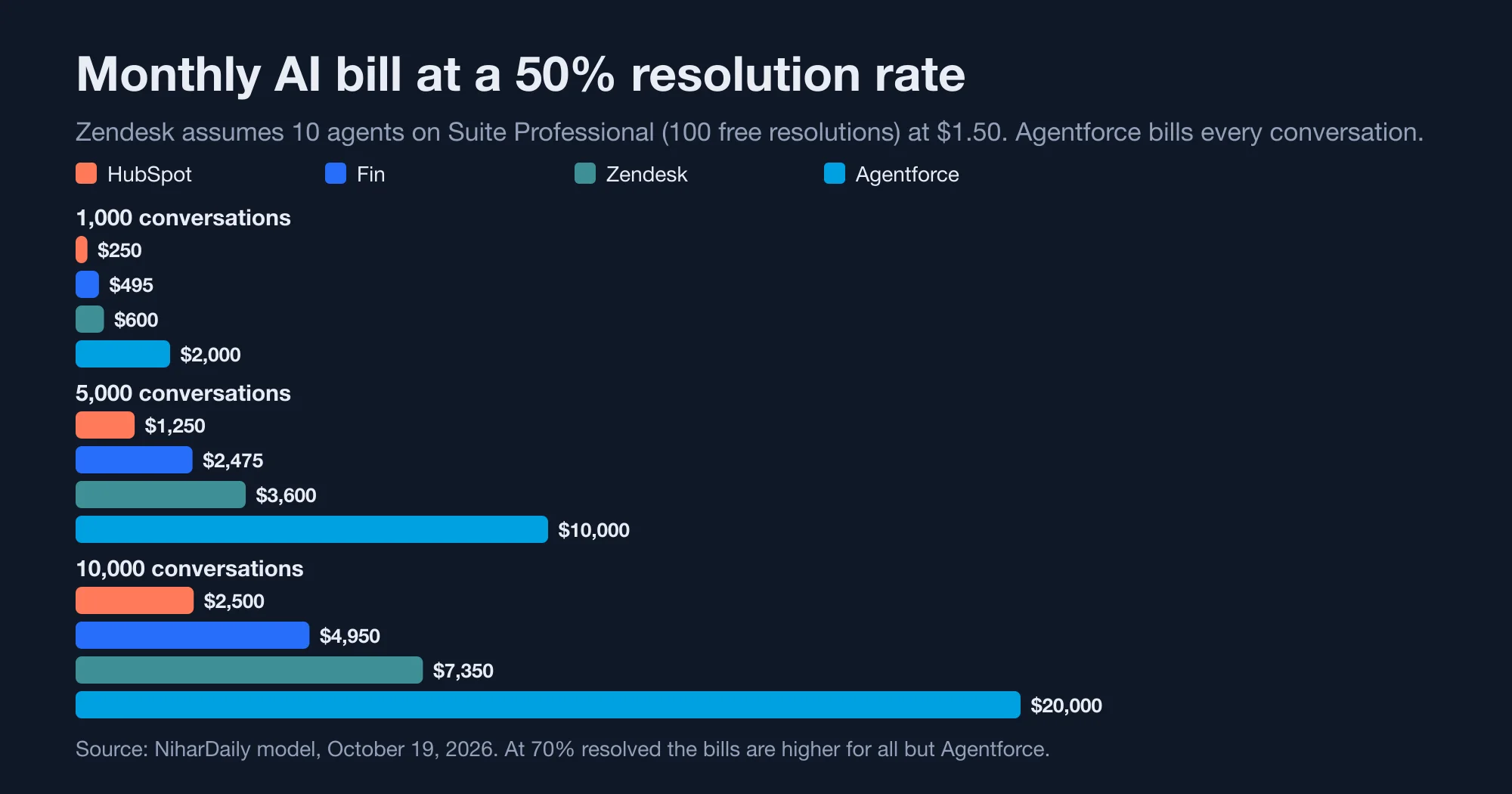
At 5,000 conversations a month and a 50 percent resolution rate, the AI bill is $1,250 on HubSpot, $2,475 on Fin, $3,600 on Zendesk and $10,000 on Agentforce. The gap between cheapest and dearest is eightfold. We assumed a Zendesk team of 10 agents on Suite Professional, which includes 100 free resolutions a month, and the committed rate of $1.50.
| Monthly conversations | HubSpot | Fin | Zendesk (committed) | Agentforce |
|---|---|---|---|---|
| 1,000 | $250 | $495 | $600 | $2,000 |
| 5,000 | $1,250 | $2,475 | $3,600 | $10,000 |
| 10,000 | $2,500 | $4,950 | $7,350 | $20,000 |
At a 70 percent resolution rate, the same volumes cost $350, $693, $900 and $2,000 at 1,000 conversations. At 10,000 conversations they cost $3,500, $6,930, $10,350 and $20,000. Notice that only Agentforce stays flat as resolution improves. The other three bills rise as the bot gets better, because you pay for each success.
That is the quiet trade-off. A resolution-priced bill goes up when your bot improves. It also goes up exactly when your human workload goes down. So the right comparison is the AI bill against the human tickets you no longer handle, not the AI bill alone.
When is Agentforce Flex Credits cheaper than $2 a conversation?
Flex Credits beat the $2 conversation price whenever an average conversation uses fewer than 20 actions. Salesforce lists one standard action at 20 credits, which is about $0.10 at $500 per 100,000 credits. So $2.00 divided by $0.10 is 20 actions.
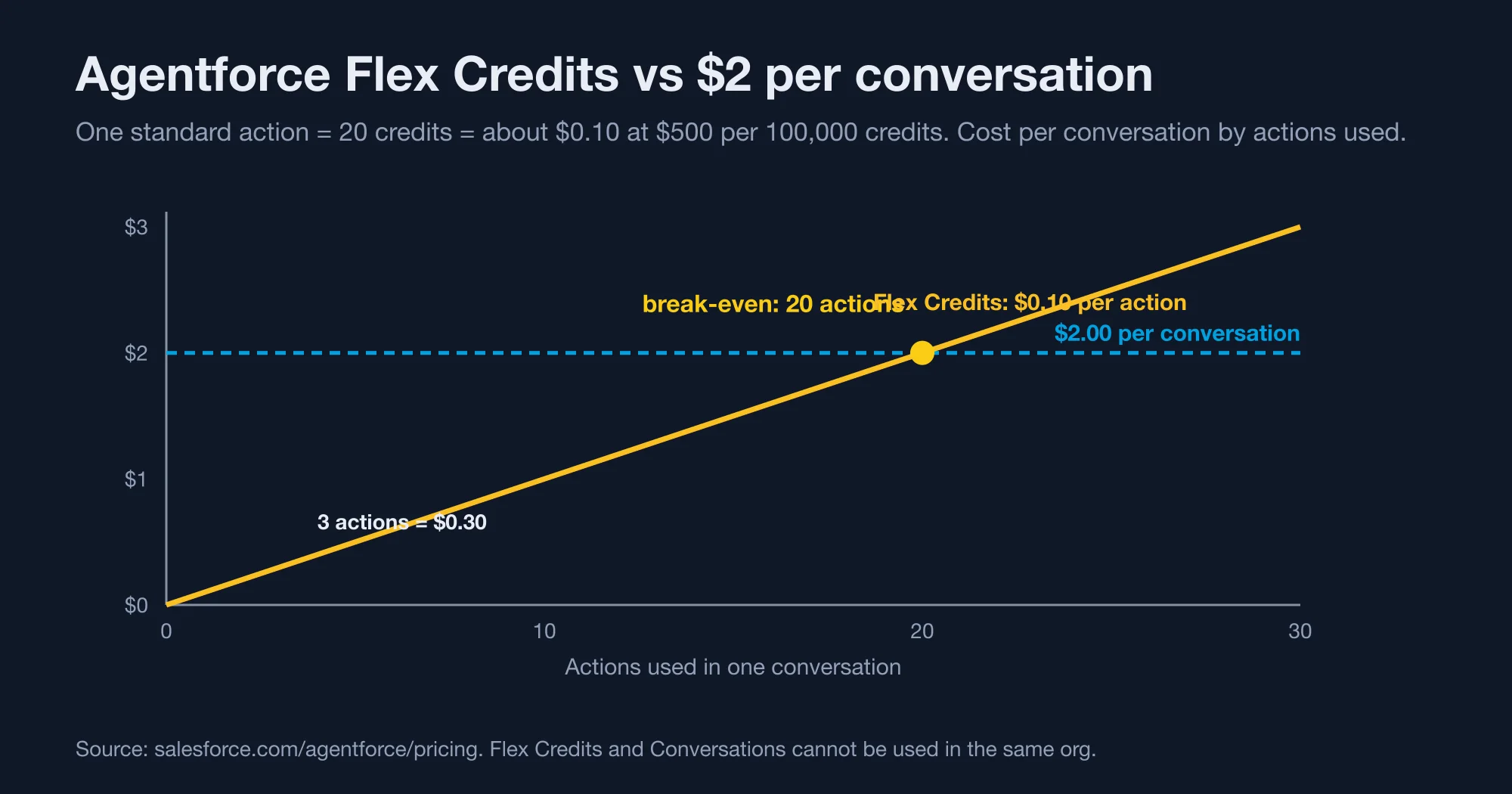
A simple refund-status bot might look up an order, check a policy and send a reply. That is three actions, or about $0.30. A multi-step flow that searches knowledge, checks three systems, drafts a reply and logs a case can reach ten or more actions, or $1.00 and up. Few support flows need 20.
The catch is that Flex Credits bill every action, including failed ones. A bot that loops, retries or calls a slow tool five times burns credits. Usage billing rewards tight flows and punishes sloppy ones. If you pick Flex Credits, cap the actions per conversation in the agent design before you go live. Cap it, test it, and read the first invoice line by line.
Salesforce also sells per-user options. The Agentforce User License costs $5 per user per month and requires Flex Credits. Agentforce add-ons for Sales, Service and Field Service cost $125 per user per month with unmetered employee usage. Those prices cover agents that help your own staff, not customer-facing bots, so they belong in a different budget line.
What does Salesforce buying Fin change?
Salesforce signed a definitive agreement on June 15, 2026 to buy Fin for about $3.6 billion in cash. Salesforce's announcement says Fin serves more than 30,000 companies and that the deal is expected to close in the fourth quarter of Salesforce's fiscal year 2027, subject to regulatory clearances.
The release does not publish post-close pricing. It mentions packaged offerings and fast-to-value deployment options for Fin, and nothing more specific. So nobody outside Salesforce knows whether Fin's $0.99 per outcome survives, rises, or gets bundled into Agentforce.
Here is how we would reason about it. Salesforce now owns two ways to sell customer-facing AI: $2 per conversation and $0.99 per outcome. A buyer who compares them sees a large gap. Salesforce can close the gap by raising Fin, lowering Agentforce, or keeping both for different customers. We cannot tell which. What we can say is that locking a Fin contract before the deal closes protects you from the first two outcomes and costs you nothing under the third.
If you are a US or EU team already on Fin, the practical advice is simple. Ask for a price lock in writing, with a term of at least 12 months. If you are evaluating, do not skip Fin because of the deal. Treat the price as a floor that may rise, and run your model at $1.50 per outcome to see whether the business case still holds.
Which one should you choose?
Choose by where your helpdesk lives and how well your bot resolves. The cheapest option is the one your stack already supports, because migrating a helpdesk costs far more than the per-ticket gap.
| Your situation | Best fit | Why |
|---|---|---|
| Already on HubSpot Service Hub | HubSpot Customer Agent | Lowest price per solved ticket at $0.50 |
| Already on Zendesk, under 500 resolutions a month | Zendesk AI agents | Included allowance absorbs the first resolutions |
| On any helpdesk, want a standalone agent | Fin | $0.99 per outcome and no seats on non-Intercom helpdesks |
| Deep in Salesforce, simple flows | Agentforce Flex Credits | Under 20 actions beats $2 per conversation |
| Deep in Salesforce, complex flows | Agentforce per conversation | Predictable, but plan for $2.86 to $4.00 per solve |
For example, a 10-agent Zendesk team handling 2,000 AI conversations a month at a 50 percent resolution rate sees 1,000 resolutions. Subtract the 100 included, and 900 resolutions at $1.50 cost $1,350. The same volume on Fin costs $990 and on HubSpot $500. Whether the $350 gap between Zendesk and Fin justifies a migration depends on your helpdesk lock-in, not on the AI.
What should you check before you sign?
Check four things before signing, because each one changes the bill by more than the headline price does.
- Ask for the definition of "resolved" in writing. A vendor that counts a closed chat as resolved bills more than one that requires no human follow-up. HubSpot's announcement does not define the term, so ask.
- Measure your own resolution rate on a pilot. Vendor claims such as HubSpot's reported 65 percent or more of conversations resolved automatically are measured on the vendor's customers, not yours. HubSpot's page does not say how it measured them.
- Find the minimums and the floors. Fin has a 50-outcome monthly minimum on non-Intercom helpdesks. Zendesk's committed rate requires a commitment. Agentforce Flex Credits do not roll over to later terms.
- Check the disclosure rule. In the EU, a customer must know when they are talking to a machine. Our guide, EU AI Act Article 50: what chatbots must disclose now, covers what the label has to say and when it applies.
The hidden cost is usually the knowledge base. A bot resolves what your articles already answer. If your help center is thin, no vendor's resolution rate will match its marketing. Fix the articles first, and the per-ticket price matters less.
If you are building agents rather than buying them, the same unit-cost discipline applies. What giving every AI agent its own database branch costs shows how a small per-run charge becomes a large bill at volume.
Advertisement
FAQ
How much does an AI customer support agent cost per resolution?
Published prices run from $0.50 to $2.00 per resolution. HubSpot charges $0.50 per resolved conversation, Fin charges $0.99 per outcome, and Zendesk charges $1.50 committed or $2.00 pay-as-you-go. Agentforce charges $2.00 per conversation, which works out to $2.86 to $4.00 per solved ticket at 70 and 50 percent resolution rates.
Is Fin cheaper than Zendesk AI agents?
Yes on the per-resolution price. Fin charges $0.99 per outcome, and Zendesk charges $1.50 committed or $2.00 pay-as-you-go per automated resolution. Zendesk includes 5 to 10 resolutions per agent each month, which narrows the gap for small teams. For 900 billable resolutions, Fin costs $891 and Zendesk costs $1,350.
What is the cheapest AI support agent in 2026?
HubSpot Customer Agent is the cheapest published price at $0.50 per resolved conversation, or 50 credits. Its included credits cover 60 resolutions on a Professional seat. The catch is that you need HubSpot's Service Hub, so the cheapest agent is only cheap if you already use the platform.
What happens to Fin pricing after Salesforce buys it?
Nobody knows yet. Salesforce announced the roughly $3.6 billion purchase on June 15, 2026 and expects it to close in the fourth quarter of fiscal 2027. The announcement does not state post-close pricing. If you use Fin, ask for a written price lock of 12 months or more.
When is Agentforce Flex Credits cheaper than the $2 conversation price?
Flex Credits are cheaper when a conversation uses fewer than 20 actions. A standard action costs 20 credits, or about $0.10 at $500 per 100,000 credits. Three actions cost about $0.30. Flex Credits and Conversations cannot be used in the same org.
Comments
Loading…
Sign in to join the conversation.
Related posts
What Claude's new OpenTelemetry traces actually send out
Claude API OpenTelemetry traces are now in public beta, and the default setting sends no prompts at all. We ran the Anthropic Python SDK against a mock server and counted what leaves your app.
Mon Oct 19 2026 · 10 min read · 0 views
Porting AutoGen to Microsoft Agent Framework: what breaks
An AutoGen to Microsoft Agent Framework migration is mostly a rename, except for four defaults that change silently. We ported a two-agent writer and reviewer team on Python 3.15.0, from AutoGen 0.7.5
Mon Oct 19 2026 · 10 min read · 0 views
Gemini 4 Argon price doubles December 1: what you will pay
Gemini 4 Argon API pricing doubles on December 1, 2026. Standard input goes from $2.00 to $4.00 per million tokens, and output goes from $10.00 to $20.00, according to Google's own pricing page. We
Mon Oct 19 2026 · 10 min read · 0 views