Gemini 4 Argon price doubles December 1: what you will pay
By Nihar Ranjan Das · Mon Oct 19 2026 · 10 min read · 0 views
View as a Web StoryAI#ai agents#google#gemini#llm costs#api pricing
Gemini 4 Argon API pricing doubles on December 1, 2026. Standard input goes from $2.00 to $4.00 per million tokens, and output goes from $10.00 to $20.00, according to Google's own pricing page. We priced one chat question and one long agent session on both rate cards. The agent session costs $0.63 today and $1.26 after the change, and the same session without cache hits costs $1.60, then $3.20. This guide shows the full table, the models Argon matches before and after, and the four moves that cut the bill.
What is Gemini 4 Argon, and when does the price change?
Gemini 4 Argon is Google's flagship reasoning model in the Gemini API, billed per million tokens, with output tokens that include thinking. Google's pricing page lists the model as gemini-4-argon and says it is not available on the free tier. The lower prices apply through November 30, 2026, and the higher prices start on December 1, 2026.
Google's page does not label the lower price as introductory, and it does not say whether the model is generally available or still in preview. It says only that the model is now available. Third-party sites disagree on both points. One blog, Activepieces' pricing explainer, says only the output price rises. Google's table shows input, output and caching all doubling, so we use Google's numbers.
The pricing page lists no input context window, only long-decode generation up to 1M tokens. It also lists no separate rate for long prompts, unlike some other Gemini models on the same page. That makes Argon simple to budget. One rate applies at any prompt length.
What are the exact prices before and after December 1?
Every tier doubles on December 1. The table below copies Google's rates per million tokens in US dollars.
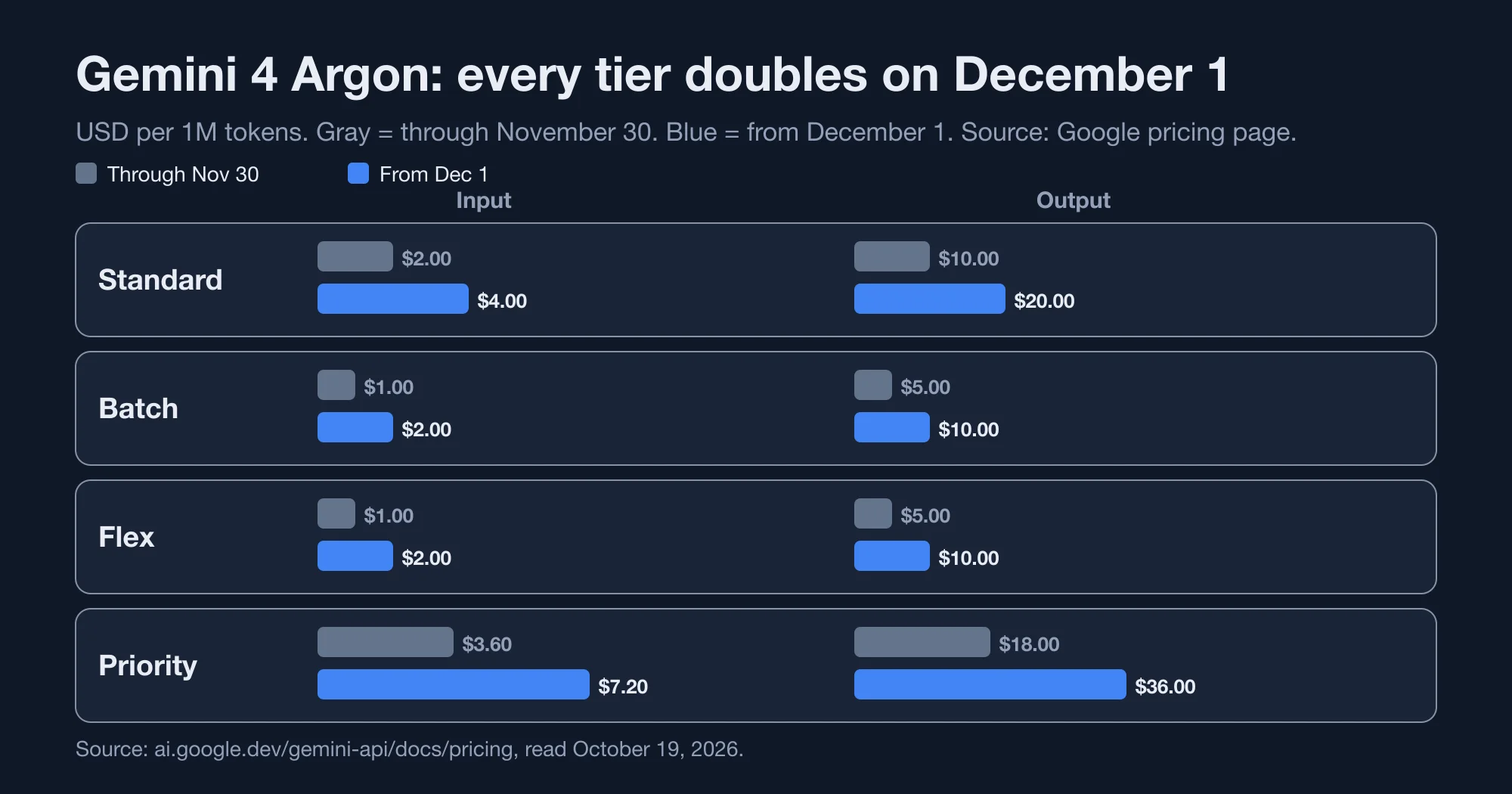
| Tier | Input, through Nov 30 | Input, from Dec 1 | Output, through Nov 30 | Output, from Dec 1 | Cached input, through Nov 30 | Cached input, from Dec 1 |
|---|---|---|---|---|---|---|
| Standard | $2.00 | $4.00 | $10.00 | $20.00 | $0.10 | $0.20 |
| Batch | $1.00 | $2.00 | $5.00 | $10.00 | $0.05 | $0.10 |
| Flex | $1.00 | $2.00 | $5.00 | $10.00 | $0.05 | $0.10 |
| Priority | $3.60 | $7.20 | $18.00 | $36.00 | $0.18 | $0.36 |
| Contributor (invite-only preview) | $1.00 | $2.00 | $5.00 | $10.00 | $0.05 | $0.10 |
Batch is the Argon tier priced at half of Standard. Priority is the Argon tier priced at 1.8 times Standard. Prices are in US dollars only. European teams should add VAT and expect currency conversion on the invoice. Google's page lists no euro or sterling rates.
Grounding is priced separately. Google Search and Google Maps each include 5,000 free requests per month, shared across all Gemini 3 and newer models. After that, the page lists $14 per 1,000 requests. That charge does not change on December 1.
How do we price a chat question and an agent session?
We multiply each token count by the tier's price and add the parts. Our test setup uses two workloads, both our own assumptions, not Google figures. A chat question has 6,000 input tokens and 800 output tokens, with no caching. An agent session has 600,000 input tokens, of which 85 percent are cached, plus 40,000 output tokens.
The agent number is large because an agent re-sends its context at every step. Reading files, running a tool and editing code each trigger a new model call with the same long prefix. So most input tokens repeat. That repetition is what caching exists to discount.
Advertisement
Here is the formula. Cost equals fresh input times the input price, plus cached input times the cached price, plus output times the output price, all divided by one million. For example, an agent session on Standard today is 90,000 times $2.00, plus 510,000 times $0.10, plus 40,000 times $10.00, divided by one million. That is $0.18 plus $0.051 plus $0.40, or $0.631.
We treat the cached-input rate as the price of a cache hit. Google's table lists it as context caching. We ignore any cache storage fees, because the caching page we read does not mention them.
What do a chat question and an agent session cost now and after the change?
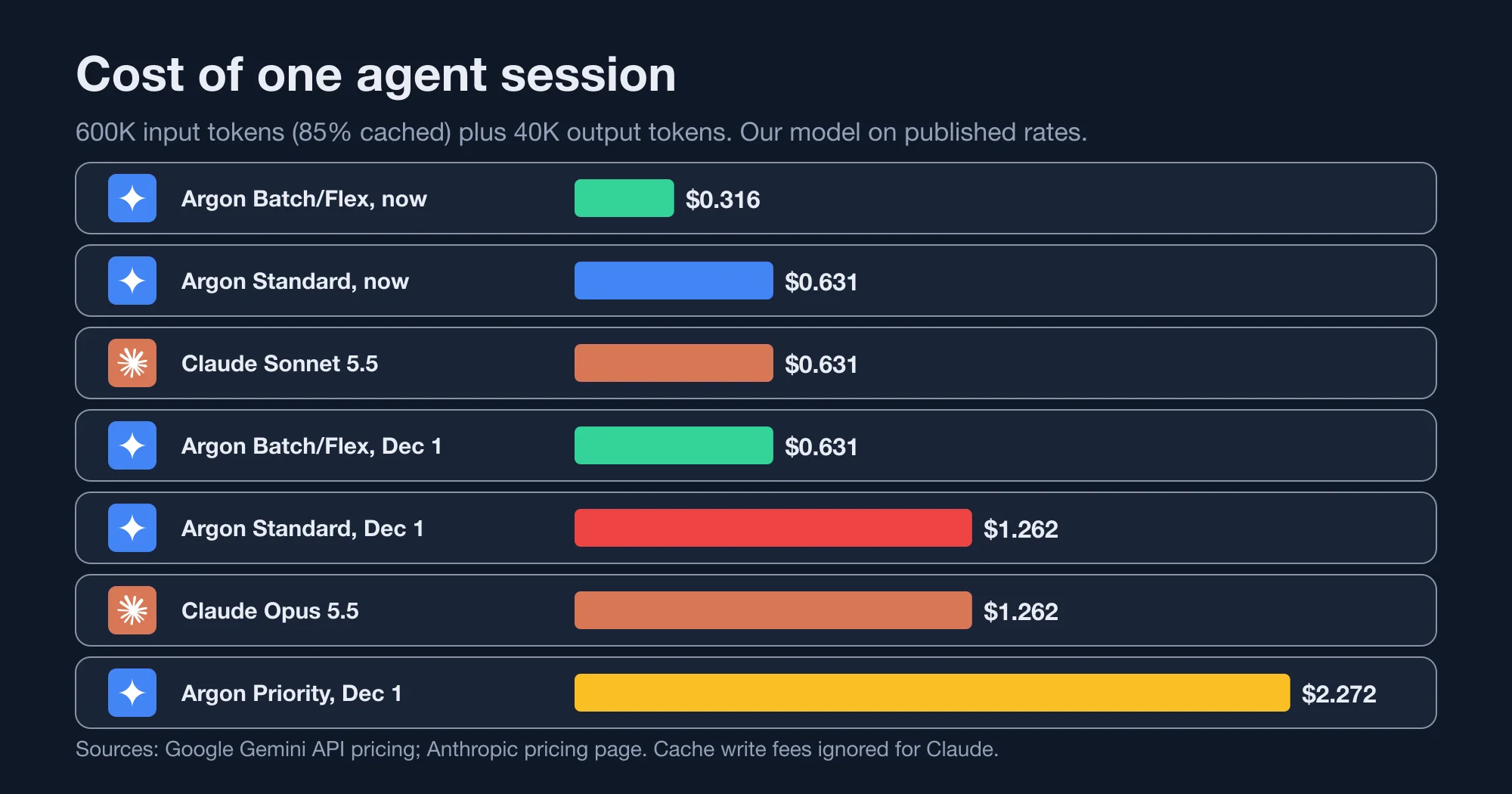
An agent session costs $0.63 on Standard today and $1.26 after December 1. A chat question costs $0.020 today and $0.040 after. Batch and Flex after the change match Standard today.
| Tier or model | Chat question | Agent session |
|---|---|---|
| Argon Standard, through Nov 30 | $0.020 | $0.631 |
| Argon Standard, from Dec 1 | $0.040 | $1.262 |
| Argon Batch or Flex, through Nov 30 | $0.010 | $0.316 |
| Argon Batch or Flex, from Dec 1 | $0.020 | $0.631 |
| Argon Priority, through Nov 30 | $0.036 | $1.136 |
| Argon Priority, from Dec 1 | $0.072 | $2.272 |
Output tokens carry most of the bill. In our agent session, the 40,000 output tokens cost $0.40 today, which is 63 percent of the $0.631 total. That matters because output is the part you control least. A model that thinks longer bills more, because the page says output includes thinking.
Which Claude model does Argon match before and after December 1?
Argon's current Standard price equals Claude Sonnet 5.5, and its December 1 price equals Claude Opus 5.5. Anthropic's pricing page lists Sonnet 5.5 at $2 per million input tokens, $0.10 for cache hits and $10 for output. It lists Opus 5.5 at $4, $0.20 and $20.
| Model | Input | Cache hit | Output | Agent session |
|---|---|---|---|---|
| Gemini 4 Argon, through Nov 30 | $2.00 | $0.10 | $10.00 | $0.631 |
| Claude Sonnet 5.5 | $2.00 | $0.10 | $10.00 | $0.631 |
| Gemini 4 Argon, from Dec 1 | $4.00 | $0.20 | $20.00 | $1.262 |
| Claude Opus 5.5 | $4.00 | $0.20 | $20.00 | $1.262 |
This is a price comparison, not a quality ranking. We did not test either model's output quality here. The point is narrower. After December 1, a team choosing Argon pays Opus 5.5 money, so Argon must beat Opus 5.5 on your own evaluations to justify the pick. Today it only has to beat Sonnet 5.5.
One caveat favors Argon. Anthropic charges extra to write to its prompt cache, at $2.50 per million tokens for Sonnet 5.5 on a five-minute write. We left cache writes out of the Claude numbers, so they understate a Claude session slightly. Google's page lists no cache write fee for Argon.
How big is a monthly bill at 1,000, 3,000 and 10,000 sessions?
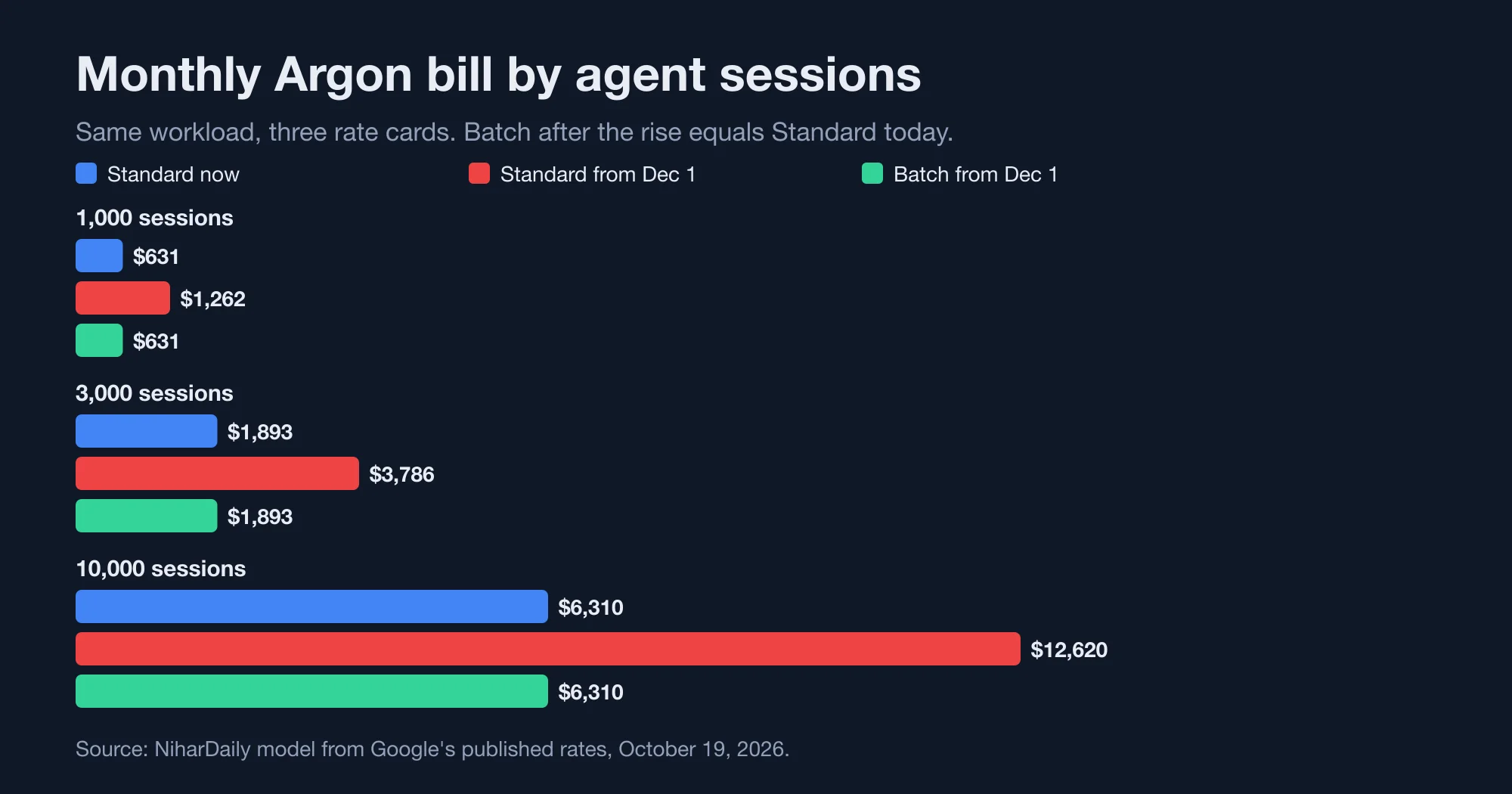
At 3,000 agent sessions a month, the bill rises from $1,893 to $3,786 on Standard. At 10,000 sessions it rises from $6,310 to $12,620. Moving the same volume to Batch or Flex after the change holds the bill at today's Standard level.
| Agent sessions per month | Standard now | Standard from Dec 1 | Batch from Dec 1 |
|---|---|---|---|
| 1,000 | $631 | $1,262 | $631 |
| 3,000 | $1,893 | $3,786 | $1,893 |
| 10,000 | $6,310 | $12,620 | $6,310 |
The extra cost is $631 per 1,000 sessions. A team that runs 10,000 sessions a month pays $6,310 more every month from December. Over a year, that is $75,720, before any growth in usage.
What happens when the cache misses?
A cache miss costs 2.5 times a cache hit on the same session. With no caching, our agent session costs $1.60 today and $3.20 after December 1, against $0.63 and $1.26 with 85 percent cache hits. The reason is that cached tokens cost one twentieth of fresh input tokens.
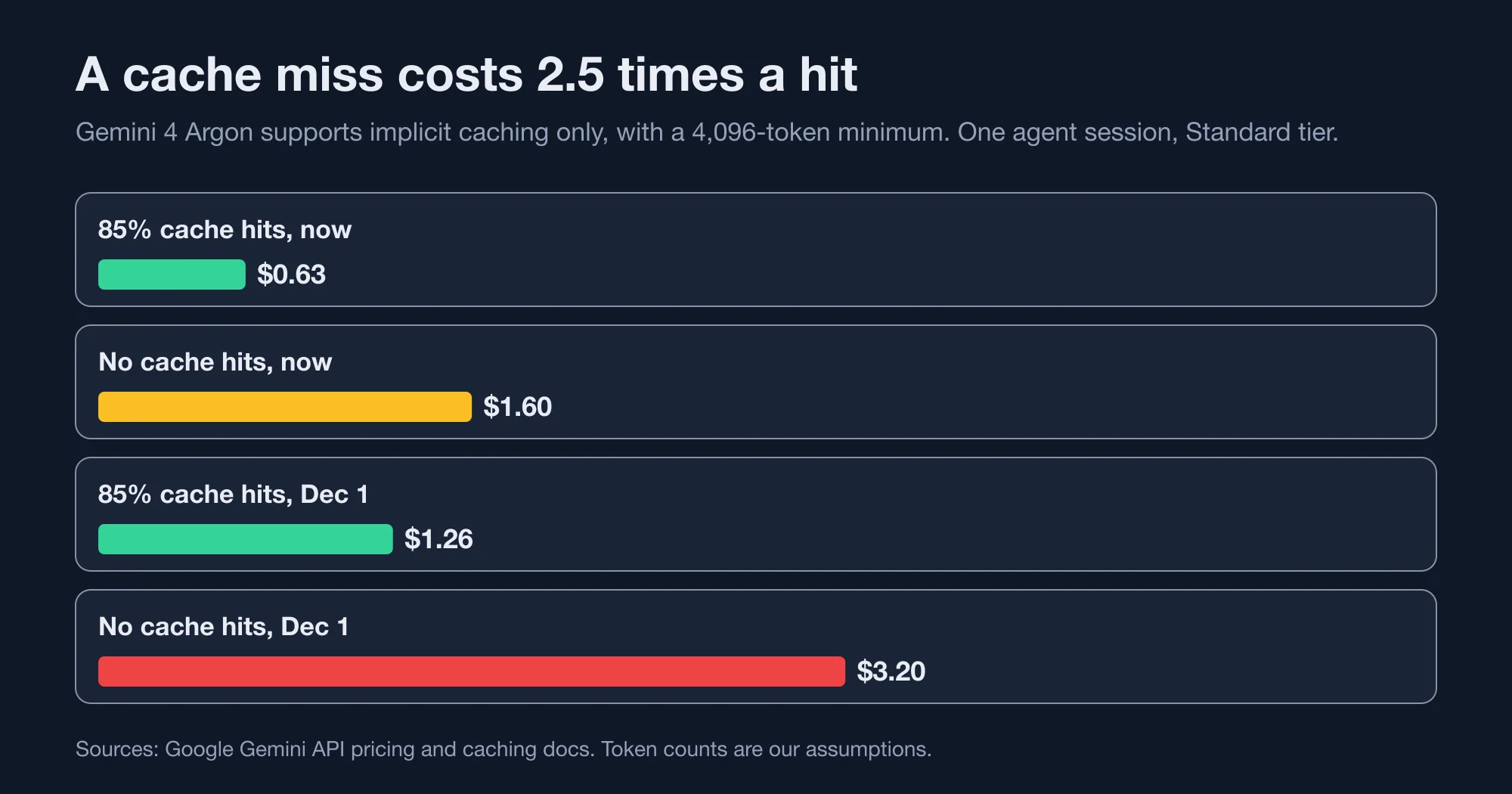
Argon gives you less control here than some rivals. Google's caching documentation says explicit caching is not supported for Gemini 4 Argon and later, and that implicit caching is on by default. Implicit caching is automatic reuse of a repeated prompt prefix, where the provider passes the savings on without any setup. The minimum is 4,096 input tokens for Argon.
Google says to put large, common content at the start of the prompt and to send requests with similar prefixes in a short time window. It also says the count of cached tokens appears in usage.total_cached_tokens. Log that field on every call. A falling cached count is the first sign your bill is about to double again.
Three habits protect the hit rate. Keep the system prompt and tool definitions byte-identical between calls. Append new messages at the end instead of editing earlier ones. And do not insert timestamps or request IDs near the top of the prompt, because one changed token early in the prefix breaks the match after it.
How much does grounding add?
Grounding adds nothing until you pass 5,000 requests a month, then $14 per 1,000. The 5,000 free requests are shared across Gemini 3 and newer models for Search and Maps each, per Google's page.
For example, an agent that searches three times per session uses 3,000 searches per 1,000 sessions. At 3,000 sessions a month, that is 9,000 searches. The first 5,000 are free, and the remaining 4,000 cost $56. That is small next to the $1,893 token bill, so grounding is rarely the budget problem. Token output is.
What does a support bot cost on Argon?
A support bot that handles 10,000 conversations a month costs about $73 now and $146 after December 1. That assumes each conversation sends 4,000 input tokens, of which a 3,000-token system prompt is cached, and returns 500 output tokens. The workload is our assumption, so swap in your own counts.
The math per conversation is 1,000 fresh tokens at $2.00, 3,000 cached tokens at $0.10 and 500 output tokens at $10.00, divided by one million. That is $0.0073, or $73 for 10,000 conversations. After the change it is $0.0146, or $146. A short chat is cheap enough that the doubling stays small in dollars.
The lesson is about shape, not size. Short chats with a cached prefix cost cents per thousand. Long agent sessions with big outputs cost dollars per thousand. So the December increase hurts agents far more than chatbots in absolute terms, and the cheapest fix for agents is the same either way: cache hits and Batch.
What should you do before December 1?
Measure your cache hit rate this week, move anything asynchronous to Batch or Flex, and decide which model earns its December price. None of these needs a code rewrite.
- Measure cache hits. Log
usage.total_cached_tokensfor a week. If hits are below 85 percent in an agent loop, fix the prompt prefix first. - Split the workload. Anything a user is not waiting for, such as nightly summaries, evals and backfills, goes to Batch or Flex. After December 1 those tiers cost what Standard costs today.
- Check what the tier terms mean. Google's page lists Batch and Flex at the same price. We did not read the latency or availability terms, so confirm them before moving traffic.
- Re-run your evals. Compare Argon to Sonnet 5.5 and Opus 5.5 on your own tasks, at your own token counts, with December prices.
- Set a budget alert. A doubling is easy to miss in a monthly total. Alert on cost per session, not only on monthly spend.
The bottom line is that November 30 is a date to budget around, not a deadline to rush. Prices change in six weeks for every tier at once. Teams that measure cache hits and split their workload now will see the increase as a line on a dashboard. Teams that do not will see it as a surprise invoice.
If you are building an agent product, bake the cost per session into your pricing model before the rate changes. What a 30-second AI explainer video costs, line by line shows the same discipline applied to video: list every unit, multiply, then check which one dominates. Here the dominant unit is output tokens.
Advertisement
FAQ
How much does Gemini 4 Argon cost per million tokens?
Through November 30, 2026, Standard costs $2.00 per million input tokens, $10.00 per million output tokens and $0.10 for cached input. From December 1 those become $4.00, $20.00 and $0.20. Batch and Flex are half of Standard. Priority is $3.60 and $18.00 now, rising to $7.20 and $36.00.
When does Gemini 4 Argon pricing go up?
Google's pricing page lists the higher rates as starting December 1, 2026, with the lower rates applying through November 30. Every tier doubles, including input, output and cached input. The page does not call the lower price introductory and lists no way to lock it in.
Is Gemini 4 Argon cheaper than Claude Sonnet 5.5?
No, they cost the same today. Argon Standard is $2.00 input, $0.10 cached and $10.00 output, and Sonnet 5.5 lists the same three numbers. After December 1, Argon matches Claude Opus 5.5 at $4.00, $0.20 and $20.00 instead.
Does Gemini 4 Argon support context caching?
Only implicit caching. Google's documentation says explicit caching is not supported for Gemini 4 Argon, and implicit caching is on by default with a 4,096-token minimum. Put shared content at the start of the prompt and check usage.total_cached_tokens to confirm hits.
How can I lower my Gemini 4 Argon bill?
Raise your cache hit rate, move asynchronous work to Batch or Flex, and cap output length. A session with 85 percent cache hits costs $0.63 now against $1.60 with none. After December 1, Batch and Flex cost what Standard costs today.
Comments
Loading…
Sign in to join the conversation.
Related posts
What an AI-resolved support ticket really costs in 2026
AI customer support agent pricing per resolution runs from $0.50 to about $4.00 for the same solved ticket. HubSpot charges $0.50 per resolved conversation, Fin charges $0.99, and Zendesk charges
Mon Oct 19 2026 · 10 min read · 0 views
What Claude's new OpenTelemetry traces actually send out
Claude API OpenTelemetry traces are now in public beta, and the default setting sends no prompts at all. We ran the Anthropic Python SDK against a mock server and counted what leaves your app.
Mon Oct 19 2026 · 10 min read · 0 views
Porting AutoGen to Microsoft Agent Framework: what breaks
An AutoGen to Microsoft Agent Framework migration is mostly a rename, except for four defaults that change silently. We ported a two-agent writer and reviewer team on Python 3.15.0, from AutoGen 0.7.5
Mon Oct 19 2026 · 10 min read · 0 views