Supabase Alternatives: What to Use and When
By Nihar Ranjan Das · Fri Oct 09 2026 · 7 min read · 0 views
View as a Web StorySoftware#backend#supabase#supabase-alternatives#firebase#neon
The best Supabase alternative depends on which part of Supabase you actually use. If you want the same Postgres-plus-auth-plus-storage bundle, use Nhost. If you only need a database, use Neon. If you want a realtime backend with no SQL, use Convex or Firebase. If you want one file you can run anywhere, use PocketBase.
People leave Supabase for four reasons: the free tier pauses idle projects, the jump from Free to Pro is $25 per month per organization with per-project compute on top, they want a different data model, or they want to self-host. Each reason points to a different replacement. This guide matches reason to tool, using the pricing pages we read on October 9, 2026, and ends with a switch test that shows how locked in you really are.
Supabase alternatives at a glance
Supabase is an open-source backend platform built on PostgreSQL that bundles a database, authentication, file storage, realtime subscriptions and edge functions. An alternative has to replace the part you use, and most apps use only two or three of those pieces.
| If you need | Use | Why |
|---|---|---|
| Postgres + auth + storage, same shape | Nhost | Postgres with GraphQL, auth and storage |
| Only a managed Postgres database | Neon | Scale to zero, branching, usage billing |
| Reactive backend in TypeScript | Convex | Functions and database in one product |
| Mobile-first realtime documents | Firebase | Firestore plus Auth, no SQL |
| One binary you host yourself | PocketBase | SQLite, auth and API in a single executable |
| Stay on Supabase but cheaper | Self-host or Neon plus an auth library | Split the bundle |
What the free tiers really give you
Free tiers differ more in behavior than in size. Size is easy to read, so start there.
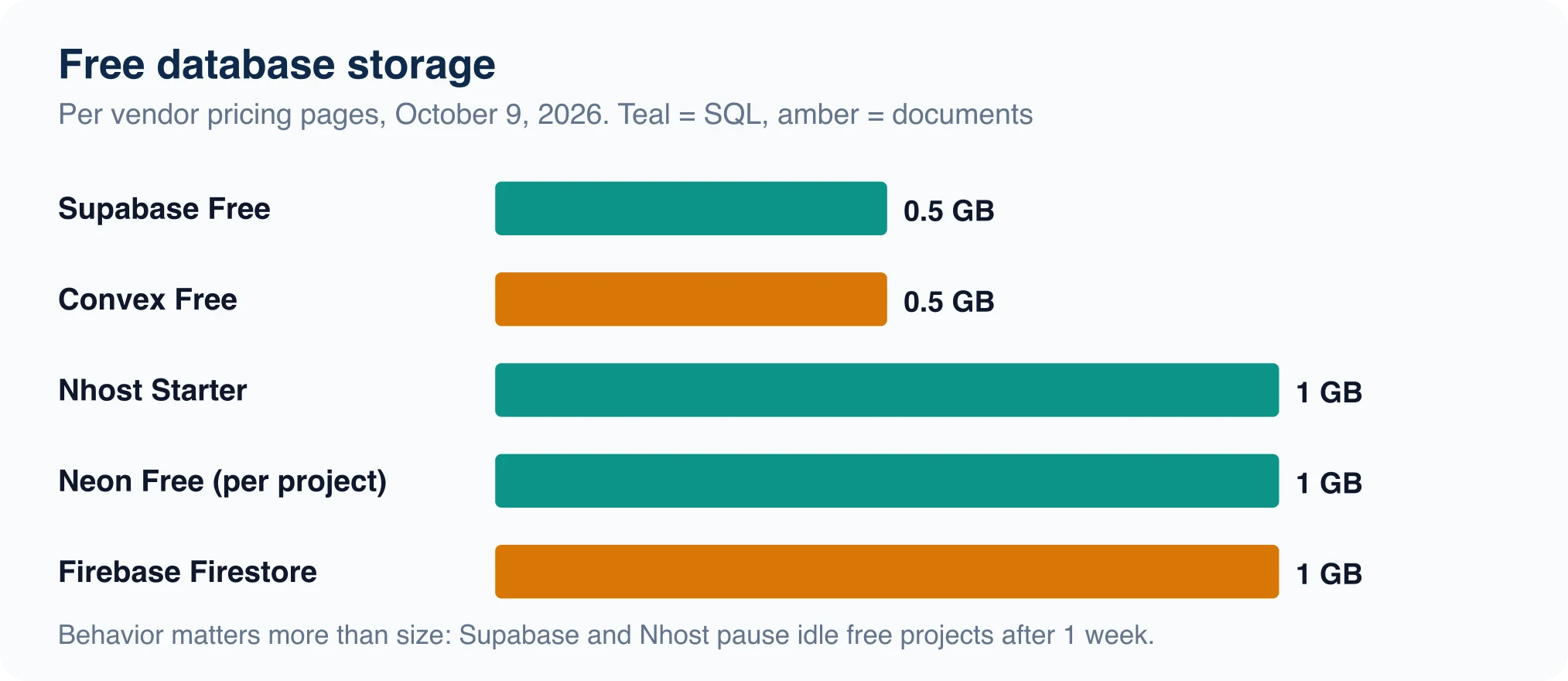
| Provider | Free database storage | Idle behavior | Paid entry |
|---|---|---|---|
| Supabase | 500 MB, 2 active projects | Paused after 1 week of inactivity | Pro from $25 per month |
| Nhost | 1 GB, 1 project | Paused after 1 week of inactivity | Pro from $25 per month |
| Neon | 1 GB per project, 20 GB total | Scales to zero after 5 minutes, no pause | Pay as you go |
| Convex | 0.5 GB | Not stated on the page | $25 per developer per month |
| Firebase | 1 GiB Firestore | Not paused | Blaze, usage above free quota |
The pause rule is the one that bites. A Supabase or Nhost free project that nobody touches for a week is paused, and your demo link stops working until you resume it. Neon works differently: compute suspends after five minutes and wakes on the next connection, so the first request is slower but the project stays alive. Firebase's free Firestore quota is a daily one, 50,000 reads and 20,000 writes per day, and it applies to the whole project.
Nhost adds one useful behavior: it says it never stops a project for exceeding limits and charges for the excess instead. That protects a launch day spike from an outage but can surprise you on the invoice. Set a budget alert.
What a small app really pays
Sticker prices hide the per-project rule. Supabase's pricing page says a Pro organization includes $10 per month of compute credit, and each additional project adds its full compute cost. Its own example is a Pro organization with two Micro projects, which costs $35 per month, not $50.
That matters if you run a staging project beside production. Compare it with Nhost, where the Pro plan allows unlimited projects, and with Neon, where a branch for staging costs $1.50 per branch-month beyond the included ten on Launch. A common pattern for small teams is one production database and one cheap branch, and the branch model is cheaper than a second full project. Write down your real project count before you compare plans.
Nhost: the closest swap
Nhost mirrors the Supabase shape. Its Starter plan is free with 1 GB of database, 1 GB of storage and 5 GB of egress. Pro starts at $25 per month with 10 GB of database, 50 GB of storage and 50 GB of egress included, then $0.20 per extra database GB.
Advertisement
Choose it when you like Postgres and want auth and storage under one roof, and when GraphQL fits your team. The migration is mostly configuration: export the schema with pg_dump, restore it, recreate row-level policies, and point your client at the new endpoints.
Neon: when you only need the database
If you use Supabase for Postgres and nothing else, Neon is the cleanest swap. Its Launch plan bills $0.106 per compute-unit hour and $0.35 per GB-month, with no monthly minimum. Free projects get 100 compute-unit hours and 10 branches each. Suspended compute costs nothing.
The tradeoff is that Neon is a database and nothing more. You bring your own auth and file storage. For many apps that is a feature, because auth libraries and object storage are easy to swap independently and cost less than a bundle. See our cloud database comparison for Neon's security features by plan.
Convex and Firebase: when you want to leave SQL
Both replace the database with a document model and tie it to realtime updates.
Convex pairs a reactive database with TypeScript functions. Its free plan includes 0.5 GB of storage, 1 million function calls and 1 GB of bandwidth, and Professional is $25 per developer per month with 50 GB of storage. Use it when your app is TypeScript from end to end and live updates are the core feature.
Firebase pairs Firestore with Authentication, hosting and cloud functions. The free quota is 1 GiB stored, 10 GiB egress per month, 50,000 reads and 20,000 writes per day, and Identity Platform includes 50,000 monthly active users free. It suits mobile apps that need offline sync. It bills by reads and writes, so a chatty client can cost more than a heavy query, which is the opposite of Postgres.
If you are comparing Firebase and Supabase directly, the question is data model. Firestore stores documents and cannot join. Supabase stores tables and can. Choose Firebase for offline-first mobile with simple access patterns, and choose a Postgres option for anything with reporting. Our PostgreSQL vs MongoDB guide explains the same tradeoff for documents.
PocketBase: one file, your server
PocketBase is an open-source backend in a single executable. It embeds SQLite and adds realtime subscriptions, auth, a dashboard and a REST-style API. You start it with ./pocketbase serve and it creates pb_data and pb_migrations folders next to the binary. The current version listed in its docs is v0.40.5.
The warning in its own documentation is the part to read twice: full backward compatibility is not guaranteed before v1.0.0, and it is not yet recommended for critical production applications unless you accept following the changelog and applying manual migrations. That makes PocketBase excellent for side projects, internal tools and prototypes, and a deliberate risk for a paying product. Because it uses SQLite, our guide to opening a .db file is useful for inspecting its data.
The switch test: how locked in are you?
Here is the extra step most comparisons skip. Before you pick a replacement, score your own app on five questions. Each "yes" means the move is easy.
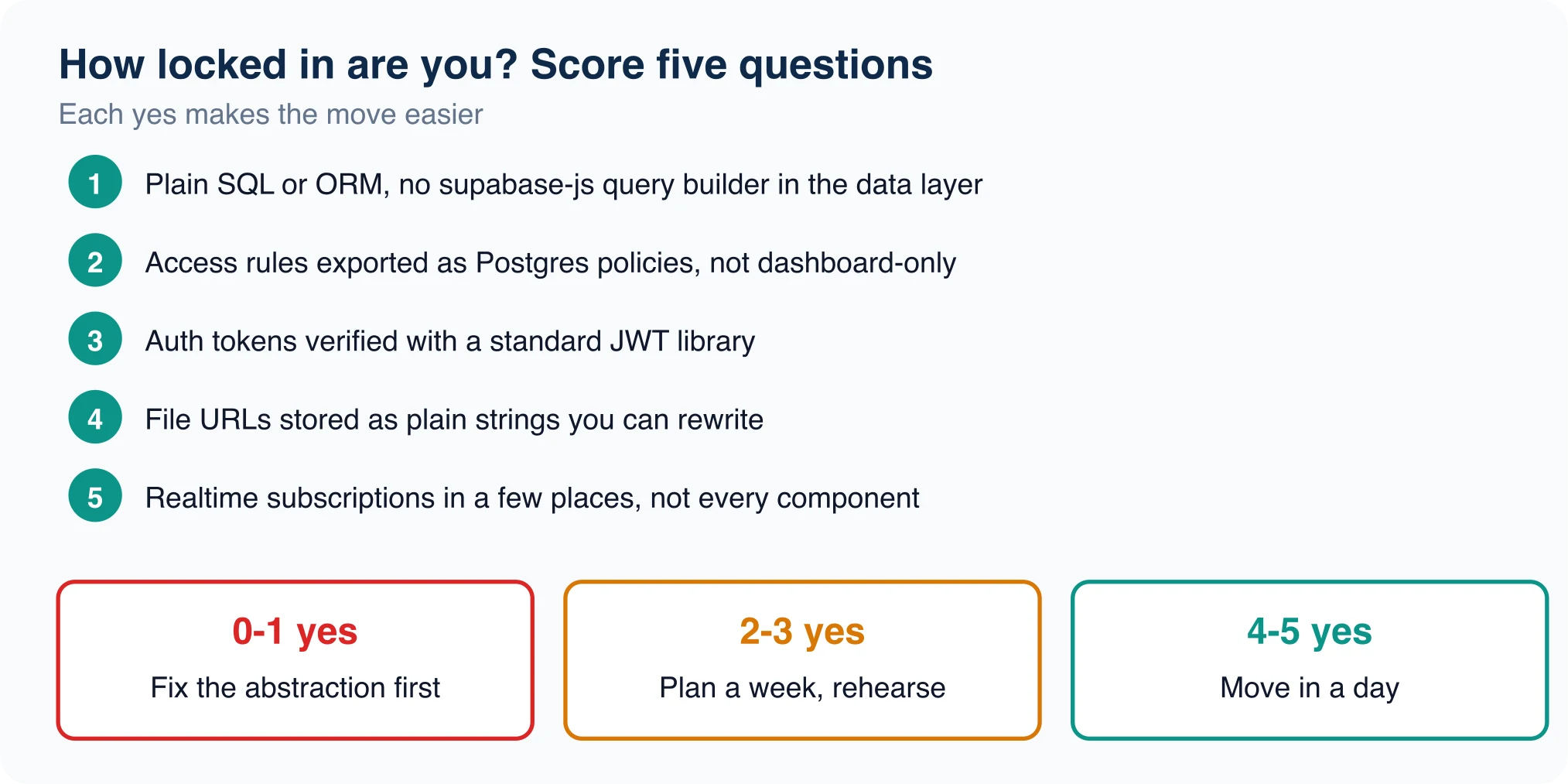
- Does your app use plain SQL or an ORM, with no
supabase-jsquery builder in the data layer? - Are your access rules written as Postgres policies that you can export, not as dashboard-only settings?
- Do you verify auth tokens with a standard JWT library instead of a Supabase-only helper?
- Are file URLs stored in your tables as plain strings you can rewrite?
- Do you subscribe to changes in a few places, not in every component?
Score 4 or 5: move in a day. Score 2 or 3: plan a week and rehearse. Score 0 or 1: you are locked in by code, not by contract, so keep Supabase and fix the abstraction first.
Because Supabase is PostgreSQL underneath, the database itself is portable. Dump it, restore it elsewhere and verify. Our data migration strategy guide gives the four-number check for proving the data arrived.
Choosing in one minute
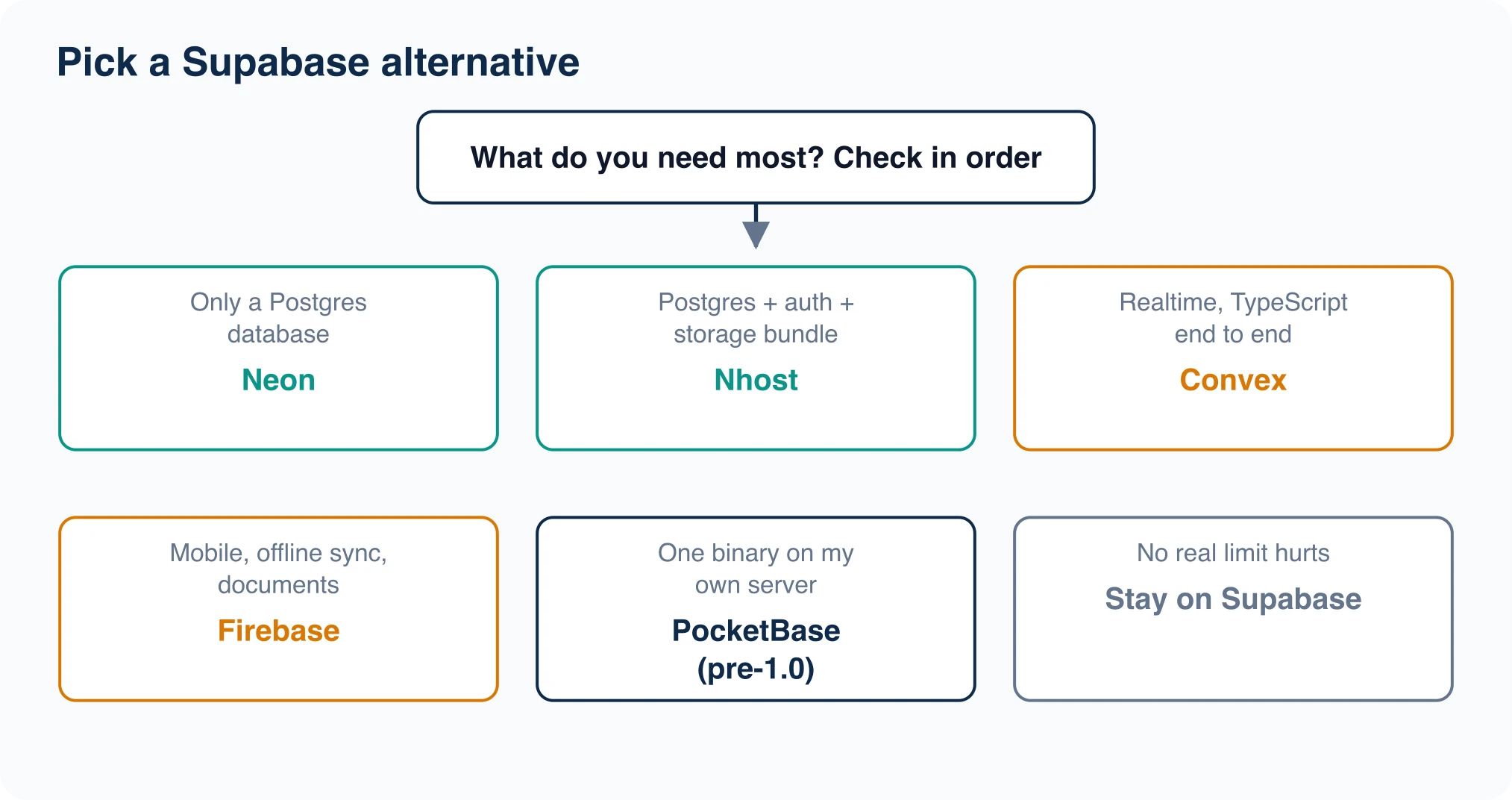
- Want to keep SQL? Pick Neon for the database only, or Nhost for the bundle.
- Want realtime without SQL? Pick Convex for TypeScript, or Firebase for mobile.
- Want to host it yourself? Pick PocketBase for small projects, or run Postgres yourself.
- Not sure? Stay put until a real limit hurts. Moving costs a week; a pause or a bill is cheaper.
Advertisement
FAQ
What is the best free alternative to Supabase?
Neon is the best free alternative if you only need Postgres: its free plan gives 100 compute-unit hours and 1 GB per project, and it scales to zero rather than pausing a project. Nhost is the closest full replacement.
Is Firebase better than Supabase?
Not in general. Firebase is a document database with offline sync and per-read billing, and Supabase is relational Postgres with SQL and joins. Choose by data model: documents and mobile sync favor Firebase, reporting and relations favor Supabase.
Can I self-host Supabase?
Supabase is open source and can be self-hosted, but running the full stack yourself means operating the database, auth, storage and realtime services. Many teams find a managed Postgres plus a lightweight auth library simpler.
Does Supabase pause free projects?
Yes. Its pricing page says free projects are paused after one week of inactivity, and paused projects can be resumed. Pro and Team projects are not paused for inactivity.
Is PocketBase production ready?
Its own documentation says it is not yet recommended for critical production applications before v1.0.0 unless you accept manual migrations. It is a good fit for prototypes and internal tools.
Comments
Loading…
Sign in to join the conversation.
Related posts
Relational Databases: Top 10 Ranked and How They Work
Oracle still leads the October 2026 DB-Engines list of relational databases, but PostgreSQL is the only top-four system that gained ground this year. PostgreSQL scored 688.75, up 45.56 points from
Fri Oct 09 2026 · 9 min read · 1 views
What Is PostgreSQL? A Plain-English Guide With Real Tests
PostgreSQL is a free, open-source relational database that stores data in tables and answers questions written in SQL. It began in 1986 as the POSTGRES project at the University of California,
Fri Oct 09 2026 · 8 min read · 0 views
Serverless Databases Compared: What They Cost in 2026
A serverless database costs the least when your app sits idle, and the most when it runs all day. That single fact decides most purchases. A hobby app can run free on Neon, Turso or Cloudflare D1. An
Fri Oct 09 2026 · 9 min read · 0 views