SQL vs NoSQL in 2026: Which to Choose
By Nihar Ranjan Das · Fri Oct 09 2026 · 8 min read · 0 views
View as a Web StorySoftware#postgresql#mongodb#nosql#sql#Databases
Choose SQL when your data has clear relationships and you need joins, transactions and a fixed shape. Choose NoSQL when your data is document-shaped, key-based or enormous and you read it by one key more than by many fields. In 2026 that is a softer line than it used to be, because the biggest "SQL" databases now store documents and the biggest "NoSQL" databases now offer SQL-like queries.
This post gives you the decision first, then the October 2026 popularity data behind it, and then two tests I ran so the advice rests on measurements rather than slogans. It also answers the sibling question, "MongoDB vs SQL", because it is the same decision with a brand name attached.
SQL vs NoSQL in one table
| SQL (relational) | NoSQL | |
|---|---|---|
| Data shape | Tables with rows and typed columns | Documents, key-value pairs, wide columns or graphs |
| Schema | Defined up front, enforced by the database | Flexible, often enforced by your code |
| Relationships | Joins across tables | Embed related data, or join in the app |
| Transactions | Multi-row ACID is standard | Strong within a document; across documents varies by product |
| Scaling | Scale up first, then replicas and sharding | Built to spread across many machines |
| Query language | SQL | Product-specific query APIs |
| Examples | PostgreSQL, MySQL, SQLite, SQL Server | MongoDB, Redis, Cassandra, DynamoDB, Firestore |
The words "SQL" and "NoSQL" describe a query language and a loose family of exceptions to it. They do not describe one design. "NoSQL" now means four or five unrelated designs that share only the fact that they are not a classic relational engine.
What the popularity data says
The DB-Engines ranking blends mentions, job postings, searches and discussion into one score. Its October 2026 list covers 440 systems, and the top of it looks like this:
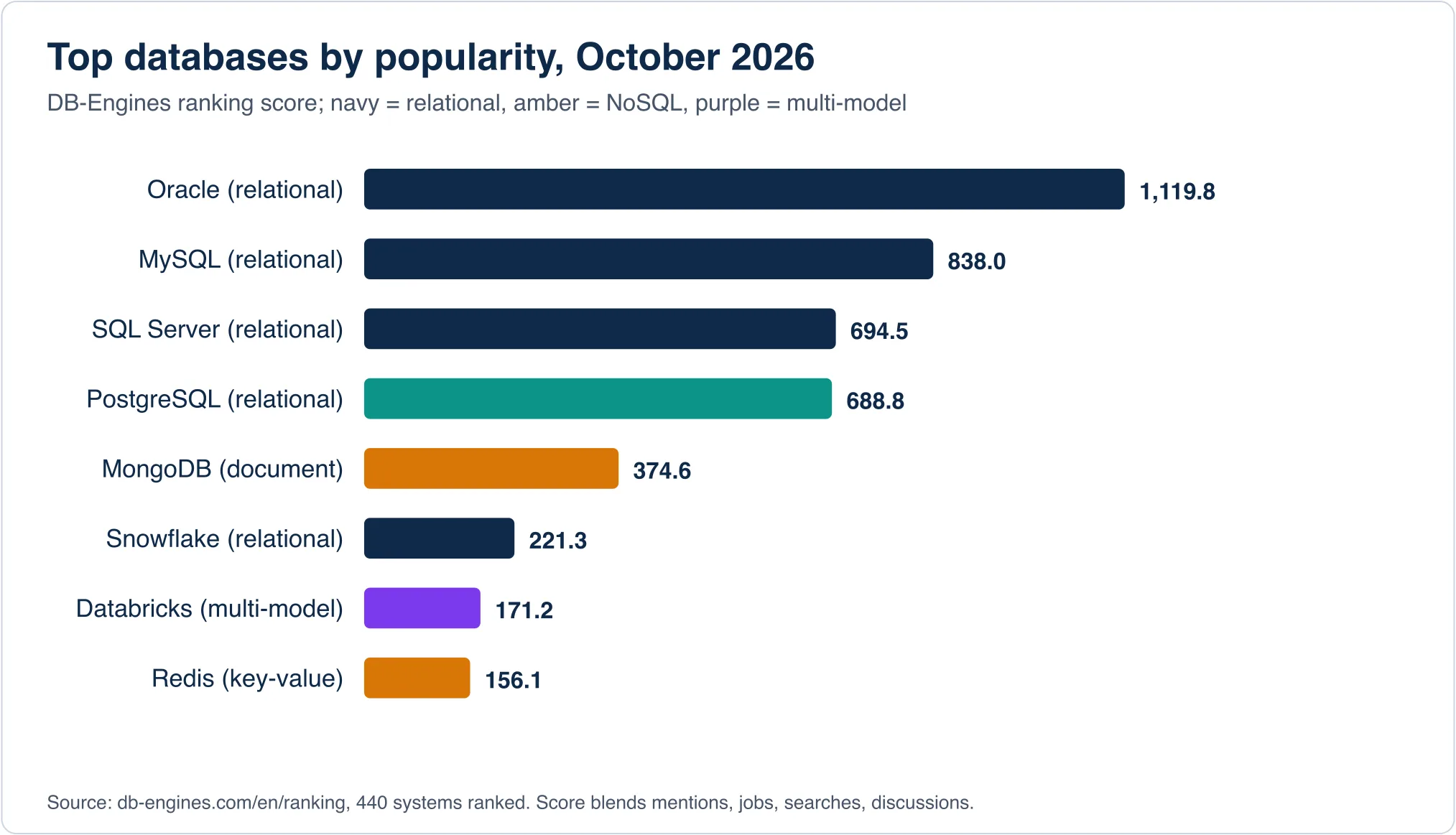
Four of the top five are relational. The first non-relational system, MongoDB, scores 374.6, about a third of Oracle's 1,119.8. PostgreSQL is the one moving: it gained 45.56 points over the past year while Oracle lost 92.98 and MySQL lost 41.70. Popularity is not performance, and these are signals of what people search for and hire for, not proof of quality. But for a team choosing a stack, "can I hire for it" and "will the answer exist on a forum" are real costs.
Note what sits at number seven. Databricks is classed as multi-model, and Snowflake at number six is relational. Much of the growth in the last two years sits in analytics platforms, a third category that neither word in "SQL vs NoSQL" describes.
The line has blurred
Here is the finding that changes the advice. DB-Engines lists the models each system supports. The "SQL" systems claim document support, and the "NoSQL" systems claim a long list of models:
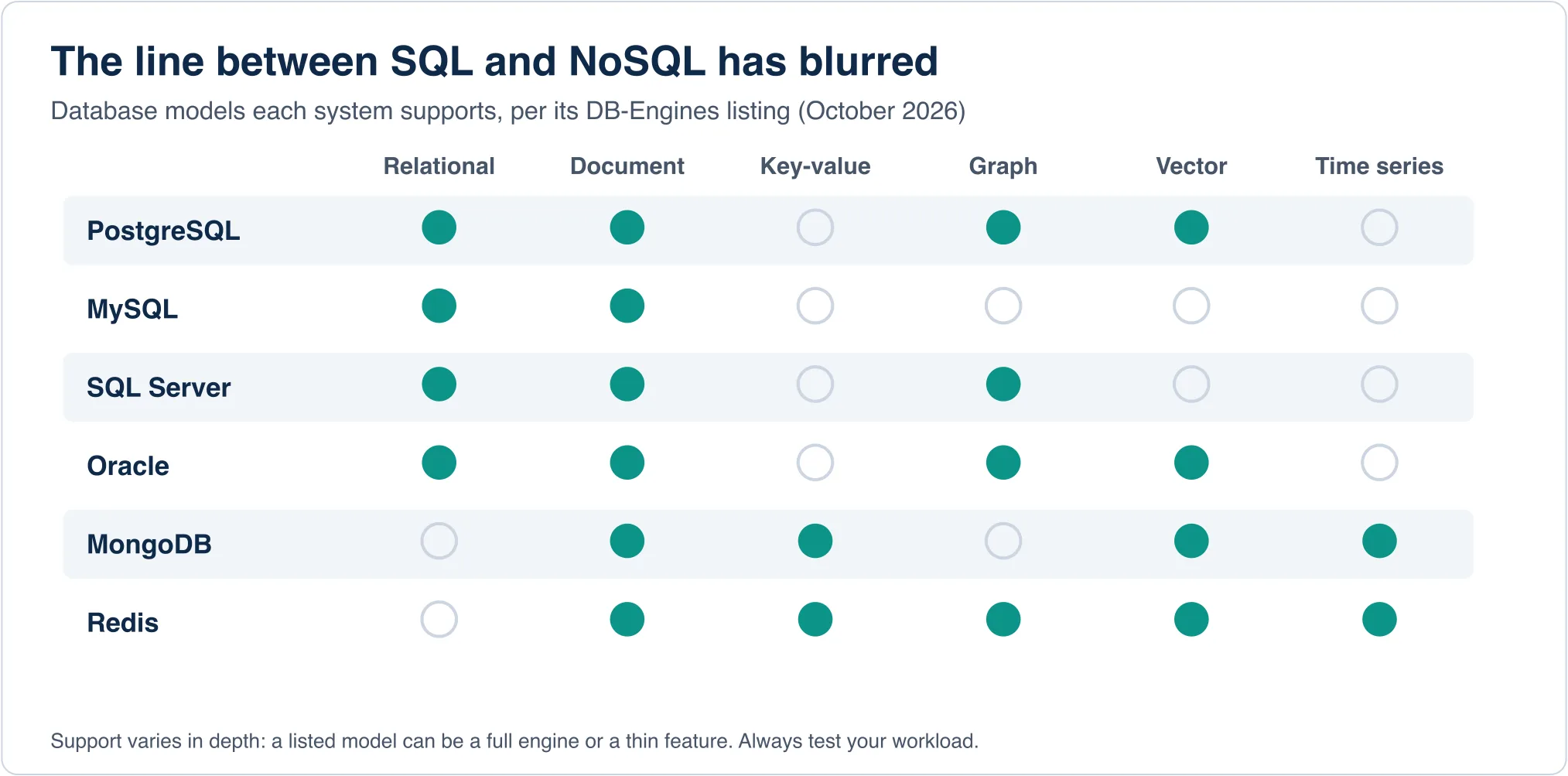
PostgreSQL, MySQL, SQL Server and Oracle all list document-store support next to relational. PostgreSQL also lists graph, spatial and vector. MongoDB lists key-value, search, time series and vector next to document. A listed model can be a full engine or a thin add-on, so I tested the one that matters most to this decision.
Advertisement
Test 1: can a SQL database act like a document store?
I loaded 2 million rows into a PostgreSQL 18 table with a jsonb column holding {"sku": "A7", "qty": 3}, added a GIN index, and flagged every hundredth row with a new field "gift": true, which no other row has. That is the "different fields per record" case that sends people to document databases.
- Adding the new field to 20,000 documents needed no schema change at all. The update of 20,000 rows ran in 0.3 seconds.
- Finding every document with the new field, using
meta @> '{"gift": true}', returned 20,000 rows in 30 ms through the index. - Filtering on two fields inside the JSON with no index on them returned 40,000 rows in 148 ms, which is a full scan of 2 million rows.
So a jsonb column handles flexible fields well, and it handles index-backed lookups on them. What it does not do is replace document-database sharding. If your data does not fit one server, that is a different question, and the longer comparison in PostgreSQL vs MongoDB covers the JSONB query numbers in more detail.
Test 2: is changing a SQL schema painful?
The classic argument for NoSQL is that you add a field and move on, while SQL makes you run a migration. On the same 2-million-row table I timed both kinds of ALTER TABLE:
- Adding a column with a constant default,
ADD COLUMN status text NOT NULL DEFAULT 'new', took 0.17 seconds, and a second, similar column took 0.46 seconds. PostgreSQL stores the default in the catalog and does not rewrite the table. - Adding a column whose default is a volatile function,
DEFAULT (random()*10)::int, took 4.9 seconds, because each row needs its own value written.
The lesson: in PostgreSQL the "schema change is slow" objection applies only to defaults that differ per row and to type changes. Most real migrations are the fast kind. SQLite behaves differently, with its own rules about ALTER, covered in the SQLite CREATE TABLE guide. The cost that remains is coordination: every application that reads the table must handle the new column. Both worlds pay that cost, and the database migration process explains how to do it safely.
What you give up by leaving SQL
Rather than run a benchmark whose result depends on my hardware, here is what you lose, stated plainly, because it is the part sales pages skip.
- Joins. In a document store you either embed related data, which duplicates it, or look it up in a second query from your application. If a customer's address is embedded in 40,000 orders, changing it means 40,000 writes.
- Constraints. A relational database refuses a row that breaks a foreign key or a
CHECK. A document store accepts it and your code finds out later. In a quick test of SQLite, inserting text into an integer column succeeded until I made the tableSTRICT, which shows how much of this safety is opt-in even in SQL. - Ad hoc reporting. Analysts know SQL. Every non-SQL product needs its own query language or a connector.
And here is what you gain: horizontal scale without sharding code, single-digit-millisecond key lookups at huge volume, and a data model that matches your objects.
When SQL is the right default
Pick SQL, and in practice PostgreSQL, when:
- Your entities reference each other: users, orders, invoices, payments.
- Money, inventory or bookings are involved, where two writes must succeed together or not at all.
- You do not yet know your queries. A relational model survives questions you did not plan for.
- The team is small and one database must do several jobs. PostgreSQL covers relational data, JSON documents, full-text search, queues and vectors well enough for most products' first years.
If you are choosing between two relational engines, the PostgreSQL vs MySQL decision table compares them with measured query times.
When NoSQL is the right choice
Pick NoSQL when the workload fits one of these:
- Key-value at huge scale: sessions, caches, rate limiters and counters. Redis and DynamoDB are built for this, and Redis ranks eighth overall in October 2026.
- Documents read whole: a product catalog or content record that you always fetch by id and rarely join. MongoDB is the standard answer.
- Massive write streams: event logs, telemetry and time-ordered data spread over many nodes. Cassandra and time-series stores are built for it.
- Deep relationship traversal: friends-of-friends and fraud rings, where a graph database such as Neo4j beats a many-join query.
Most of these pair well with a relational core instead of replacing it. A typical production setup is PostgreSQL for the source of truth and Redis for the cache.
"MongoDB vs SQL" is the same question
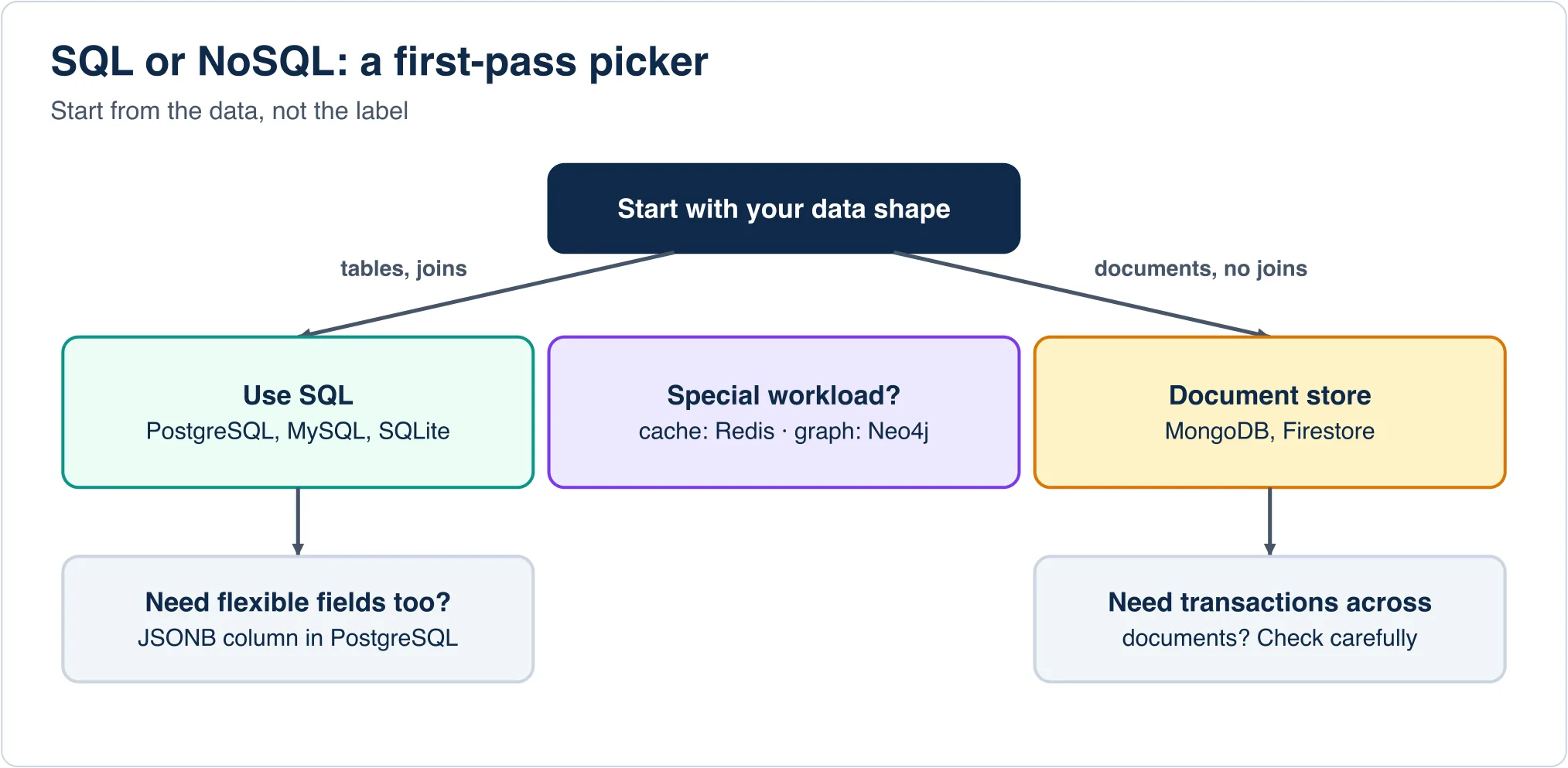
People search for "MongoDB vs SQL", "does MongoDB use SQL" and "MongoDB advantages over SQL". The answers are short. MongoDB does not use SQL. It has its own query language and an aggregation pipeline, though SQL-style access is offered through connectors and extra products. Its advantage is a flexible document model with built-in sharding and replication. SQL's advantage is joins, constraints and a mature reporting ecosystem. The side-by-side test is the PostgreSQL vs MongoDB post, which includes a decision flow and JSONB query times.
A checklist before you decide
- List your five most important queries. If three of them join tables, choose SQL.
- Estimate your data in two years. Under a few hundred gigabytes and one region, one PostgreSQL server is almost always enough.
- Ask who will run it. A managed service removes most operations work for either family. The best cloud database guide compares the managed options.
- Pick the boring option and keep an exit: use an ORM or repository layer so one table can move later.
- Re-check in a year. If a single access pattern dominates, add a specialised store next to your relational one. Do not migrate everything.
For the wider map of models, including graph, vector and time-series, read database types explained. Popularity numbers come from the DB-Engines ranking, and the PostgreSQL JSON behaviour is documented on the JSON types page.
Advertisement
FAQ
What is the main difference between SQL and NoSQL?
SQL databases store typed rows in tables and link them with joins. NoSQL covers several designs, such as documents, key-value pairs and graphs, that trade joins and fixed schemas for flexibility or scale.
Does MongoDB use SQL?
No. MongoDB has its own query language and aggregation pipeline, though SQL-style access exists through connectors and add-on products.
Is NoSQL faster than SQL?
Not in general. NoSQL stores are fast at the access pattern they were built for, such as key lookups. A well-indexed relational database is fast for most application queries.
Can PostgreSQL replace MongoDB?
For flexible fields, often yes: a jsonb column with a GIN index returned 20,000 matches from 2 million rows in 30 ms in my test. It does not replace MongoDB's built-in horizontal sharding.
Which is better for a startup, SQL or NoSQL?
SQL, usually PostgreSQL, because you rarely know your queries yet and one relational database can also hold JSON documents, search and vectors.
Comments
Loading…
Sign in to join the conversation.
Related posts
Relational Databases: Top 10 Ranked and How They Work
Oracle still leads the October 2026 DB-Engines list of relational databases, but PostgreSQL is the only top-four system that gained ground this year. PostgreSQL scored 688.75, up 45.56 points from
Fri Oct 09 2026 · 9 min read · 1 views
What Is PostgreSQL? A Plain-English Guide With Real Tests
PostgreSQL is a free, open-source relational database that stores data in tables and answers questions written in SQL. It began in 1986 as the POSTGRES project at the University of California,
Fri Oct 09 2026 · 8 min read · 0 views
Serverless Databases Compared: What They Cost in 2026
A serverless database costs the least when your app sits idle, and the most when it runs all day. That single fact decides most purchases. A hobby app can run free on Neon, Turso or Cloudflare D1. An
Fri Oct 09 2026 · 9 min read · 0 views