Database Types Explained With Use Cases
By Nihar Ranjan Das · Fri Oct 09 2026 · 8 min read · 0 views
View as a Web StorySoftware#postgresql#mongodb#Databases#Redis#Architecture
There are eight database types worth knowing in 2026: relational, document, key-value, wide-column, time-series, graph, search and vector. Each stores data in a different shape and is fast at a different job. If you only need a starting point, pick relational. PostgreSQL covers more of the other seven than most people expect.
This guide explains each type in plain terms, shows which products lead each one according to the October 2026 DB-Engines ranking, and ends with a picker you can use on your own project. All counts and scores below were read from DB-Engines in October 2026.
The short list
| Type | Stores data as | Best for | Leading system (score) |
|---|---|---|---|
| Relational | Tables with rows and columns | Orders, accounts, anything with joins | Oracle (1,119.8) |
| Document | JSON-like documents | Content, catalogs, varied fields | MongoDB (374.6) |
| Key-value | A key and a value | Caches, sessions, counters | Redis (156.1) |
| Wide-column | Rows with flexible column families | Huge write volume across many nodes | Cassandra (98.9) |
| Search | Inverted indexes | Full-text search, log search | Elasticsearch (94.1) |
| Graph | Nodes and relationships | Many-hop relationship queries | Neo4j (48.9) |
| Time-series | Timestamped measurements | Metrics, sensors, finance ticks | InfluxDB (21.2) |
| Vector | Embeddings | Semantic search, RAG | Elasticsearch (94.1) in the vector category |
"Leading" here means popular, not best. DB-Engines scores mentions, job ads, searches and discussion, so a high score means a large community, which is a real advantage but not a benchmark.
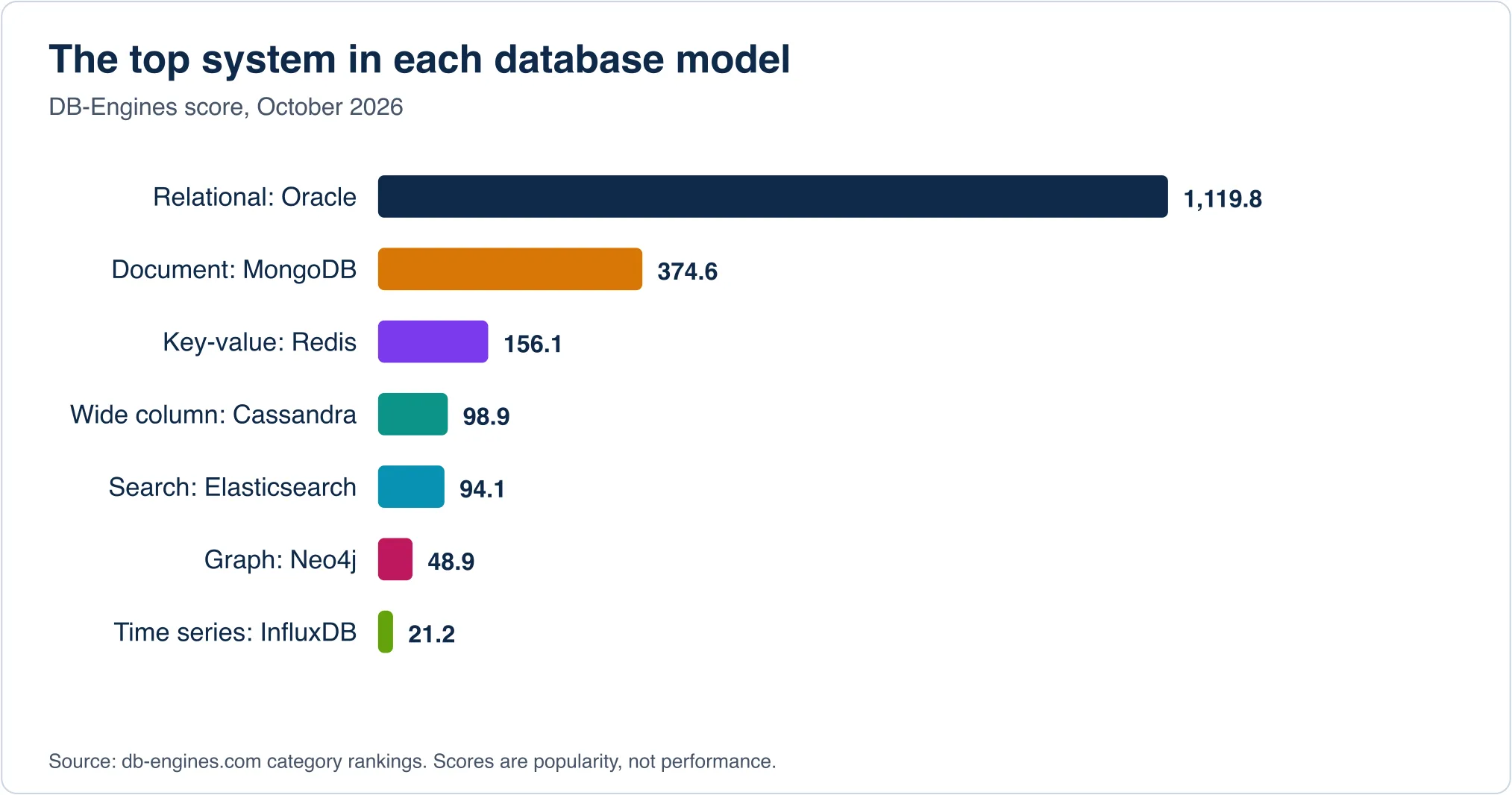
The gap is the first thing the chart tells you. The leading relational system scores three times the leading document store and more than eleven times the leading wide-column store. If you pick relational, you are choosing the type with the largest pool of tools, answers and people.
Relational databases
A relational database stores data in tables and links them with keys. Orders reference customers, invoices reference orders, and a query can join them. You write SQL, and the engine enforces types, uniqueness and foreign keys. Transactions make several changes succeed or fail together, which is why banks and shops build on them.
DB-Engines tracks 170 relational systems, more than any other type. The top four are Oracle, MySQL, SQL Server and PostgreSQL, and SQLite ranks eleventh at a score of 95.7, a widely used embedded database. Choose relational when your data has clear entities and you do not yet know every question you will ask. Our PostgreSQL vs MySQL benchmarks compare the two open-source leaders on real queries.
Watch out for: scaling writes across many servers is harder than in a distributed store, and rigid schemas need migrations. Neither is as bad as reputation suggests. Adding a column with a constant default to a 2-million-row PostgreSQL table took under half a second in my test.
Document databases
A document database stores each record as a self-contained JSON-like document. A product with 40 attributes lives in one document, and the next product can have different attributes. DB-Engines lists 58 document stores, led by MongoDB at 374.6.
Choose it when you read and write whole records by id, the shape varies, and you rarely join across records. Content management, catalogs and user profiles fit well. The trade-off is that relationships between documents are your code's problem. The detailed head-to-head is in PostgreSQL vs MongoDB, and the wider decision is in SQL vs NoSQL.
Advertisement
Key-value stores
The simplest model: give it a key, get a value. There are no tables and no query language beyond get, set and a few operations on the value. That simplicity makes it extremely fast. Redis leads at 156.1 and sits eighth overall in the ranking, with Amazon DynamoDB second in the category at 53.4. There are 72 systems listed.
Use it for caches, session storage, rate limiters, leaderboards and job queues. Treat it as a speed layer in front of a relational database, not as the source of truth, unless you have read how your chosen product persists data to disk.
Wide-column stores
A wide-column store, such as Apache Cassandra at 98.9, organises data into rows and column families spread across many machines. It is built for very high write volume and for queries you design in advance around a partition key. It is the smallest of the main types, with only 13 systems.
You choose it when one server cannot take your writes: messaging history, activity feeds, large event logs. You give up joins and ad hoc queries, so you plan the access patterns before you load a row.
Search engines
A search engine builds an inverted index, a map from each word to the documents that contain it. That makes full-text queries, typo tolerance, ranking and faceting fast. Elasticsearch scores 94.1 and Splunk follows at 69.3. Use one for site search, product search and log analysis.
Most search engines are a secondary copy of data kept somewhere else. If your search needs are modest, PostgreSQL's built-in full-text search is enough, and it avoids running a second system and keeping two copies in sync.
Graph databases
A graph database stores nodes and the relationships between them as first-class data. Questions like "who are the friends of friends of this user who bought the same product" are one short query in a graph database and a pile of self-joins in SQL. Neo4j leads at 48.9, and Azure Cosmos DB is second at 21.4. DB-Engines lists 44 graph systems.
Reach for it for recommendations, fraud rings, network topology and knowledge graphs. Skip it if your relationships are one or two joins deep, because a relational database handles that well.
Time-series databases
A time-series database is optimised for data keyed by time: server metrics, sensor readings, prices. It compresses runs of timestamped values, drops old data automatically and answers range queries quickly. InfluxDB leads at 21.2, followed by Prometheus at 9.7 and TimescaleDB at 6.3. The category has 46 systems.
The scores are small because the audience is narrow, not because the tools are weak. TimescaleDB is notable for being a PostgreSQL extension, so you keep SQL and gain time-series features inside the database you already run.
Vector databases
A vector database stores embeddings, lists of numbers that represent the meaning of text, images or audio, and finds the nearest ones. It powers semantic search and retrieval-augmented generation for AI apps. DB-Engines lists 27 vector systems, and it is the newest category. Elasticsearch leads at 94.1 and OpenSearch is second at 22.7.
Note how many general-purpose databases now claim a vector model. PostgreSQL, Oracle, MongoDB and Redis all list one. For a first AI feature with fewer than a few million vectors, a vector column in the database you already have is the lowest-effort route, and a dedicated vector store is a later optimisation.
How many systems exist per type
The count of systems shows where the market is crowded and where it is niche.
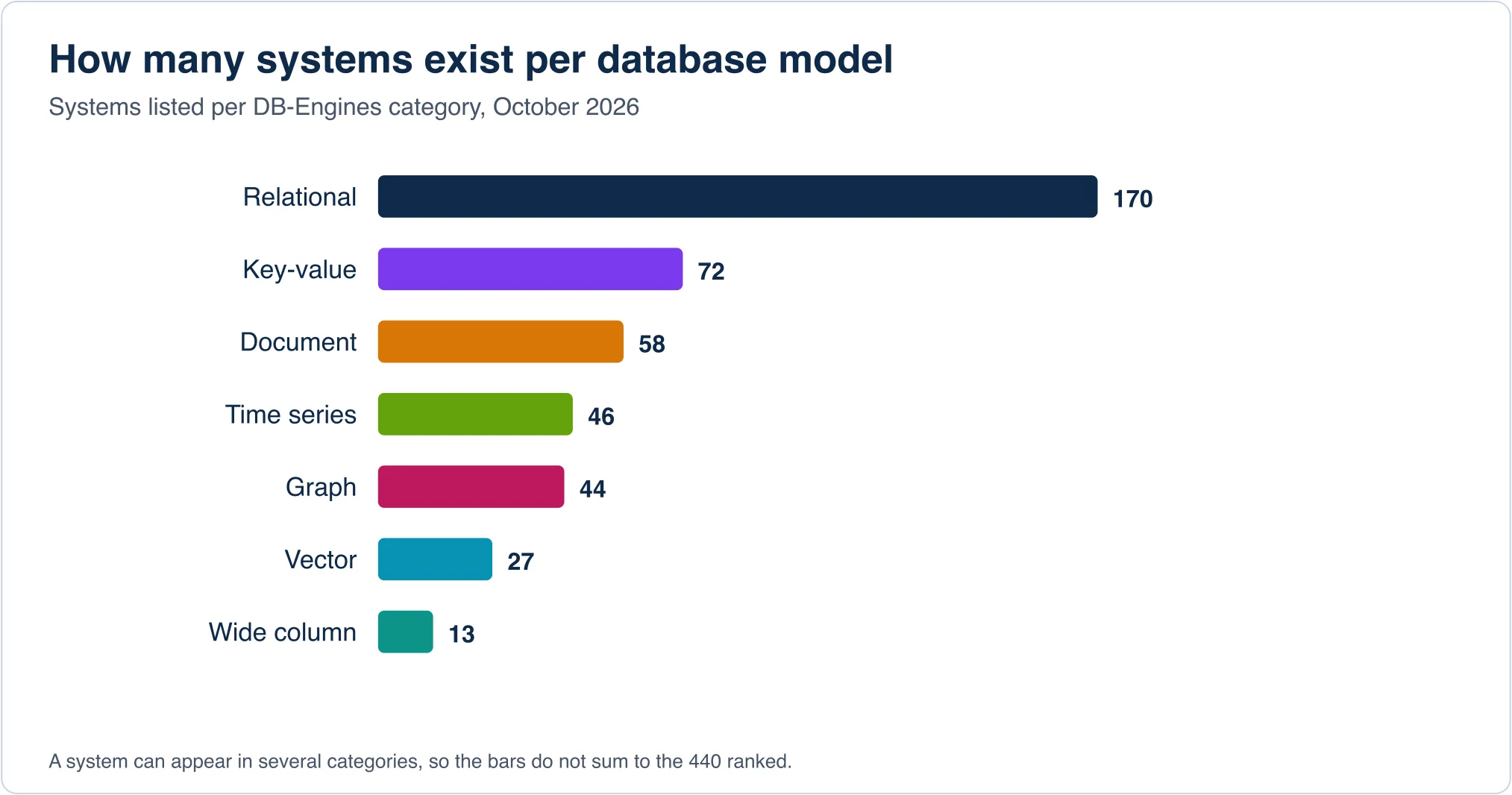
A system can sit in several categories, so the bars add up to more than the 440 systems ranked. The pattern holds regardless: relational is by far the largest, and the special-purpose types are small and quickly changing. More choice also means more churn. If you pick a young category, expect your product to be renamed, merged or deprecated within a few years, and keep your data in a format you can export.
One database, several types
The most useful finding in the ranking is that the types overlap. DB-Engines lists PostgreSQL as relational, document, graph, spatial and vector. MongoDB lists document, key-value, search, time series and vector. The labels describe features a product has, and plenty of products have more than one.
That changes the question from "which type?" to "what is my main job, and can one product do the side jobs well enough?" A single PostgreSQL server can hold your tables, your JSON documents, your search and your embeddings. It will not beat the specialist in each, but for a small team, running one system beats running five.
The picker
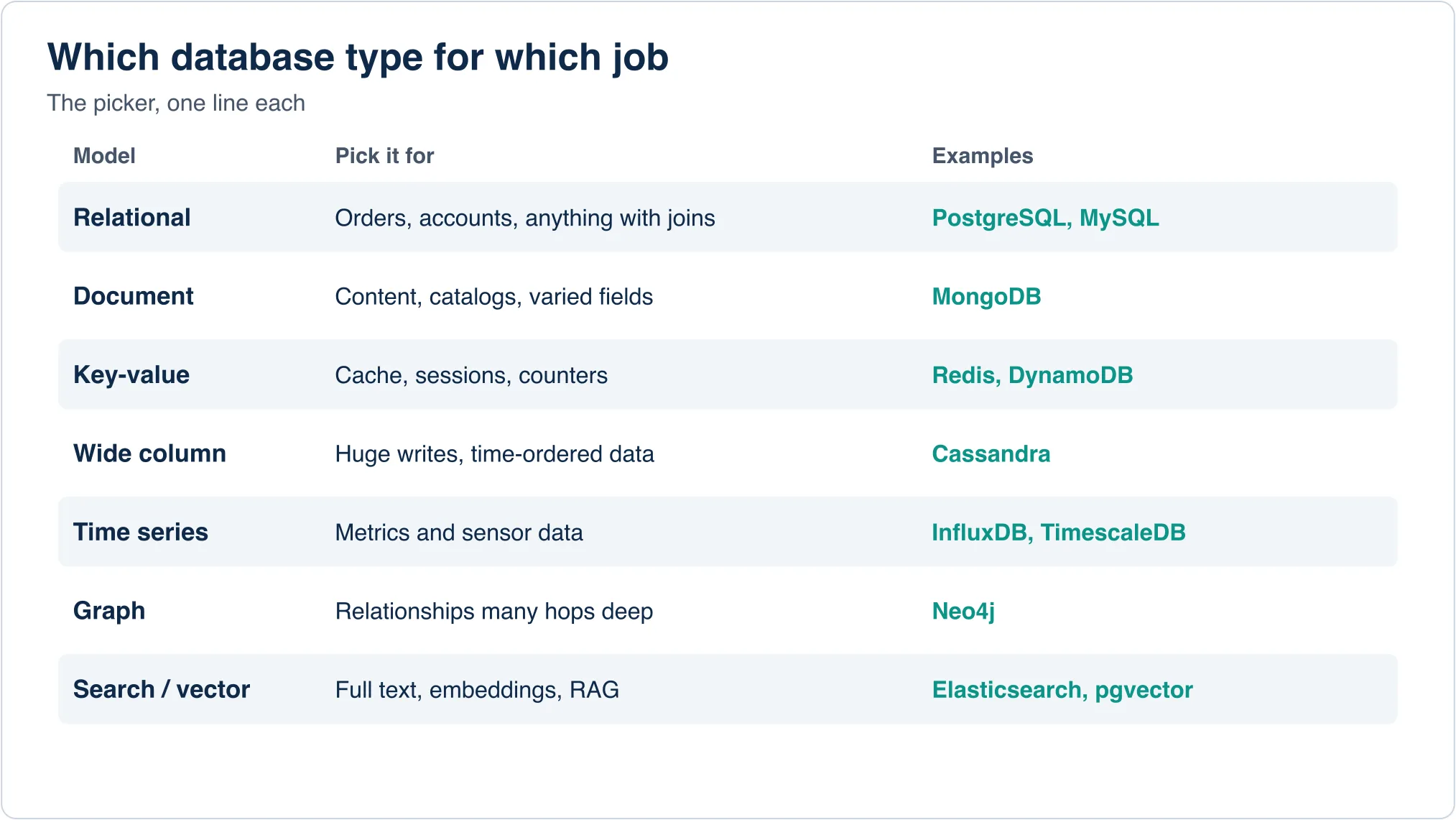
Use this order of questions:
- Do records reference each other and need to stay consistent? Relational.
- Are records self-contained and varied, read by id? Document.
- Is it a cache, session or counter? Key-value.
- Are you writing more than one server can absorb? Wide-column.
- Is it timestamped measurements? Time-series, or a PostgreSQL extension.
- Do you traverse many hops of relationships? Graph.
- Do users search text or meaning? Search or vector, starting with what you already run.
If two answers apply, take the one that matches your largest or most critical data, and let the other be a feature.
Common mistakes
- Choosing by hype. A graph database for three-table data adds a system and removes joins you already had.
- Treating the cache as the database. Key-value stores are fast because they hold less guarantee. Keep a durable copy.
- Starting distributed. Wide-column and sharded stores solve a problem most apps never reach. One managed relational server gets a long way, and the best cloud database comparison lists good managed options.
- Ignoring the exit. Whatever you pick, make sure you can export it. The database migration tools comparison shows what moving costs.
- Mixing up "database" and "server". A single server can hold many databases. Listing them in PostgreSQL takes one command.
For the embedded end of the scale, SQLite has its own habits, covered in the CREATE TABLE guide. Storing files in a database has its own trade-offs, tested in images in PostgreSQL. The data in this post comes from the DB-Engines ranking and its category pages; scores change monthly.
Advertisement
FAQ
What are the main types of databases?
Relational, document, key-value, wide-column, search, graph, time-series and vector databases. Each stores data in a different shape for a different job.
What is the most popular type of database?
Relational. DB-Engines lists 170 relational systems, and four of its top five databases in October 2026 are relational.
What type of database is PostgreSQL?
Relational first. DB-Engines also lists document, graph, spatial and vector models for it.
When should I use a graph database?
When your questions traverse many relationship hops, such as recommendations or fraud rings. For one or two joins, a relational database is enough.
Which database type is best for AI apps?
Vector databases store embeddings for semantic search. For a first feature, a vector column in a database you already run is often enough.
Comments
Loading…
Sign in to join the conversation.
Related posts
Relational Databases: Top 10 Ranked and How They Work
Oracle still leads the October 2026 DB-Engines list of relational databases, but PostgreSQL is the only top-four system that gained ground this year. PostgreSQL scored 688.75, up 45.56 points from
Fri Oct 09 2026 · 9 min read · 1 views
What Is PostgreSQL? A Plain-English Guide With Real Tests
PostgreSQL is a free, open-source relational database that stores data in tables and answers questions written in SQL. It began in 1986 as the POSTGRES project at the University of California,
Fri Oct 09 2026 · 8 min read · 0 views
Serverless Databases Compared: What They Cost in 2026
A serverless database costs the least when your app sits idle, and the most when it runs all day. That single fact decides most purchases. A hobby app can run free on Neon, Turso or Cloudflare D1. An
Fri Oct 09 2026 · 9 min read · 0 views